
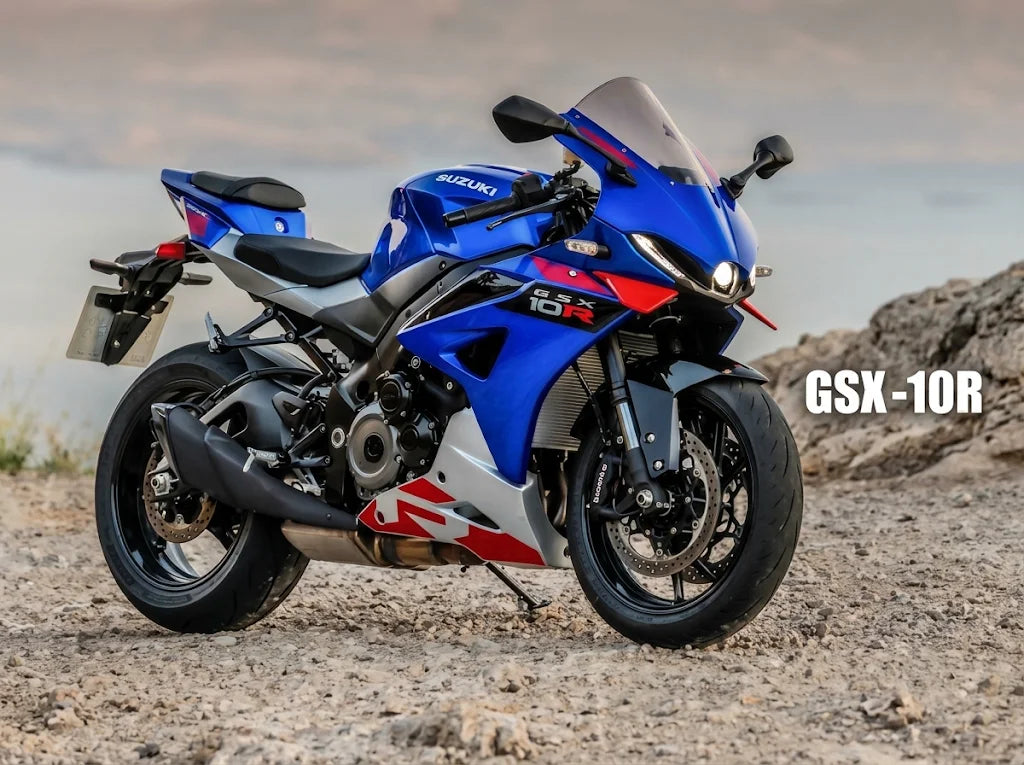
Suzuki’s new GSX-10R is a road-focused, fully faired sportbike built around a reworked K5 999 cc four-cylinder (152 PS, 106 Nm). It adds sharper geometry, 53° of lean angle, an aluminium frame, KYB suspension, Brembo brakes and 15 rider aids, including Suzuki’s first Slide Control and a Brake Hold that works on flat ground and downhill. It weighs 214 kg with an 810 mm seat. Price and exact dates are unannounced, with sales planned from summer 2027. Our guide covers the specs, who it suits, how it compares with the GSX-R1000R, and the best ways to carry gear on it.
Table of contents
Suzuki kept the details of this one quiet. At EICMA 2026 in Milan, it pulled the covers off the GSX-10R, a fully faired, liter-class sportbike. It uses the famous K5 engine, but it isn’t trying to be a track weapon. The idea is a sportbike you can use every day and still enjoy at a track day.
Here’s what it is, what we know so far, and what’s still unconfirmed.
Quick answer: The 2027 Suzuki GSX-10R has a reworked 999 cc inline-four making 152 PS (about 150 hp) and 106 Nm (78 lb-ft). It weighs 214 kg (472 lb), has an 810 mm (31.9 in) seat and 15 rider aids. It sits between the GSX-S1000 range and the GSX-R1000R. Price is unannounced, and sales are planned from summer 2027 in selected markets.
1. What is the Suzuki GSX-10R?
Think of it as the missing middle of Suzuki’s liter-bike range. The GSX-S1000 naked and the GSX-S1000GT sports-tourer sit on one side. The uncompromising GSX-R1000R sits on the other. The GSX-10R fills the gap, with the GSX-R-style riding position and a friendlier engine and chassis.
It doesn’t replace the GSX-R1000R. That bike stays in the lineup, and Suzuki deliberately left the new bike short of its peak performance. The “10R” name follows the same naming style Suzuki used on the GSX-8S and GSX-8R.

2. Suzuki GSX-10R specs at a glance
| Spec | Detail |
|---|---|
| Engine | 999 cc liquid-cooled inline-four (K5-based, reworked) |
| Power | 152 PS (112 kW, about 150 hp) at 11,000 rpm |
| Torque | 106 Nm (78 lb-ft) at 9,250 rpm |
| Weight | 214 kg / 472 lb (curb, claimed) |
| Seat height | 810 mm / 31.9 in |
| Wheelbase | 1,455 mm / 57.3 in |
| Fuel tank | 18 liters / 4.7 US gal |
| Max lean angle | 53° |
| Front / rear tire | 120/70 ZR17 / 190/55 ZR17 |
| Suspension | Fully adjustable KYB 43 mm USD fork; fully adjustable linkage shock |
| Front brakes | Dual discs, radial Brembo four-piston calipers, radial master cylinder |
| Display | 4.2-inch color TFT |
| Rider aids | 15 (IMU-based) |
| Emissions | Euro 5+ |
Suzuki also quotes a WMTC fuel figure of 6.3 L/100 km. On paper that stretches an 18-liter tank to roughly 285 km (about 177 miles), though real riding will vary.
2.1 The engine: a reworked K5
The heart of the bike is Suzuki’s 999 cc K5-derived inline-four, first seen in the 2005 GSX-R1000. It has a long stroke, which gives strong midrange pull. Suzuki later moved the GSX-R1000 to a short-stroke engine making over 200 PS. The K5 lived on in the GSX-S1000 family, where rideability matters more than a headline number.
For the GSX-10R, Suzuki revised the exhaust valves, cam chain and oil passages for durability and lower mechanical noise. It also uses Suzuki Exhaust Tuning, which adjusts exhaust back pressure with engine speed. The throttle is ride-by-wire with three modes (A, B and C). The full 152 PS is available in every mode, and the modes change how sharply it arrives. A bi-directional quickshifter and the SCAS slipper-assist clutch are standard. The clutch also has a lighter lever pull, which helps in traffic.
At 152 PS it falls well short of a GSX-R1000R. For most road riders that’s the point. Few public roads let you use 200 PS, and a strong midrange is what you use every day.


2.2 Chassis, ergonomics and brakes
Suzuki started from the GSX-S1000 platform and sharpened it:
- Steering geometry: Fork offset drops from 35 mm to 30 mm for easier turn-in, and the wheelbase is 5 mm shorter than the GSX-S1000’s.
- Rear tire: A 190/55 replaces the 190/50, for stability and traction out of tight corners. Factory tires are Bridgestone Battlax Hypersport S23.
- Lean angle: 53°, up from 48° on the GSX-S1000, because the pegs sit higher and further back.
- Frame: A twin-spar aluminum frame with a new swingarm and subframe, reinforced in places for track use.
- Steering damper: Electronic, so it firms up with speed and frees the steering at low speed.
The riding position follows the GSX-R1000R, with a forward lean and clip-ons. Suzuki says the seat is more softly padded, and the tank shape gives a good knee grip. There’s also a storage compartment under the pillion seat, big enough for a rain suit.

2.3 Electronics: 15 rider aids
Suzuki calls its package S.I.R.S. (Suzuki Intelligent Ride System), run by a six-axis IMU. It’s Suzuki’s biggest electronics suite yet:
- Slide Control: A Suzuki first. It senses the rear stepping out mid-corner and steps in gently, and it can allow a controlled slide rather than killing it instantly.
- Cornering ABS, traction control, wheelie control, engine brake control and launch control.
- Brake Hold: Holds the rear brake for about 30 seconds after you stop. Most systems only work uphill. This one works on flat ground and downhill too.
- Cruise control with Curve Speed Control, which slows the bike automatically before corners.
- Low RPM Assist and Easy Start, to stop stalls and start the engine with one press.
- Suzuki Ground Beacon indicators, which project a light beam onto the road to show other road users which way you’re turning.
Connectivity runs through the Suzuki Ride Connect+ app (navigation, messages, weather) on iOS and Android, with a USB-C socket for charging.
2.4 Design and colors
The look takes cues from the GSX-R family, with a pointed nose, a compact LED headlight, side-mounted position lights, and small winglets either side of the front fairing. The slim tail rises steeply. It’s a busy design in the details, with plenty of lines and graphics.
There are three color schemes:
- Pearl Vigor Blue / Metallic Mystic Silver
- Pearl Pulse Red / Solid Iron Gray
- Metallic Galaxy Gray / Glass Sparkle Black
A pillion seat cover with its own winglets is the headline accessory.
3. Suzuki GSX-10R price and release date
Suzuki hasn’t announced pricing or an exact release date.
- Timing: Sales are planned from summer 2027 in selected markets, with Europe among the first.
- Price: Early guesses vary. Italian press talks about a price under €15,000, and one outlet expects around £11,999, in line with the GSX-S1000GT. Journalists were reportedly told it would land between the GSX-S1000GT and GSX-S1000GX. Treat all of this as speculation.
- US availability: Not confirmed.
We’ll update this section as soon as official numbers appear.
4. GSX-10R vs GSX-R1000R vs GSX-S1000 family
| GSX-10R | GSX-R1000R | GSX-S1000 family | |
|---|---|---|---|
| Style | Faired road sportbike | Track-focused superbike | Naked / sports-tourer |
| Engine | K5-based, 152 PS | Short-stroke, 200+ PS | K5-based |
| Focus | Road usability + track days | Maximum performance | Road comfort and versatility |
| Rider aids | 15, with Slide Control | Fewer than the GSX-10R, per press reports | Not compared here |
| Riding position | GSX-R-style forward lean | Aggressive | More upright |
If you want the opposite philosophy, an extreme V4 with over 210 hp, read our guide to the CFMOTO V4 SR-RR.

5. Who is the GSX-10R for?
It suits a rider who wants a fully faired liter sportbike for real roads. That means someone who also wants cruise control, a usable seat, sensible power and a few track days a year. It’s likely to appeal to people moving up from a middleweight sportbike, and to riders who find a GSX-R1000R too intense for the street.
It isn’t A2-compatible, and 152 PS is a lot for a first bike. The electronics help, but most new riders are better served by something smaller.
We haven’t ridden it, so we can’t say how it feels. Judge the handling and comfort claims against independent first-ride tests once they appear.
6. How to carry luggage on a Suzuki GSX-10R
This is where a sportbike like this gets tricky. It has no rack, a steeply rising tail, a pillion seat that may carry a cover, and a forward-leaning position that makes a heavy backpack tiring. Here’s what tends to work.
Tail bag. For most riders this is the best fit. A compact bag straps onto the pillion seat and keeps the bike’s lines intact. Viking’s street/sportbike tail bags come in a small 15 L size and an extra-large 41 L size. The small bag has MOLLE attachments and reflective details, and a buyer on the product page says it makes a day ride more comfortable. For sizing and mounting basics, see our tail bag size and fit guide.
Tank bag. Great for a phone, wallet and snacks you want within reach. A magnetic bag needs a steel tank, and Suzuki hasn’t said what the GSX-10R tank is made of. Check this first, and if it isn’t steel, use a strap-mounted bag. Browse motorcycle tank bags or read our guide to the best tank bags.
Backpack. Fine for commutes and short rides. On a forward-leaning bike the weight lands on your wrists and shoulders, so keep it light. Our motorcycle backpack guide and backpack vs tail bag comparison cover the trade-offs. You can also see motorcycle backpacks.
Saddlebags. Rare on sportbikes, and many riders find they spoil the look and handling. Our post on whether saddlebags suit a sports bike covers when they make sense.
7. Packing tips for a sportbike:
- Keep heavy items low and forward, in the tank bag or under-seat storage, and light items in the tail bag.
- Don’t overload the rear. Extra weight over the back wheel changes handling at speed.
- Keep straps clear of the tire, chain and exhaust. Reports describe the silencer as low-slung, which should help with heat, but check on your own bike.
- Use the under-seat compartment for a rain suit and tools.
- Follow your owner’s manual for weight limits.
A fitment note. Viking doesn’t list GSX-10R-specific bags yet, since the bike isn’t on sale. Universal sportbike tail bags and tank bags are designed to fit a range of bikes. For anything Suzuki-specific, see our Suzuki saddlebags page and the full street/sportbike luggage range, or call 1-888-208-1949 to check fitment.
8. Frequently asked questions
How much horsepower does the Suzuki GSX-10R have?
152 PS (112 kW, about 150 hp) at 11,000 rpm, with 106 Nm (78 lb-ft) of torque at 9,250 rpm.
How much does the Suzuki GSX-10R cost?
Suzuki hasn’t announced a price. Early estimates put it around the GSX-S1000GT to GX range.
When does the GSX-10R come out?
Sales are planned from summer 2027 in selected markets. Exact dates haven’t been confirmed.
Is the GSX-10R replacing the GSX-R1000R?
No. Both stay in the range. The GSX-10R sits between the GSX-S1000 family and the GSX-R1000R.
How heavy is the GSX-10R, and what’s the seat height?
214 kg (472 lb) claimed curb weight, with an 810 mm (31.9 in) seat.
Does the GSX-10R have cruise control and a quickshifter?
Yes to both. It has cruise control with Curve Speed Control and a bi-directional quickshifter.
How big is the fuel tank?
18 liters (4.7 US gallons).
Is the GSX-10R a good first bike?
Not for most new riders. It isn’t A2-compatible, and a smaller bike is usually easier to learn on.
Can you fit a tail bag on a GSX-10R?
Yes, in the same way as on other sportbikes, with a strap-on tail bag over the pillion seat. Check your own bike’s strap points and keep the load light.
9. The bottom line
The GSX-10R is a smart idea: a proper liter sportbike with the K5’s midrange, a long list of electronics and a more livable riding position. The open questions are price, release date and how it rides, and we’ll update this guide as those become clear. Browse our street/sportbike luggage range when you’re ready to plan how to carry your gear. You can also follow more of our EICMA 2026 coverage.
Last updated: November 10, 2026. We’ll revise this page when Suzuki confirms pricing and availability.



Leave a comment
All comments are moderated before being published.
This site is protected by hCaptcha and the hCaptcha Privacy Policy and Terms of Service apply.