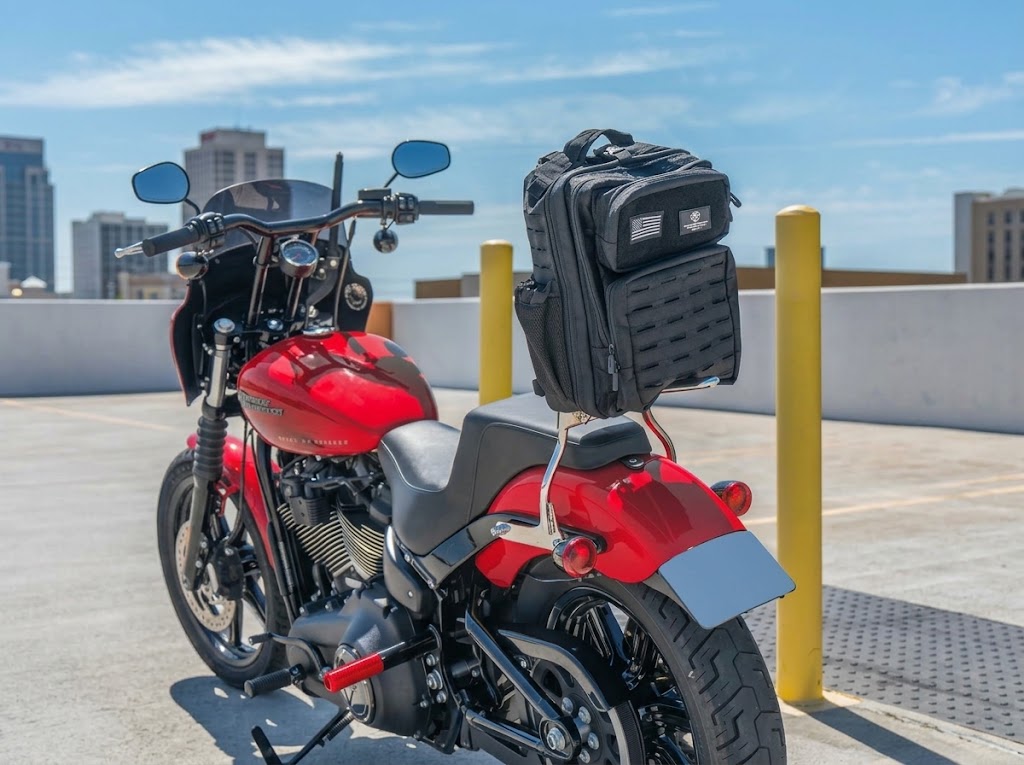
Choosing a motorcycle backpack starts with the type of riding you do and what you need to carry. The right backpack should provide enough capacity for your gear without becoming unnecessarily bulky, while keeping the load stable and comfortable in your riding position. Key factors include capacity, harness and strap design, weight distribution, back-panel comfort, ventilation, weather protection, materials, closures, laptop or tablet protection, helmet storage, hydration, and visibility features. This guide explains how to choose motorcycle backpacks for commuting, city riding, weekend trips, touring, sportbike riding, cruiser riding, and ADV use, while also comparing backpacks with saddlebags, tail bags, tank bags, and other motorcycle luggage.
A motorcycle backpack has one advantage that motorcycle-mounted luggage cannot match: you can take it with you when you leave the bike.
That matters if you ride to work, carry a laptop, stop at several places during a trip, or simply want your belongings in one bag rather than divided between the motorcycle and your pockets. It also creates a question that is easy to overlook when shopping:
Table of contents
1. Should this load be on your back at all?
A small backpack with a phone, water bottle, wallet, light layer, and a few essentials is a very different proposition from a large pack loaded with tools, clothing, electronics, and camping equipment. As the load gets heavier, carrying it on your body can become less comfortable, while saddlebags, a tail bag, or other motorcycle luggage can carry the bulk without adding that weight to your shoulders.
Once you've decided a backpack suits the job, the selection process becomes much simpler. Start with the load, then capacity, riding position, harness and fit, weather protection, construction, and the features you will actually use.
2. What Makes a Motorcycle Backpack Different?
A motorcycle backpack is designed around the conditions created by riding rather than simply being a conventional backpack worn on a motorcycle.
The differences can show up in the harness, how closely the pack sits against your back, strap adjustment, materials, weather protection, and organization. Some models also add features aimed specifically at riders, such as helmet carriers, hydration compatibility, reflective details, or compartments designed for electronics.
That does not mean every one of those features is necessary.
A rider making a short city trip with a light load may have little need for an elaborate harness or large weatherproof compartment. Someone spending several hours on the highway with a loaded backpack has different requirements.
The useful question is therefore not whether a backpack has the longest feature list. It is whether its design solves the problems you actually encounter while riding.

3. Should You Wear a Backpack or Put the Load on the Motorcycle?
This is the first decision to make.
A backpack makes sense when portability after parking is important and the load is reasonably comfortable to carry. If you take a laptop into the office, carry personal items between stops, or need the same bag on and off the motorcycle, keeping those belongings on your back can be convenient.
Motorcycle-mounted luggage starts to make more sense as the load becomes heavier or bulkier. Clothing, tools, spare equipment, camping gear, and other dense items can add up quickly.
A simple test is useful before buying anything:
Put everything you normally expect to carry into a box or bag and weigh it.
Then ask yourself how you would feel carrying that weight against your back for the longest ride you regularly make. A load that seems insignificant for a 20-minute commute may feel very different after several hours.
There is no universal weight limit that makes a backpack appropriate or inappropriate. Your riding position, fitness, gear, pack design, and the distribution of the load all matter. The important point is to decide deliberately where the weight belongs rather than choosing a backpack simply because it has enough room.

4. Motorcycle Backpack vs. Regular Backpack
Many riders use ordinary backpacks successfully. If your current backpack stays secure, carries what you need, works with your riding gear, and remains comfortable throughout your normal ride, there is no requirement to replace it simply because you ride a motorcycle.
A motorcycle-specific backpack becomes more useful when your existing bag struggles with conditions such as highway speeds, weather, heavier loads, or a more demanding riding position
Feature |
Regular backpack |
Motorcycle-specific backpack |
Everyday organization |
Usually strong |
Often designed around riding and everyday use |
Chest/sternum strap |
Varies |
Common on riding-oriented designs |
Waist/load strap |
Less common on smaller bags |
More common on larger riding packs |
Strap management |
Basic on many models |
Often includes ways to secure loose webbing |
Weather protection |
Varies widely |
More likely to emphasize rain resistance or waterproof construction |
Abrasion resistance |
Depends on the bag |
Often a more deliberate consideration |
Riding fit |
General-purpose |
Designed with riding posture in mind on some models |
Helmet storage |
Uncommon |
Available on some larger models |
Hydration |
Depends on model |
Common on some touring/ADV-oriented designs |
Off-bike use |
Usually strong |
Varies by design |
If you already own a good outdoor, commuter, or work backpack, compare it against the conditions you actually ride in before spending money on another one.

5. Who Is a Motorcycle Backpack For?
The best choice changes with what happens before and after the ride.
5.1. Daily commuting
A commuter usually needs a bag that can transition easily from motorcycle to workplace, school, or another destination.
Laptop protection, organization, weather resistance, and comfortable carrying matter more here than specialized adventure features. Think about your complete daily load rather than the laptop alone: charger, lunch, water, shoes, clothing, documents, and other personal items can quickly take up more space than expected.
For motorcycle backpacks for men or anyone looking for an everyday riding pack, the same practical considerations apply: measure the actual load and choose based on the way the bag will be used rather than relying on gendered sizing labels.
5.2. Short city rides
City riding often favors a smaller, simpler pack.
If you normally carry only a phone, wallet, water, sunglasses, a light layer, and perhaps a small tool or tire-repair kit, a large backpack can be unnecessary bulk. A compact bag that stays close to your body may be easier to live with.
5.3. Weekend rides
Weekend trips can justify more capacity without necessarily requiring a large touring pack.
Start by listing what you actually take: personal items, water, spare clothing, snacks, electronics, and any emergency or motorcycle-related equipment. If the list fits comfortably into a smaller pack, there is little benefit in carrying an oversized bag.
5.4. Long-distance and touring
Touring changes the calculation because the amount of equipment tends to grow.
The backpack can carry personal items that you want with you when you stop, while motorcycle luggage carries heavier or bulkier equipment. Keeping the backpack manageable becomes particularly important when you are riding for hours at a time.
5.5. Sportbike riding
A sportbike's forward-leaning position changes how a backpack feels.
A large, deep pack can interfere with your upper-body movement or become awkward when you lean forward. A lower-profile design with a secure harness is generally easier to manage in this position.
Try it while wearing the riding gear you actually use. A backpack that feels fine while standing upright can sit differently once you are bent forward over the tank.
5.6. Cruiser riding
An upright riding position gives you more freedom in backpack shape, but comfort still depends on how the pack sits against your back and seat area.
Pay attention to the lower portion of the bag. A heavily loaded pack can press against your lower back or the seat, and a long bag may behave differently than it does when you are walking.
5.7. ADV riding
Adventure riding adds movement that ordinary road riding does not.
If you regularly stand on the footpegs, move around the motorcycle, or ride rough surfaces, the harness needs to keep the backpack stable without restricting normal movement. Hydration compatibility can also be useful on longer ADV rides, particularly when stopping frequently to access a bottle would be inconvenient.
6. Which Backpack Features Actually Matter?
Once you've established that a backpack belongs in your luggage setup, concentrate on features that solve a real problem.
6.1. Harness and fit
Start with how the backpack sits on your body.
The shoulder straps should hold the pack securely without creating excessive pressure around your neck or armpits. The pack should remain reasonably close to your body rather than moving around every time you accelerate, brake, or change position.
Adjust the backpack while wearing your actual riding jacket. Thick protective gear can change the fit considerably.
6.2. Chest or sternum strap
A chest strap can make a noticeable difference when a loaded backpack shifts from side to side.
It brings the shoulder straps together and helps stabilize the upper part of the pack. That becomes more useful with larger loads, longer rides, and riding positions where the upper body leans forward.
On a small, lightly loaded backpack, you may barely notice whether one is present.
6.3. Waist and load straps
Larger backpacks benefit more from additional load control because there is more weight and volume to stabilize.
A waist strap can help keep the lower portion of a larger pack from moving around. On a small commuter backpack, however, a bulky waist system may add more hardware than you need.
6.4. Strap management
Excess webbing can flap around in the wind and become irritating very quickly.
Look for strap keepers, adjustment points, or other ways of securing loose ends. This is a small feature, but it becomes much more noticeable when you spend hours riding.
6.5. Back panel, padding, and ventilation
The back of the backpack has two jobs that can conflict with each other: supporting the load and allowing some airflow.
More padding can make a loaded pack more comfortable, but additional material can also reduce ventilation. On hot rides, the difference becomes obvious when the backpack keeps your jacket pressed against your back through slow traffic.
Shape matters too. A pack that stays close to your body can feel more controlled than one that sits far away from your back.
6.6. Weather protection
Consider what happens if the weather changes halfway through your ride.
Water-resistant fabric can be useful for light exposure, but riders carrying electronics, documents, or spare clothing should pay close attention to the entire construction: fabric, seams, closures, zippers, and the way the main compartment closes.
A rain cover can add another layer of protection, while roll-top or sealed constructions can provide a different approach to keeping water out.
For electronics, check the actual protection offered by the compartment rather than assuming the entire backpack provides the same level of protection.
6.7. Materials and abrasion resistance
Material names alone do not tell the whole story.
Motorcycle backpacks may use various forms of nylon, polyester, Cordura-type fabrics, TPU-coated materials, or other technical textiles. Construction also depends on reinforcement, stitching, panel placement, and closures.
If abrasion resistance matters to you, look beyond the fabric name and examine how the complete bag is constructed.
6.8. Zippers and closures
A complicated opening system is not automatically better.
Think about what you access most often. A commuter may want quick access to a phone, charger, or wallet. A touring rider may care more about keeping the main compartment secure and protected from rain.
The best closure arrangement is the one that suits the way you actually use the bag.
6.9. Laptop and tablet protection
If your backpack carries a laptop, measure the device before shopping.
Record its length, width, and thickness, then compare those measurements with the manufacturer's stated sleeve or compartment dimensions. Do not rely only on a description such as “fits a 15-inch laptop,” because screen-size labels do not describe the complete physical dimensions of every device.
Also consider padding and whether the device can move around inside the compartment.
6.10. Helmet storage
Some larger backpacks include a helmet carrier or dedicated helmet compartment.
That can be useful when the helmet needs to come with you after parking. It also consumes space and can make the backpack considerably larger when the carrier is in use, so treat it as a feature tied to a specific need rather than an automatic advantage.
6.11. Hydration
Hydration storage is particularly useful for long-distance and ADV riding.
A dedicated reservoir compartment can make drinking easier without stopping, but it also takes up space and adds another component to maintain. For a short commute, a normal bottle may be all you need.
6.12. Reflective elements
Reflective panels or details can improve visibility when illuminated by headlights in low-light conditions.
They are an additional visibility feature, not a substitute for the motorcycle's lights, reflective riding gear, or appropriate road positioning.
6.13. Hard-shell vs. soft motorcycle backpacks
for the contents. It may also be heavier and bulkier than a soft pack.
Soft backpacks generally conform more easily to their contents and can be easier to compress when partially loaded.
Choose based on what you are protecting and how the bag fits while riding.
A hard shell can protect the contents, but don't rely on a hard shell for crash protection, it isn't rated for that.
7. How Much Backpack Capacity Do You Really Need?
Capacity should come from your normal load rather than the other way around.
Before comparing backpacks, lay out everything you expect to carry on a normal ride. Include the awkward items, not just the obvious ones. A laptop, charger, water bottle, lunch, spare layer, shoes, tools, and personal items occupy considerably more space together than they do on a product page.
These aren't fixed categories; they're practical starting points for matching capacity to a typical load.
Approx. capacity |
Typical use |
8–15L |
Essentials, short city rides, light personal loads |
16–25L |
Commuting, laptop, daily clothing and personal items |
26–35L |
Larger commutes, weekend trips, more substantial personal loads |
36L+ |
Large loads, extended touring, or riders with significant equipment |
A backpack's shape matters almost as much as its stated capacity. Two bags with the same number of liters can feel completely different because one is tall and narrow, another is deep, and another divides its volume among several compartments.
Avoid buying substantially more capacity than you need simply because the larger bag appears more versatile. Empty space still has to be carried, and a larger pack can become bulkier than necessary.

8. Motorcycle Backpack vs. Saddlebags, Tail Bags, Tank Bags, and Other Luggage
Where the weight sits becomes increasingly important as the load gets larger.
Luggage type |
Main advantage |
When it makes sense |
Backpack |
Comes with you after parking |
Personal items and manageable loads |
Tail bag |
Keeps weight on the motorcycle |
Commuting, weekend trips, larger loads |
Saddlebags |
Carries substantial gear without using your back |
Touring, commuting, longer trips |
Tank bag |
Easy access while riding |
Small essentials and frequently used items |
Sissy bar bag |
Adds rear storage, especially useful on many cruisers |
Clothing, personal gear, longer rides |
Top case |
Secure, convenient motorcycle-mounted storage |
Commuting and larger everyday loads |
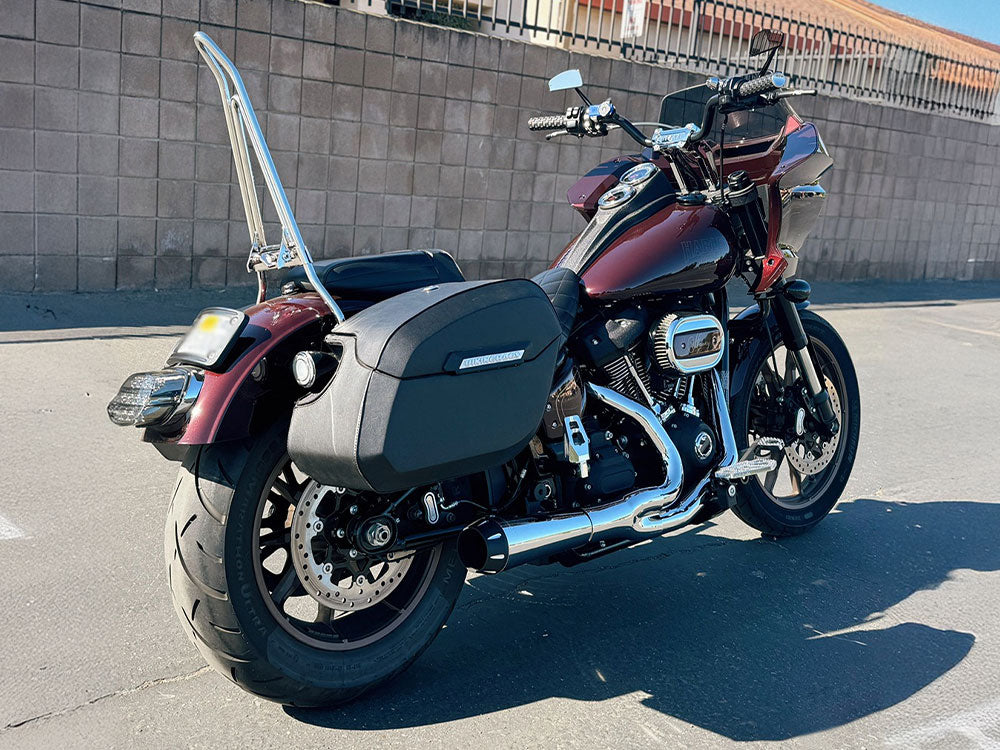
For many riders, the practical answer is a combination. A small backpack can hold the items that need to come off the bike while motorcycle luggage carries heavier equipment.
This also changes how you think about capacity. You do not necessarily need one enormous backpack if your motorcycle already carries most of your gear.
A rider carrying a laptop and lunch for a 30-minute commute has a very different storage problem from someone carrying camping equipment across several days of touring. The same backpack does not have to solve both.

9. Pros and Cons of Motorcycle Backpacks
9.1. Advantages
Easy to take with you after parking
Useful for commuting and everyday travel
Keeps personal items together in one portable bag
Can accommodate laptops, tablets, clothing, hydration, and other gear
Does not require motorcycle-specific mounting hardware
Can supplement saddlebags or other motorcycle luggage
9.2. Drawbacks
You carry the load on your body
Large or heavy packs can become uncomfortable
Backpacks can add heat against your riding jacket
Poorly secured straps can move around in the wind
Very large packs can interfere with some riding positions
Capacity is limited compared with dedicated motorcycle luggage
10. When Does a Backpack Make the Most Sense?
A backpack is a strong fit when:
You need your belongings with you after parking.
Your normal load is reasonably light and compact.
You carry a laptop or other personal electronics.
You regularly move between the motorcycle and an office, school, shop, or other destination.
You want one bag that works on and off the motorcycle.
Your motorcycle has limited luggage capacity.
A motorcycle-mounted solution deserves more consideration when:
The load is heavy enough to become uncomfortable.
You regularly carry bulky clothing or equipment.
You are touring for several days.
You carry camping or technical gear.
You want to keep weight off your shoulders and back.
The backpack becomes so large that it interferes with your riding position.
11. A Practical Motorcycle Backpack Buying Checklist
Before buying, answer these questions:
1. What do I actually carry?
List everything, including the items you only carry occasionally.
2. How much does it weigh?
Put the normal load together and weigh it.
3. Do I need the contents with me after parking? If not, motorcycle-mounted luggage may be more convenient.
4. What capacity does that load require? Compare your packed load with the usable capacity and compartment layout.
5. What is my normal riding position? Check the fit while sitting on the motorcycle rather than standing upright.
6. What weather will the bag face? Light rain, regular wet-weather riding, and prolonged exposure require different levels of protection.
7. Am I carrying electronics? Measure your laptop or tablet and compare its physical dimensions with the actual compartment dimensions.
8. Which features solve a real problem? Chest straps, waist straps, hydration, helmet storage, reflective details, and specialized closures are useful when they match your riding habits.
9. Could motorcycle luggage carry the heavier part of the load? If the answer is yes, consider using the backpack for personal items and moving the bulk to the motorcycle.
Those questions usually narrow the choices much faster than starting with a long list of features.
12. Frequently Asked Questions
Are motorcycle backpacks worth it?
For riders whose normal bags shift around, become uncomfortable, or provide inadequate weather protection, a motorcycle-specific design can solve real problems. Riders with a comfortable everyday backpack and light loads may not gain enough from changing.
Can I use a normal backpack on a motorcycle?
Many riders do. The important checks are whether it stays secure, works with your riding gear, handles the weather you encounter, and remains comfortable for the length of your ride.
What size motorcycle backpack should I get?
Measure your normal load first. A compact pack can be enough for daily essentials, while commuting with a laptop and clothing may require more room. Longer trips can justify additional capacity, but a bigger backpack is not automatically better.
Are motorcycle backpacks waterproof?
Some are designed to provide substantial water protection, while others rely on water-resistant materials or a separate rain cover. Check the manufacturer's construction and protection claims rather than treating all motorcycle backpacks as waterproof.
Is a hard-shell motorcycle backpack safer?
A hard shell can help protect the contents from impacts and maintain the shape of the bag. It should not be treated as certified protective equipment for the rider.
Is a backpack better than a tail bag?
The two solve different problems. A backpack is particularly useful when you need to carry the contents away from the motorcycle. A tail bag keeps the load on the motorcycle and can make more sense when the load is heavier or bulkier.
Do I need a chest strap?
For a small, lightly loaded backpack, you may not. As the pack gets larger or the ride gets longer, a chest strap can help stabilize the shoulder straps and reduce movement.
What should I look for in a motorcycle backpack for a laptop?
Start with the laptop's actual length, width, and thickness. Then compare those measurements with the manufacturer's compartment dimensions and look at padding, retention, and weather protection. A laptop compartment that technically fits the device may still be poorly suited to the way you ride.
13. Motorcycle Backpacks from Viking Bags
Viking Bags offers motorcycle backpacks alongside other motorcycle luggage options, giving riders different ways to carry personal and riding gear.
The useful place to start is with the way you ride and what you normally carry. If you need portable storage that comes off the motorcycle with you, a backpack can fill that role. If the load becomes heavier or bulkier, motorcycle-mounted luggage may be the better place for it.
The goal is to choose the storage arrangement that keeps the motorcycle practical without putting unnecessary weight on your body.
14. Conclusion
Before you shop, figure out what you carry, how much it weighs, and whether you actually want that weight on your back.
From there, capacity becomes easier to judge. Your riding position tells you what kind of harness and fit you need. Your weather conditions determine how much protection matters. Your laptop, helmet, hydration, and other gear determine which specialized features are worth paying attention to.
A good motorcycle backpack is ultimately one that fits the job without creating another problem during the ride.



Leave a comment
All comments are moderated before being published.
This site is protected by hCaptcha and the hCaptcha Privacy Policy and Terms of Service apply.