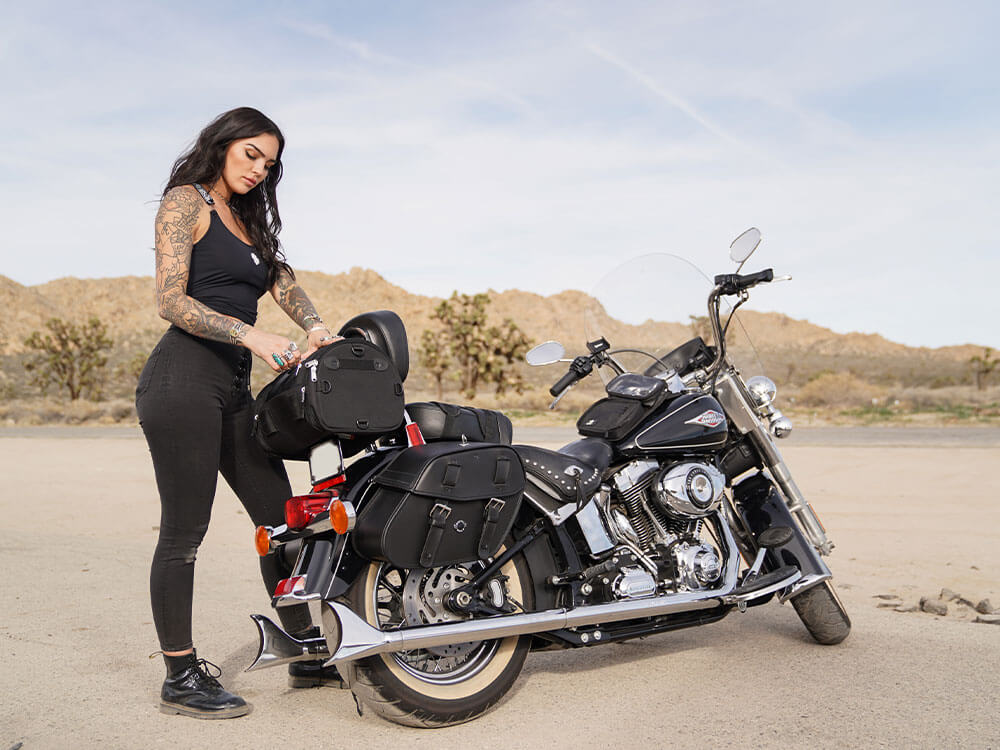
Not sure which motorcycle tail bag fits? This guide compares 11 bags by size, shape and mounting, and explains expandable designs, strap options, sissy bar needs and rain protection.
Need room for your daily essentials, a change of clothes, or the gear you want to bring on a weekend ride? A motorcycle tail bag adds storage behind you, so you do not have to carry everything on your shoulders. The right one depends on more than how many liters it holds. Its shape, opening, mounting system and weather protection all affect how well it works on your motorcycle.
A compact bag may be enough for tools, gloves and a rain layer. A larger bag can make sense for clothes and travel essentials, but only if it fits the available space and can be secured properly. Use the comparisons below to narrow your options, then check the mounting requirements for your particular bike. If you want to see everything in one place, our motorcycle tail bag collection lists every model covered here.
Table of contents
1. Quick Answers
- What is a tail bag? A bag that mounts at the very back of the motorcycle, behind the rider, so it adds storage without getting in the way of your movement on the bike.
- How big should it be? Match it to your normal load first. Compact bags around 20 liters suit essentials. Mid-size bags from about 27 to 32 liters suit a change of clothes. Bags from 42 to 57 liters suit longer trips.
- Can it expand? Some can. Viking's Axwell grows in length from 16 to 19.5 inches, and other brands expand volume with a zip. Always check both the packed and expanded dimensions.
- Does it need a sissy bar? Viking recommends a sissy bar at least 24 inches high for secure mounting on every tail bag listed here. If your bike has no sissy bar, check the product page and mounting instructions before ordering.
- Is it waterproof? The bags listed here are described as weather resistant, which is not the same as waterproof. Two models include a rain cover.

2. What Is a Motorcycle Tail Bag?
A tail bag is luggage designed to sit on the rear section of a motorcycle, usually secured to the passenger seat area, a luggage rack or a sissy bar. Our collection page explains the idea well: some rack-style bags hold plenty but can be a burden on the bike, while a tail bag sits at the tail end so your mobility on the motorcycle stays a priority. Viking manufactures the tail bags in this collection.
The terms overlap with two nearby categories. Sissy bar bags mount to the upright backrest frame behind the seat, and many of the bags below are sold under that name too. Luggage rack bags sit on a rack, and the 42L Voyage Elite XL is listed as both. Whatever the label, judge a bag by its dimensions, mounting requirements and your motorcycle's rear section.
If you are deciding between a tail bag and a backpack, we cover that separately in motorcycle backpack vs tail bag: which one suits your rides. This guide focuses on size, fit, mounting and design features.
3. How Much Storage Do You Need?
Start with the items you usually carry. Think about your regular load first, then consider whether you need extra space for longer trips. Capacity figures are useful for comparing bags, but they do not tell the whole story. A tall bag with a narrow opening can be harder to pack than a wider bag with a similar capacity.
Riding situation |
Typical items |
What to consider |
|---|---|---|
Short rides and daily essentials |
Gloves, small tools, documents, a compact rain layer |
A smaller bag may be enough. Prioritize easy access and a secure fit |
Commuting or day trips |
Everyday essentials, snacks, an extra layer, personal items |
Look at organization, opening size and whether the bag is easy to remove |
Overnight rides |
Clothing, toiletries, spare gloves, charging accessories |
Compare the main compartment dimensions as well as total capacity |
Longer trips |
Several changes of clothes, bulkier gear, additional supplies |
A larger bag may help, but check its height, footprint, mounting requirements and load limits |
These are illustrative packing scenarios, not guaranteed capacity tests. Bulky clothing, footwear, hard-sided objects and the shape of the bag can all affect what fits.

3.1. Liters, cubic inches and why both are listed
Capacity is shown in liters in the product name and in cubic inches on the product page. They describe the same volume. For example, the 20L Axwell lists 1,220 cubic inches and the 57L Voyage Premium XL lists 3,500 cubic inches. Use whichever unit you are comfortable with, but compare bags using the same one.


4. Motorcycle Tail Bags: Compare Size, Shape and Features
Two bags with similar capacity can feel very different in use. A wider bag may be easier to pack with folded clothing, while a taller design may suit a different set of belongings. The size and shape also affect where the bag sits on the motorcycle, so check the listed dimensions before choosing.
The following comparison uses published Viking Bags product information. "Weather resistant" is not a guarantee of waterproof performance, and fitment labels should not replace checking the mounting setup on your motorcycle.
Tail bag |
Capacity |
Dimensions (L × W × H) |
Lid opening |
Documented features |
|---|---|---|---|---|
20L |
16 × 10 × 9.5 in. Expands to 19.5 × 10 × 9.5 in. |
8 × 10.5 in. |
Cordura, expandable, mounting straps, weather resistant |
|
Dagr Large |
27L |
15 × 11 × 14.5 in. |
10.5 × 14 in. |
Cordura, mounting straps, weather resistant, listed weight 6.3 lbs |
28L |
21.5 × 11.5 × 13.5 in. |
7.5 × 7.75 in. |
Viking Leather, mounting straps, weather resistant |
|
30L |
18 × 11.5 × 18 in. |
18 × 14 in. |
Cordura, laptop sleeve, weather resistant |
|
30L |
12 × 11 × 16.75 in. |
11 × 12 in. |
Cordura, laptop sleeve, two mesh pockets, wet pouch, sunglasses pouch, opens flat, weather resistant |
|
32L |
11.5 × 11.5 × 19 in. |
11 × 11 in. |
Cordura, shoulder strap, two zippered water-resistant compartments, webbing for gear, weather resistant |
|
32L |
14 × 7 × 20 in. |
14 × 7 in. |
Cordura, mounting straps, listed as fitting a full helmet, two detachable tool pouches, weather resistant |
|
32L |
12 × 6.5 × 19.5 in. |
12 × 6 in. |
Cordura, padded laptop sleeve, separate shoe compartment, three front pockets, fleece pocket, weather resistant |
|
Voyage Elite XL |
42L |
24 × 14 × 10.5 in. |
19.5 × 8.5 in. |
Cordura, rain cover, mesh pockets, dual carry handles, weather resistant |
45L |
15 × 11 × 19 in. |
18 × 12 in. |
Cordura, laptop sleeve, two mesh pockets, wet pouch, sunglasses pouch, opens flat, fits two 25 oz bottles, weather resistant |
|
57L |
19.25 × 12.5 × 20.5 in. |
11 × 10.5 in. |
Laminated Cordura, reflective material, internal mesh pocket, rain cover, 14 × 10.5 in. laptop sleeve, weather resistant |
Specifications are drawn from the current collection and product pages, checked in October 2026. Product configurations and page details can change, so check the linked listing before purchasing. Many of these bags are also listed under specific motorcycle brands. The dimensions we checked matched across those listings, but confirm the page for your own bike.
4.1. Which differences matter most?
- For a compact setup: The Axwell is expandable, so compare its normal and expanded dimensions rather than treating it as a fixed-size bag. Its 8 × 10.5 in. lid opening is larger than the Century's or the Trident's but smaller than the opening on every other bag in the table.
- For a leather look: The Century Large is the leather option on this list. It has a long 21.5 in. footprint and a 7.5 × 7.75 in. lid opening, so compare both against your available space and the items you want to pack.
- For organization: The Tactical Large lists a laptop sleeve, mesh pockets and separate wet and sunglasses pouches. The Trident lists a dedicated shoe compartment and a padded laptop sleeve. These details may matter more than a small difference in total capacity.
- For a wider packing opening: The Voyage Large lists an 18 × 14 in. lid opening, compared with 11 × 12 in. for the Tactical Large. A larger opening can make some items easier to pack, but the overall dimensions still determine whether the bag fits your motorcycle.
- For carrying a helmet or tools: The Renegade XL is listed as fitting a full helmet and includes two detachable tool pouches. Its narrow 7 in. width is quite different from the standard Renegade.
- For larger loads: The Voyage Elite XL and Voyage Premium XL offer more capacity, but their footprints and heights differ. The Elite is long and low (24 in. long, 10.5 in. tall). The Premium is taller (20.5 in.) with a smaller 11 × 10.5 in. opening. Do not choose between them on liters alone.
4.2. Quick picks by need
These picks are based only on the specifications listed in the table above.
If you want... |
Look at |
Why |
|---|---|---|
The smallest bag in this collection |
Axwell Medium (20L) |
Smallest capacity listed, and it expands in length |
The widest lid opening |
Voyage Large |
18 × 14 in., the largest opening listed |
The narrowest profile |
Trident Large |
6.5 in. wide. The Renegade XL is next at 7 in. |
A bag listed as fitting a full helmet |
Renegade XL |
Stated on its product page |
The most organization |
Tactical Large or Tactical XL |
Laptop sleeve, mesh pockets, wet and sunglasses pouches, opens flat |
A separate shoe compartment |
Trident Large |
Stated on its product page |
A leather bag |
Century Large Leather (28L) |
The only leather bag in this collection |
An included rain cover |
Voyage Elite XL or Voyage Premium XL |
The only two that list one |
The most capacity |
Voyage Premium XL (57L) |
Largest capacity listed |
5. Check the Fit Before You Buy
A product labeled "universal fitment" is not a guarantee that it will sit securely on every motorcycle. Rear seats, luggage racks, passenger space and available attachment points vary. Check the exact product instructions and assess your bike before ordering.
Use this checklist:
- Measure the available space. Check the usable seat or rack length and width, not just the overall rear section of the motorcycle.
- Compare the bag's full dimensions. Include its height and expanded dimensions where applicable.
- Confirm mounting compatibility. Identify the attachment points and follow the product's mounting instructions.
- Check passenger room. Make sure the bag does not occupy space needed by a passenger or interfere with normal movement.
- Check clearance. Keep the bag, straps and contents clear of the tire, suspension travel, exhaust heat and other hot or moving components.
- Check the load limit. Follow the motorcycle manufacturer's luggage or rack limits and the bag manufacturer's instructions.
- Plan for removal. Consider whether you need to take the bag off frequently or carry it into work, a hotel or home.

5.1. The sissy bar requirement
Every tail bag in this comparison carries the same recommendation: for secure mounting, use a sissy bar with a minimum height of 24 inches. Treat that as an important mounting requirement, not an optional styling suggestion. Several listings also publish a minimum and maximum sissy bar loop strap measurement, which is worth comparing with your bar.
Tail bag |
Minimum loop strap |
Maximum loop strap |
|---|---|---|
Dagr Large |
8 in. |
13 in. |
Axwell Medium |
9.5 in. |
14 in. |
Voyage Large |
11.5 in. |
16 in. |
Tactical XL |
12 in. |
16 in. |
Trident Large |
12 in. |
16 in. |
Voyage Premium XL |
13.5 in. |
20 in. |
The other bags do not list a loop strap range on the pages we checked. Ask the manufacturer for clarification if your setup differs from the documented configuration. Our guide to choosing a sissy bar bag size and mount explains how to measure your bar.
6. How to Mount a Tail Bag Securely
The exact installation depends on the bag and motorcycle. Follow the instructions supplied with the product, then check the finished setup before riding.
- Position the bag first. Place it where you intend to carry it and check seat access, passenger room and overall clearance.
- Route the straps through suitable attachment points. Avoid routing them across hot exhaust parts, moving components or places where they can rub against sharp edges.
- Tighten and secure the straps. Keep loose ends contained and make sure the bag cannot slide or rock freely.
- Check the loaded setup. Packing changes the shape and weight of the bag. Recheck stability and clearance after loading it.
- Recheck after a short ride. Stop somewhere safe and inspect for strap loosening or movement. Follow the product instructions for any further checks.
Do not assume that a strap arrangement suitable for one motorcycle will work on another. If you cannot find secure attachment points or maintain safe clearance, choose a different setup or seek advice from the manufacturer or a qualified motorcycle technician. Also make sure the bag does not block your lights, turn signals or license plate, and check your local rules.
7. Tail Bag Design Features Explained
Beyond liters, a few design details decide how a tail bag behaves on the road. The points below explain what each one means and how Viking's tail bags handle it, so you know what to look for on any product page.
7.1. Expandable volume
Some tail bags have a zip that lets the bag grow when you need more room. Viking's Axwell, for example, expands in length from 16 to 19.5 inches. The advantage is a compact bag on short rides that can still handle extra gear. The trade-off is that the footprint changes, so check clearance in both the packed and expanded sizes.
7.2. Semi-rigid or soft construction
A semi-rigid bag has stiffened sides and a molded lid, which help it keep its shape when it is half empty. Fully soft bags usually pack more easily but can slump when they are not full, which is worth knowing if you plan to ride with a light load. Viking's tail bags are built from Cordura, laminated Cordura or Viking Leather, and the Voyage Premium XL adds reflective material. Check each listing for the construction details of the model you are considering.
7.3. What the fabric rating means
You will see terms like "1680D ballistic nylon" on some bags. The "D" stands for denier, a measure of thread thickness. Higher numbers generally mean a heavier, tougher weave, but coatings, stitching and zips matter just as much. Viking's pages list the material, such as Cordura, laminated Cordura or Viking Leather, rather than a denier figure, so compare construction details instead of a single number.
7.4. Where the straps go
There are two common ways to hold a strap-on tail bag in place:
- Adjustable straps with looped ends clip to the corners of the bag and run to fixed points on the bike. Riders use passenger footpeg brackets, exhaust hangers, grab handles and frame points. Once tightened, the excess strap is rolled up and secured with Velcro. This is the most flexible method.
- Velcro straps looped under the seat work well on some bikes, especially those with a separate passenger seat. The drawback is that you usually need to remove the seat to fit or release them, so the bag cannot come off quickly.
Bikes differ, so the attachment points available on yours decide what works. Viking's tail bags are designed around a sissy bar and include mounting straps, so follow the product's own instructions. Whatever the method, keep straps clear of exhaust heat and moving parts.
7.5. Inside the bag
Organization varies by model, so match it to what you carry:
- The Tactical Large and Tactical XL list a laptop sleeve, two mesh pockets, a wet pouch and a sunglasses pouch, and they open flat for easier packing.
- The Trident Large lists a padded laptop sleeve, a separate shoe compartment, three front pockets and a fleece pocket.
- The Renegade lists two zippered water-resistant compartments and webbing for attaching gear.
- The Voyage Premium XL lists an internal mesh pocket and a 14 × 10.5 in. laptop sleeve.
- The Voyage Elite XL lists mesh pockets and dual carry handles.
8. Weather Protection: Water-Resistant or Waterproof?
Check the exact wording on the product page. A bag described as weather resistant should not automatically be treated as waterproof in prolonged or heavy rain.
Among the tail bags compared here, the Voyage Elite XL and Voyage Premium XL list a rain cover as included. The other models in the table do not list one in their specifications, so check the relevant product page for the current contents of any model you are considering.
If you regularly ride in wet conditions, consider:
- Whether the bag itself is described as weather resistant or waterproof.
- Whether a rain cover is included and how it is fitted.
- Whether the closure and seams are designed to keep water out.
- Whether electronics, documents and other sensitive items need a separate waterproof pouch.
A rain cover is useful only when it is fitted correctly and suitable for the conditions. For valuable or moisture-sensitive items, an additional waterproof inner bag is a sensible precaution.
One more detail is worth checking: the zips. Fabric and lids can repel showers and light rain, but zips that are not waterproof may let water through in a heavy downpour. That is why a rain cover or waterproof liner is worth having, and why the Voyage Elite XL and Voyage Premium XL, which include a rain cover, are worth a look if you ride in the wet.
9. Packing Tips for a Tail Bag
These are general guidelines. Always follow the load limits for your bike and the bag.
- Put heavy items low and close to the bike's center. A tall bag with a heavy load high up can change how the bike feels.
- Use the organizers. Pockets, pouches and compartments keep small items from migrating to the bottom.
- Keep essentials reachable. Put gloves, documents and rain gear near the top or in an outer pocket.
- Do not overpack. If the bag bulges or the straps will not close, take something out.
- Protect valuables. Take electronics, wallets and documents with you when you leave the bike.
10. Which Bike Suits Which Tail Bag?
Different bikes have different rear sections, so the best bag differs too.
- Cruisers with a sissy bar: Viking's tail bags are designed around a sissy bar, so the main questions are loop strap length and bar height. Taller and longer bags such as the Voyage Elite XL need more clearance.
- Sportbikes and naked bikes: These usually have little rear space and no sissy bar. Check the listing carefully, and consider bags designed for street and sport bikes. Our guide to luggage for street and sport bikes covers this in more detail.
- Adventure and touring bikes: A tail bag often works as extra storage alongside panniers rather than as a replacement for them. See our guide to adventure motorcycle luggage for how the pieces fit together.
- Longer trips and camping: A larger tail bag can carry bulky gear, but it is only one part of the setup. Our guide to motorcycle luggage options for a camping trip walks through the rest.
11. Tail Bags vs. Other Motorcycle Luggage
A tail bag is one part of a luggage setup, not the right answer for every rider. Here is how it fits with the other options.
- Backpack: Handy for carrying belongings off the bike. We compare the two in detail in our backpack vs tail bag guide, and you can browse motorcycle backpacks directly.
- Tank bag: Keeps smaller essentials close at hand for frequent stops. Check compatibility with the tank shape, fuel access and riding position.
- Saddlebags: Provide storage on the sides and suit riders who need to spread luggage beyond the rear seat. Our guide to saddlebags, tour packs and sissy bar bags explains the differences, and you can browse motorcycle saddlebags.
- Hard luggage, top cases and panniers: Better for riders who want a more permanent or rigid setup, provided the motorcycle supports the mounting system. See our adventure luggage bags for that style.
For a wider look at the categories, our motorcycle luggage bags page is a good starting point.
12. Frequently Asked Questions
How many liters should a motorcycle tail bag be?
It depends on what you carry. Compact bags around 20 liters suit daily essentials, 27 to 32 liter bags suit a change of clothes or a laptop, and 42 to 57 liter bags suit longer trips. Compare the dimensions and lid opening as well as the liters.
Do tail bags need a sissy bar?
For the Viking tail bags compared here, the product pages recommend a sissy bar at least 24 inches high for secure mounting. If your motorcycle has no sissy bar, check the product page and installation instructions, and ask the manufacturer if you are unsure.
Are motorcycle tail bags waterproof?
The bags in this comparison are described as weather resistant, which is not a waterproof guarantee. The Voyage Elite XL and Voyage Premium XL list an included rain cover. For sensitive items, add a waterproof inner bag.
Can I carry a laptop in a tail bag?
Several models list a laptop sleeve, including the Voyage Large, Tactical Large, Tactical XL, Trident Large and Voyage Premium XL. Check the sleeve dimensions against your laptop.
Can a tail bag fit a helmet?
The Renegade XL is listed as fitting a full helmet. For other models, compare the main compartment dimensions with your helmet before ordering.
Is mounting hardware included?
According to Viking's product pages, any required hardware is included with its luggage and parts unless explicitly stated otherwise. Several bags also list mounting straps as included.
What is the difference between a tail bag and a sissy bar bag?
The two terms overlap. A sissy bar bag mounts to the sissy bar behind the seat, and many tail bags use the same mounting. Judge the bag by its dimensions and mounting requirements, not just its name.
How do I know a tail bag will fit my motorcycle?
Measure the space on your bike, compare it with the bag's full dimensions, and follow the mounting instructions. Our shop by bike page can help narrow the options for your exact model.
What is Viking Bags' return policy?
Viking's product pages state that you can return or exchange products within 45 days of purchase, and that products carry a one-year warranty.
Can an expandable tail bag be used on any bike?
Not automatically. Expandable bags are flexible, but the attachment points on your bike and the available space still decide the fit. Check the bag's packed and expanded dimensions, and follow the mounting instructions.
What does denier mean on a tail bag?
Denier measures the thickness of the thread used in the fabric. Higher numbers generally mean a heavier, tougher weave, though coatings, stitching and zips also affect durability. Viking's pages list the fabric type, such as Cordura or Viking Leather, rather than a denier figure.
Do tail bag zips leak in the rain?
They can. Zips that are not waterproof may let water through in heavy rain, even when the fabric repels light rain. A rain cover or waterproof liner gives better protection.
Do tail bags affect motorcycle handling?
They can. Viking's own comparison of backpacks and tail bags notes that large, heavily loaded tail bags can affect handling and that a tail bag can reduce aerodynamic efficiency. Keep heavy items low, do not overpack, and stay within your bike's load limits.
What size tail bag do I need for a weekend trip?
There is no single answer, because clothing bulk varies. As a rough guide, riders packing light often look at bags in the 30 to 45 liter range for a weekend, and smaller bags only work if you pack very tightly. Treat this as a rule of thumb, not a tested capacity, and compare the bag's dimensions and lid opening with what you plan to carry.
What is the largest tail bag in Viking's collection?
As of October 2026, the 57L Voyage Premium XL is the largest capacity listed in the tail bag collection. Its listed dimensions are 19.25 × 12.5 × 20.5 inches.
Can I use a tail bag on a sportbike with no sissy bar?
It depends on the bag and the bike. Viking's tail bags recommend a sissy bar at least 24 inches high, so check the product page and installation instructions before ordering. Some other strap-on designs attach to points such as passenger footpeg brackets, grab handles or frame points instead, but those attachment points vary by motorcycle.
Can I carry a passenger with a tail bag fitted?
Only if the bag leaves enough room. A tail bag takes up the passenger's space or backrest area, so measure the available room and make sure the bag does not interfere with normal movement before you ride with a passenger.
Is it safe to leave a tail bag on the bike?
Take valuables with you whenever you leave the motorcycle. A bag secured with straps can be removed, and locks or straps should be treated as a deterrent rather than real security.
13. Why Riders Choose Viking Tail Bags
- Made by Viking. Viking manufactures the tail bags in this collection.
- A range of sizes and shapes. The collection runs from the 20L Axwell to the 57L Voyage Premium XL, with different footprints, openings and organizers.
- Listings for many motorcycle brands. Many of these bags are listed under specific brands, including Harley-Davidson, Indian, Honda, Yamaha, Kawasaki, Suzuki, Triumph, BMW, Ducati and Royal Enfield, so you can find the page for your own bike.
- Hardware included. According to Viking's product pages, any required hardware is included unless stated otherwise.
- Shipping and returns. Product pages state that orders ship within 48 hours, with delivery in 3 to 5 business days, and that you can return or exchange within 45 days.
- One-year warranty. Viking's product pages state that products are covered by a one-year warranty.
If you are unsure which bag suits your bike, reach out to the Viking team with your motorcycle's make, model and year, and ask about the mounting setup before you order.
14. Before You Choose a Motorcycle Tail Bag
The most useful comparison starts with your motorcycle and your normal packing list, not the biggest number on a product page. Decide what you need to carry, measure the available space, compare the dimensions and opening, and confirm that the bag can be mounted securely. Then check the weather-protection details and any features that will make packing or carrying it easier.
Once you have narrowed down the options, review the linked product specifications and installation instructions for the exact model. A bag that fits your gear and your motorcycle is more useful than one that simply offers more capacity.



Leave a comment
All comments are moderated before being published.
This site is protected by hCaptcha and the hCaptcha Privacy Policy and Terms of Service apply.