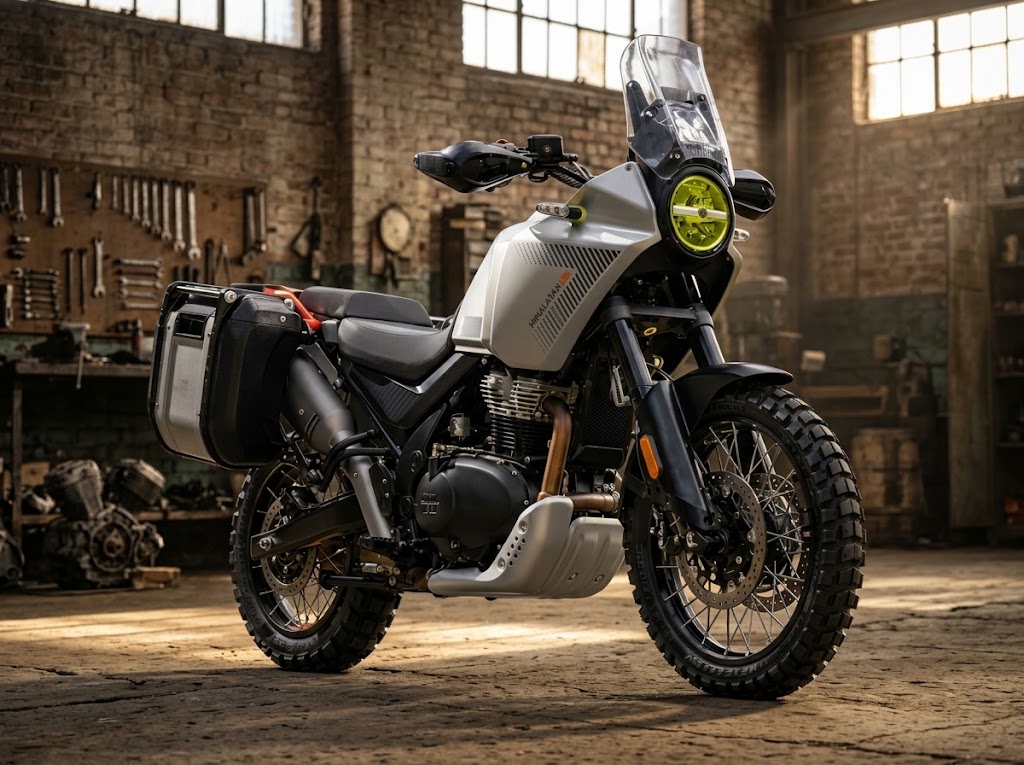
Quick answer: The Himalayan 750 is Royal Enfield’s most capable and most technical Himalayan yet. It has a 743cc air-cooled parallel-twin making about 54 hp, weighs 223 kg wet, has an 815 mm seat and a claimed range of around 400 km. UK pricing starts at £6,999. It is built for balanced on- and off-road touring, not hard-core rally riding.
Table of contents
Royal Enfield has just revealed the bike many riders have been waiting for, and in person it looks fantastic. More importantly, the spec sheet makes sense. Royal Enfield has not tried to build the most extreme adventure bike. It has built a balanced one.
Here is everything riders are asking, followed by a practical look at how to carry your gear on it.

1. What is the Royal Enfield Himalayan 750?
It is a larger version of Royal Enfield’s 650 parallel-twin, now displacing 743cc, in a semi-retro adventure-touring package. The name gives it away. It is the 650 platform with more capacity, more power and a much longer features list. If you ride a Super Meteor 650 or another 650 twin today, this is the same engine family, grown up.
2. How much power does the Himalayan 750 make?
Royal Enfield quotes 54 hp at 7,000 rpm and 63 Nm at 5,000 rpm. The 650 makes around 47 hp, so this is a real step up. It still won’t suit anyone chasing fast adventure riding, but for relaxed touring the extra punch is welcome.
The engine keeps what people like about the 650: air cooling, the sound, and the 270-degree crank. That character suits a semi-retro adventure bike well. It is also a step up from the Himalayan 450 single in outright power, though the 450 is lighter and more off-road focused. If you’re comparing the two, our best-selling Royal Enfield models guide puts the wider range in context.

3. What is the chassis and suspension like?
- Frame: steel, running around the back of the engine rather than as a full cradle
- Travel: 190 mm (7.5 in) front and rear, short of the 220–230 mm on more aggressive adventure bikes
- Adjustability: compression and rebound damping on the fork, preload and rebound on the shock
- Wheels: 19-inch front, 17-inch rear, tubeless on both variants
- Wheel choice: spoked or cast
Spoked wheels are stronger off-road but heavier and harder to clean. Cast wheels are easier to look after. Either way, tubeless tyres make roadside punctures simpler to deal with.
3.1 How are the brakes?
There are twin discs at the front and a 255 mm rear disc with a two-piston caliper. It’s not a sportbike setup. It is smooth, and using both brakes together limits nose-dive. Lean-sensitive ABS is part of the electronics package.
3.2 How heavy is it, and how far will it go?
- Weight: 223 kg (about 492 lb) wet, with the tank 90% full
- Tank: 17.8 L (about 4.7 US gallons)
- Claimed consumption: about 4.4 L/100 km
- Claimed range: around 400 km (250 miles)
It isn’t a light bike, but for a middleweight tourer it sits in the right place. Claimed range assumes steady riding. Luggage, headwinds and motorway speed will all reduce it, so plan fuel stops with a margin.

3.3 What is the seat height?
815 mm (32.1 in). At 5'9" (175 cm) that’s an easy reach to the ground, and the bike isn’t especially wide between the legs. Accessories for different seat heights are expected.
The riding position is open, with wide bars and a slim screen. The screen felt stiff to adjust on the show bike, which may just be pre-production or the wear of a busy show, and most riders set it and forget it anyway. The passenger seat is comfortable if a little firm, and there are grab rails.
3.4 What tech does it have?
This is where the Royal Enfield Himalayan 750 departs most from a typical Royal Enfield:
- 4-inch round TFT display with connectivity
- IMU with lean-sensitive traction control and ABS
- Five riding modes: Road, Sport, Rain, Trail, Custom
- Traction control in Low, Medium and High, or off
- Rear ABS switchable via a dedicated left-hand switch
- Cruise control
- Tyre pressure monitoring
- 15 W USB-C port
- Self-cancelling indicators and an emergency brake-light feature
It is the most technical Royal Enfield yet, without losing the simplicity the brand is known for.


3.5 How much does it cost?
UK pricing was announced at the show:
| Version | UK price |
|---|---|
| Base (Aztec Green, cast wheels) | £6,999, reported as an introductory offer |
| Spoked wheels in bronze or white | +£300 |
| Flagship Antarctic Silver with factory luggage | £8,699 |
The flagship costs roughly £1,300–£1,400 more mainly for its luggage. Many riders may do better buying the base bike and choosing luggage separately. Prices elsewhere may differ, so confirm with your dealer.
4. What about the Continental GT 750?
Royal Enfield also showed a café racer on the same engine, with clip-ons, spoked wheels and twin clocks instead of the TFT. It reportedly uses twin throttle bodies against the Himalayan’s single, so it may make a little more power. Full specs have not been released.
5. Who is the Himalayan 750 for?
- Riders stepping up from a 650 who want more torque
- Tourers who value comfort and range over outright performance
- Newer adventure riders who want a manageable seat height and helpful electronics
Anyone after a light, technical off-road bike should look elsewhere.
6. How should you plan luggage for the Himalayan 750?
A bike with a 400 km range invites longer trips, so luggage matters. Here is how we’d think it through.
Work out your trip first. A weekend usually needs a pair of 20–30 L saddlebags. For reference, Viking’s 28L Baelor for the Himalayan 410 holds 1,708 cubic inches per pair, while the 20L Outlaw is a more compact option. These are for the 410, not the 750, but they show how capacity maps to real trips. For longer rides, a top case or duffel adds space. Our guide to high-capacity ADV top cases covers helmet storage, and the daily-commute top case guide covers quick-release setups.
Choose hard or soft by terrain. The 750 has 190 mm of travel and a 19-inch front wheel, so it suits gravel and light trails more than serious off-roading. If you ride mostly paved roads, hard luggage’s security and weather protection are an advantage. If you head off-road more often, lighter soft luggage is worth a look. We compare them in Hard or Soft? Pros, Cons & Best Options for 2026 and Why Soft Panniers Win for Off-Road ADV Trips.
Decide how often the bags come off. If you take luggage into hotels or the office, quick-release is convenient. If the bags stay on, a fixed mount is simpler. Quick-Release vs. Permanent-Mount Saddlebags explains the trade-offs.
Prefer bike-specific fit. At 223 kg the bike is already substantial, and clearance from the exhaust and rear suspension matters. Purpose-built hardware helps with both. Universal vs. Bike-Specific Saddlebags goes through this.
Pack for balance. Keep heavy items low and close to the frame, split the load evenly, and stay inside the load limits in your owner’s manual and the bag maker’s guidance. Our installation mistakes guide covers weight balance and heat clearance.
Plan for weather. Mountain and touring weather changes quickly. See Waterproof Motorcycle Saddlebags for All-Weather Riding.
7. Where to look for Himalayan luggage
The 750 is brand new, so fitment for new models is confirmed individually. Talk to the Viking team before you order. In the meantime, Viking already makes adventure-touring luggage for other Himalayans. The Himalayan 450 collection includes the Apex XL aluminum top case, the Odyssey luggage system, duffels and backpacks. The Himalayan 410 saddlebags range covers fixed-mount, quick-disconnect and throw-over options. If you’re not sure where to start, the shop-by-bike Royal Enfield page lets you pick your model. Our guide to saddlebags for adventure and dual-sport bikes is a good primer for the style.
Viking Bags holds a 4.8 TrustScore on Trustpilot from more than 6,000 reviews, and every bag ships with its mounting hardware, so it’s a sensible place to start while you wait for 750-specific fitment.
8. Frequently asked questions
Is the Himalayan 750 bigger than the Himalayan 450?
Yes. It has a 743cc twin against the 450’s single, and it is heavier and more road-biased.
Is the Himalayan 750 good off-road?
For gravel and light trails, yes. With 190 mm of travel and a 19-inch front wheel it is built for balance, not hard enduro.
Does it have cruise control?
Yes, along with tyre pressure monitoring, an IMU and five riding modes.
Are the wheels tubeless?
Yes, on both spoked and cast versions.
What size saddlebags suit the Himalayan 750?
It depends on your trips. A 20–30 L pair covers most weekends. Confirm fitment for your exact bike.
Does the 750 fit Himalayan 450 or 410 luggage?
Don’t assume so. They are different bikes, so check with Viking Bags before buying.
9. The verdict
The Himalayan 750 is a well-judged bike: more power than the 650, sensible suspension, tubeless wheels, a strong tech package and a price that undercuts most of the class. We can’t wait to see how riders load it up.



Leave a comment
All comments are moderated before being published.
This site is protected by hCaptcha and the hCaptcha Privacy Policy and Terms of Service apply.