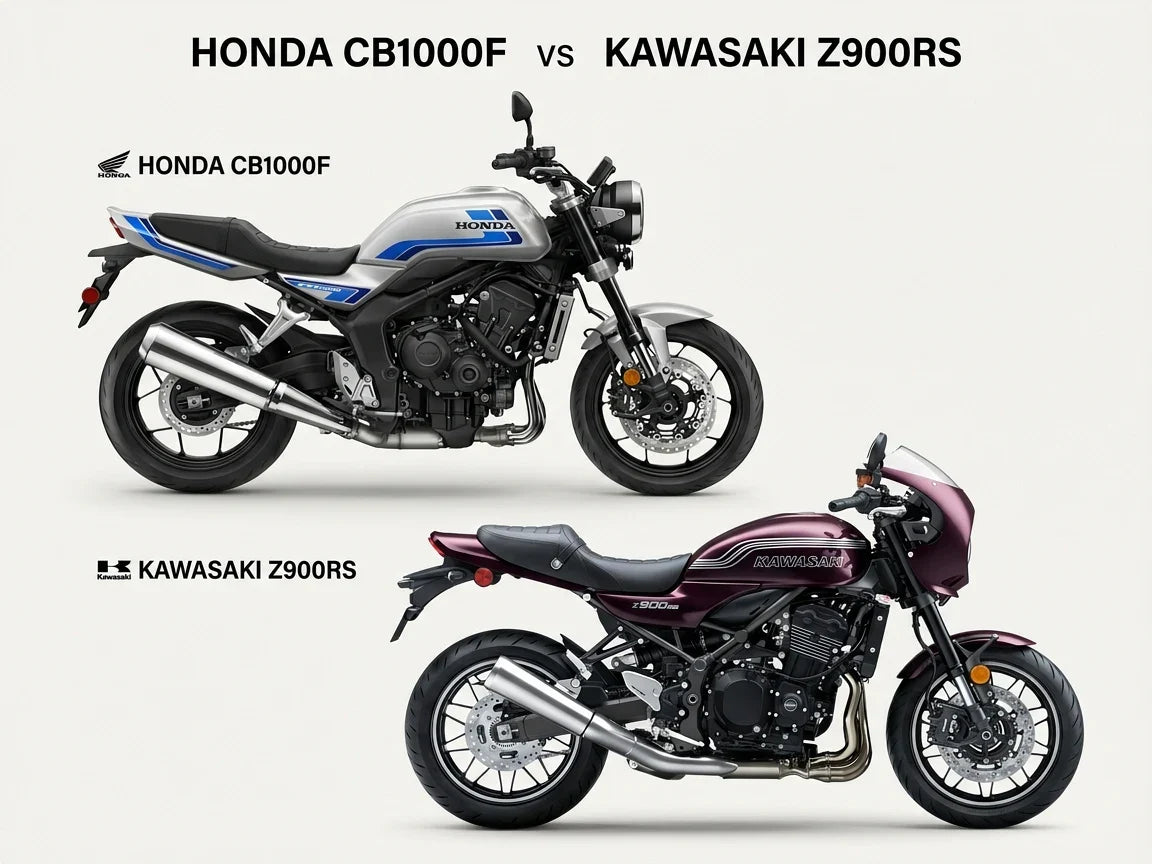
The Honda CB1000F starts at $10,599 in the U.S. The Kawasaki Z900RS ABS starts at $12,999 for 2027 ($12,899 for 2026), a gap of about $2,400. Both are upright, inline-four retro roadsters. The Honda costs less, sits slightly lower and has a color TFT dash. The Kawasaki adds standard cruise control, a two-way quickshifter and classic twin gauges. Specs and prices checked November 25, 2026.
Table of contents
The Honda CB1000F and the Kawasaki Z900RS are chasing the same rider: someone who wants a four-cylinder motorcycle that looks like it rolled out of 1979 but brakes, shifts and manages traction like a 2026 machine. They get there in different ways, and the differences show up less in the headline numbers than in the details: what each bike costs once destination is added, how it fits at a stoplight, and which conveniences come standard.
This comparison uses Honda's and Kawasaki's own U.S. figures. Where markets disagree, as they do on seat height and power, we say so instead of blending numbers from different countries.

1. Quick answer: Honda CB1000F or Kawasaki Z900RS?
Choose the Honda CB1000F if price is the deciding factor. It starts about $2,400 below a 2027 Z900RS ABS, has a 31.3-inch seat and a 5-inch TFT display. Choose the Kawasaki Z900RS if standard cruise control, a two-way quickshifter and analog-style gauges are worth the extra money, or if you want the option of the Öhlins- and Brembo-equipped SE. Sit on both before you decide. A 0.6-inch seat-height gap on paper matters less than how the bars, pegs and tank fit your body.
2. Honda CB1000F vs Kawasaki Z900RS: U.S. specs side by side
| Honda CB1000F (2026) | Kawasaki Z900RS ABS (2027) | |
|---|---|---|
| Base MSRP | $10,599 | $12,999 (2026 model: $12,899) |
| Destination charge | $775 | $840 |
| MSRP plus destination | $11,374 | $13,839 |
| Engine | 1,000cc liquid-cooled inline-four | 948cc liquid-cooled inline-four |
| Claimed power (U.S.) | Not published | 115 hp at 9,300 rpm, 73 lb-ft at 7,700 rpm |
| Transmission | Six-speed | Six-speed, sealed chain |
| Seat height | 31.3 in (795 mm) | 31.9 in |
| Weight | 472 lb (claimed, full tank) | 476.3 lb (curb) |
| Fuel capacity | 4.2 gal | 4.5 gal |
| Wheelbase | 57.2 in | 57.7 in |
| Rake / trail | 25.0° / 3.9 in | 25.0° / 3.9 in |
| Front brakes | Dual 310 mm floating discs, radial-mount four-piston Nissin calipers | Dual 300 mm discs, four-piston calipers |
| Instruments | 5-inch color TFT, Honda RoadSync | Twin analog-style gauges, smartphone connectivity via Rideology |
| Rider aids | Throttle-by-wire, five ride modes, Honda Selectable Torque Control, IMU-based cornering ABS | Cruise control, two-way quickshifter, traction control, cornering management (KCMF), IMU-enhanced ABS, power modes |
| Cruise control | Not listed | Standard |
| Quickshifter | Not listed as standard | Standard |
Sources: Honda and Kawasaki U.S. model pages and spec sheets, checked November 25, 2026. Base MSRP excludes destination, taxes, dealer fees and options. Kawasaki's 115 hp is measured to ISO 4106, which Kawasaki notes can read higher than SAE-based figures. Each brand uses its own weight standard, so the 4.3 lb difference is not a precise comparison.


3. How much do the CB1000F and Z900RS cost?
Honda lists the 2026 CB1000F at $10,599 plus a $775 destination charge, which comes to $11,374 before taxes and dealer fees. Kawasaki lists the 2027 Z900RS ABS at $12,999 plus $840 destination, or $13,839. That puts the gap at $2,400 on base MSRP and $2,465 once destination is included.
The model year matters here. Kawasaki's 2027 Z900RS carries the same published specifications as the 2026 bike for the U.S., with new color options, and its base price rose $100. If a dealer still has a 2026 Z900RS ABS on the floor, the numbers to compare are $12,899 base and $13,739 with destination. Honda's U.S. site currently lists the CB1000F as a 2026 model.
Kawasaki also sells two other versions:
- Z900RS SE ABS: $14,599 for 2026 and $14,699 for 2027, with an Öhlins S46 rear shock with remote preload adjuster and Brembo M4.32 monobloc front calipers.
- Z900RS Cafe ABS: $13,299 for 2026 and $13,399 for 2027, with a cafe-racer front cowl and a black drop handlebar.
The Honda comes in a single version. When you shop, compare out-the-door prices rather than monthly payments, and ask about current incentives, since they vary by dealer and change through the year.
4. Which is more powerful?
Honda built the CB1000F on the architecture of its CB1000 Hornet engine, then retuned it for a roadster. It uses revised cam timing and intake tuning aimed at low- and midrange response, and the gearbox has a lower first and second gear and taller third through fifth than the Hornet. The result is meant to feel strong off the line and relaxed on the highway.
Kawasaki's 948cc four is a different character. The 2026 update added electronic throttle valves, which also made cruise control and IMU-based rider aids possible. Kawasaki's U.S. page lists 115 hp and 73 lb-ft.
Here is the catch for anyone searching for a "winner": American Honda has not published horsepower or torque for the U.S. CB1000F. Honda's U.K. site lists 91 kW and 103 Nm, but those are not U.S. figures, and different emissions rules can change output. Without matching U.S. numbers, any claim that one bike is definitively more powerful is a guess. A dealer demo, or a ride on a road you know, will tell you more about how each engine pulls than a spec sheet can.

5. Which is easier to sit on?
On U.S. figures, the CB1000F has a 31.3-inch seat and the Z900RS ABS has a 31.9-inch seat, a difference of 0.6 inch. The Z900RS SE is listed at 32.3 inches.
Be careful comparing across sources, because Kawasaki's seat height is not reported consistently. Kawasaki's U.S. spec sheet lists 31.9 inches. Kawasaki's Canadian spec sheet lists 835 mm, about 32.9 inches, and some third-party databases show the larger number too. Honda's 795 mm figure is the same in the U.S. and U.K. So the real-world gap depends on which Z900RS spec you are reading. Confirm the exact trim and market at the dealership.
Seat height is only part of fit. Seat width, suspension sag, boot sole thickness, handlebar reach and peg position all change how a bike feels. When you sit on each one, check these:
- Can you put both feet down confidently, and move the bike backward on level ground?
- Do your wrists and shoulders stay relaxed at the bars?
- Is there enough room between seat and pegs for your inseam?
- Can you reach the clutch, brake, switches and display without straining?
6. How do they handle and stop?
On paper the two chassis are close cousins. Both use 17-inch wheels, with a 120/70 front and 180/55 rear tire, inverted forks, dual front discs, upright seating and identical 25.0° rake and 3.9 inches of trail.
The Honda carries a 41 mm Showa SFF-BP inverted fork that Honda describes as fully adjustable, a Pro-Link rear shock and radial-mount Nissin calipers on 310 mm floating discs. The Kawasaki uses a trellis frame, a horizontal back-link rear suspension with adjustable rebound damping and spring preload, and four-piston front calipers on 300 mm discs.
Hardware changes noticeably at the Z900RS SE, with its Öhlins rear shock and Brembo front calipers. That doesn't automatically make it better value. A rider who mostly commutes might do better spending the savings on a Honda, tires, training and protective gear. If you do want the SE, compare the extra $1,700 against what you will actually feel at your riding pace.
7. What about electronics, cruise control and instruments?
This is the clearest dividing line between the two bikes.
Kawasaki Z900RS: Standard electronic cruise control, a two-way quickshifter, traction control, Kawasaki's cornering management function and IMU-enhanced ABS, with a classic twin-gauge cluster and app-based smartphone connectivity.
Honda CB1000F: A 5-inch color TFT with Honda RoadSync, throttle-by-wire with five ride modes (Standard, Sport, Rain and two user-programmable), Honda Selectable Torque Control and IMU-based cornering ABS.
What the Honda does not list as standard is cruise control or a quickshifter. Motorcycle.com's first-ride review specifically noted the absence of both. If you ride long highway stretches or like clutchless shifts, that is a practical point in the Kawasaki's favor. If you would rather have a bright, configurable screen and don't care about cruise, the Honda's dash may suit you better. Neither display style improves performance. It's a matter of taste.

8. Which is better for commuting and longer rides?
Both bikes put you upright, and both have more than enough engine for the highway. The practical differences are small. The Z900RS has a larger tank on paper (4.5 gallons against 4.2), and its cruise control helps on repetitive freeway stretches. Real-world range depends on speed, traffic, weather and how you ride, so don't read tank size as a range guarantee.
Neither bike has a touring fairing, so expect wind at sustained freeway speeds. The Honda's lower price leaves more room in the budget for a windscreen or luggage, depending on what's available for your model. The Kawasaki's extras may save you from buying add-ons later.
9. What luggage can you use on a retro roadster?
Retro roadsters look great and offer little storage. Neither the CB1000F nor the Z900RS is sold as a luggage-ready motorcycle, so decide how you'll carry things before you buy accessories. In practice, riders usually choose one of three setups:
- A tail bag for the passenger seat area. This suits a rain layer, gloves and a change of clothes. Mounting depends on what attachment points your bike has, so read our guide to motorcycle tail bag size, fit and mounting first, and see our street and sportbike tail bags for bags aimed at bikes without a sissy bar.
- A riding backpack. No brackets needed, which is handy on a bike with minimal rear bodywork. We compare the trade-offs in backpack vs tail bag, and you can browse motorcycle backpacks.
- A seat bag or compact bag. Smaller and less intrusive, it works for the daily essentials. See street and sportbike seat bags.
For more on the options, our street and sportbike luggage guide and cafe racer luggage guide cover the categories in more depth.
Whatever you choose, check exhaust and tire clearance, make sure straps stay off hot and moving parts, keep turn signals and the plate visible, and respect both the bike's and the bag's load limits. We haven't verified fit for any specific Viking bag on the CB1000F or Z900RS, so don't assume a universal label guarantees fitment. If you want a second opinion before you order, Viking's team can look at your model year and mounting setup.
10. Which is the safer long-term bet?
The Z900RS has been sold in the U.S. since the 2018 model year, so owners have had years of real-world experience with the platform. The CB1000F reached U.S. dealers in May 2026, which means it has a much shorter track record here. That is not a mark against it. It does mean there is less long-term ownership data to lean on. Both bikes come with a one-year limited warranty from the manufacturer, so ask each dealer about extended coverage if long-term peace of mind matters to you.
11. Which retro bike should you buy?
11.1 Buy the Honda CB1000F if:
- Price matters, and you'd rather put the difference into gear, tires and training.
- You prefer a modern TFT display and Honda's RoadSync interface.
- Its seat, bars and pegs fit you better on a test ride.
- You don't need cruise control or a quickshifter.
11.2 Buy the Kawasaki Z900RS if:
- Classic twin gauges and Z1-inspired styling are why you want a retro bike.
- Standard cruise control and a two-way quickshifter will get regular use.
- You want the higher-spec SE or the Cafe styling.
- You like its track record since 2018.
Our verdict: For a U.S. buyer focused on value, the CB1000F is the place to start: it undercuts the Z900RS by about $2,400 and still brings modern electronics. For a rider who wants cruise control, a quickshifter and classic gauges as standard, the Z900RS earns its premium. If neither feels quite right, our roundup of retro roadster motorcycles covers more options. Whichever you pick, ride both first.
12. Frequently asked questions
Is the Honda CB1000F cheaper than the Kawasaki Z900RS?
Yes. The CB1000F starts at $10,599, versus $12,999 for the 2027 Z900RS ABS ($12,899 for 2026). With destination, it's $11,374 against $13,839 for the 2027 Kawasaki. Taxes, dealer fees and incentives vary.
Which has the lower seat height?
On U.S. figures, the CB1000F is lower at 31.3 inches against 31.9 inches for the Z900RS ABS. Kawasaki's Canadian sheet lists the Z900RS at 835 mm (about 32.9 inches), so check the exact market and trim.
Which is more powerful, the CB1000F or the Z900RS?
It can't be answered cleanly on U.S. data. Kawasaki lists 115 hp and 73 lb-ft for the Z900RS, while American Honda hasn't published power figures for the U.S. CB1000F.
Does the CB1000F have cruise control or a quickshifter?
Honda does not list either as standard on the U.S. CB1000F. The Z900RS has electronic cruise control and a two-way quickshifter as standard.
Is the Z900RS SE worth the extra money?
The SE adds an Öhlins S46 rear shock and Brembo M4.32 front calipers for $1,700 more than the standard bike in both model years. It's worth it if you will use and notice the upgrade. Many riders will do fine on the standard bike.
Are the CB1000F and Z900RS good first motorcycles?
Both are powerful, roughly 470 lb four-cylinder bikes, so they're generally better for riders with some experience. If you're newer, take a rider-training course and try both on a demo ride before buying.
What luggage works on the CB1000F or Z900RS?
It depends on the bag and your bike's attachment points. Tail bags, seat bags and backpacks are the usual choices. Confirm mounting, clearance and load limits for your exact model year before you order.
Should I compare 2026 or 2027 models?
Honda's U.S. site lists a 2026 CB1000F. Kawasaki now lists a 2027 Z900RS ABS with the same published specs and a $100 higher base price than 2026. Compare against whichever model year your dealer actually has in stock.
13. Final thoughts
There isn't one winner. The Honda CB1000F is the better value and a strong modern take on a 1979 classic. The Kawasaki Z900RS is the better-equipped bike, with a longer track record and a wider choice of versions. Pick the one that fits your body, your riding and your budget, not the one that looks best in a comparison chart.



Leave a comment
All comments are moderated before being published.
This site is protected by hCaptcha and the hCaptcha Privacy Policy and Terms of Service apply.