Quick Answer: The “Skyliner motorcycle” is usually the MBK Skyliner, a family of automatic scooters associated with Yamaha's Majesty range. Earlier Skyliners were offered in several engine sizes, including 125cc, 150cc, 180cc and 250cc. A substantially revised Skyliner S 125 appeared in 2014. It is a practical city scooter, not a newly announced 2027 sport motorcycle. Specifications depend on the exact year and version.
Table of contents
Type Skyliner motorcycle into a search bar and you might expect to find a conventional motorcycle with a fuel tank between the rider's knees. Instead, you'll mostly find a scooter with a windscreen, a step-through floorboard and an automatic transmission. There is a good reason for the confusion: used listings, parts catalogues and owners don't always use the same name.
The interesting part isn't whether it counts as a “real motorcycle.” It is whether the Skyliner suits the riding you actually do—and whether an older example is worth bringing home. Here is how to tell the versions apart, what their specifications mean on the road and which things matter most before buying one.

1. What is the Skyliner motorcycle?
The Skyliner is best known as a scooter sold under the MBK name in European markets. MBK was a French manufacturer that became part of the Yamaha group, and several MBK models had closely related Yamaha-branded counterparts. In the Skyliner's case, the name most worth knowing is Yamaha Majesty.
The classic Skyliner layout is familiar to anyone who has ridden a small touring scooter: a step-through body, weather-protective front panels, a seat for a rider and passenger on suitable versions, and a twist-and-go automatic drivetrain. This makes it very different from a manually shifted cruiser or street motorcycle.
Is it a Yamaha Skyliner? People use that phrase because of the Yamaha connection. However, MBK Skyliner is the more precise model name for the European scooters; Yamaha Majesty is the related Yamaha name. That does not mean every Majesty part will fit every Skyliner. The 2014 Skyliner S, for example, is a different generation from the late-1990s and 2000s machines.
For a broader explanation of the riding experience, see Viking Bags' guide to motorcycles versus scooters. This article stays focused on the Skyliner itself.
2. MBK Skyliner models: 125, 150, 180, 250 and Skyliner S
There is no single set of specifications for every scooter wearing a Skyliner badge. Parts catalogues document several engine-size versions, and availability varied by market and production year.
| Version | What identifies it | Best-fit riding use |
|---|---|---|
| Skyliner 125, older generation | Around 125cc; liquid-cooled four-stroke single; automatic belt transmission | Urban commutes and local roads |
| Skyliner 150 | Approximately 150cc member of the older family | Similar commuting role with a modest displacement increase |
| Skyliner 180 | Approximately 180cc version listed in early-2000s parts data | City and suburban use; check the exact model year |
| Skyliner 250 | Approximately 250cc version; separate parts and service requirements | Longer suburban journeys where local road speeds permit |
| Skyliner S 125, introduced in 2014 | Redesigned 125cc, fuel injection, 13-inch wheels and a different chassis | Compact city commuting with updated ergonomics |
The table is a family overview, not a cross-year fitment chart. If you are buying tires, brake parts, a drive belt or accessories, use the actual model code, registration year and chassis identification—not only the “Skyliner” name.


2.1 Older Skyliner 125: the familiar maxi-scooter shape
The older 125 is the version that appears frequently in used European listings. A representative 2006–2010 technical listing describes a roughly 124cc liquid-cooled four-stroke engine, automatic variator transmission, 12-inch wheels and a seat height of about 774 mm. Those are generation-specific reference figures, not guaranteed numbers for every Skyliner 125 built.
Its appeal is simple: wind protection, room to stretch out compared with some compact scooters, no clutch to operate in traffic, and storage built around day-to-day use. Expect an older vehicle's maintenance history to matter much more than a few brochure numbers.
2.2 Skyliner 150, 180 and 250: why engine size matters
The larger-displacement versions are worth separating from the 125 before making any purchase decision. They may offer more usable performance, but an engine-size change can also mean different brakes, transmission components, tires, weight, insurance requirements and licensing rules. A 250 should not be treated as a 125 with an interchangeable engine.
A used-listing photograph or a badge alone is not enough to establish which version you are viewing. Confirm the registration document, identification plate and engine details, particularly on a scooter that has had replacement body panels or major repairs.
2.3 The 2014 Skyliner S is not just a facelift
In 2014, MBK brought back the Skyliner S 125, marketed alongside the Yamaha Majesty S 125. Contemporary reports describe the two as corresponding versions of the same modernized city scooter. It uses a different, more compact design than the older Skyliner line.
Its period specification includes a liquid-cooled, four-valve single-cylinder engine with fuel injection, automatic V-belt drive, 13-inch wheels, a single rear shock and hydraulic disc brakes at both ends. It was designed for city use rather than high-speed touring.
3. Skyliner S 125 specs: the figures you can compare
These are 2014 Skyliner S / equivalent Yamaha Majesty S specifications—not a universal spec sheet for every Skyliner.
| Specification | 2014 Skyliner S / Majesty S 125 |
|---|---|
| Engine | 125cc, liquid-cooled, four-stroke single |
| Fuel delivery | Fuel injection |
| Claimed maximum power | 8.8 kW at 7,500 rpm |
| Claimed maximum torque | 11.6 Nm at 7,000 rpm |
| Transmission | Automatic V-belt |
| Front / rear tires | 120/70-13 / 130/70-13 |
| Front / rear brake discs | 267 mm / 245 mm |
| Seat height | 795 mm |
| Ready-to-ride weight | 148 kg |
| Fuel tank | 7.4 liters |
A key takeaway: compare like-for-like model years and weight definitions. A dry-weight figure from an older Skyliner cannot be directly compared with the 2014 S's ready-to-ride weight. Likewise, a larger older-model fuel tank does not prove better real-world fuel range.

4. Is the Skyliner good for everyday commuting?
For the right route, yes. This is exactly the sort of job the 125 versions were built for: short trips, stop-and-go traffic, local errands and getting to work without manually shifting gears.
The positive experience comes from the package, not outright power. The floorboard makes frequent stops straightforward, the front bodywork offers a degree of weather protection, and the automatic transmission lets you focus on traffic. The 2014 S also features underseat and front compartments, although whether a particular helmet fits should be checked in person.
There are trade-offs. An older 125 may feel strained on fast roads, may not have the newest braking or rider-assistance features, and will not magically become a touring bike just because it has a tall windscreen. A larger Skyliner can be more suitable for longer journeys, but condition, local speed limits, licensing and road type still govern whether it is a sensible choice.
For riders thinking about the daily practical side of two wheels, Viking Bags also covers why people commute by motorcycle.
5. How reliable is a used MBK Skyliner?
There is no sound reason to call every Skyliner indestructible—or unreliable—based only on the Yamaha connection. These are now older scooters, so an individual bike's servicing, storage, mileage and previous repairs are central to reliability.
One independent summary of UK motorcycle inspection records reports 763 Skyliner MOT tests across 2005–2025, with 65.9% passing first time. That is a useful condition signal, but an MOT pass rate is not an engine-breakdown rate. The sample also mixes years and owners, so it cannot predict whether the exact scooter in front of you will be dependable.
A better question for a seller is: What was done, when was it done, and can you show receipts? A clean, correctly serviced 125 can be preferable to a neglected 250 with a more impressive badge.
6. Seven checks before you buy a Skyliner
- Start it from cold. Look for hesitant starting, abnormal smoke, warning lights or unusual noises. Do not rely on a scooter the seller has warmed up before you arrive.
- Ask about the CVT drive belt and rollers. Belt-driven automatic scooters need drivetrain maintenance. Ask for dated service evidence and use the correct interval for that model.
- Inspect the cooling system. Look for coolant leaks, damaged hoses, overheating history and evidence of neglected fluid changes on liquid-cooled versions.
- Check the brakes, tires and wheels. Examine disc condition where fitted, brake feel, tire date codes, cracks and wheel damage—not just tread depth.
- Test all electrical equipment. Indicators, brake lights, horn, charging, battery condition and instrument panel functions should work reliably.
- Look for fork leaks, loose steering and crash repairs. Steering bearings, suspension condition, replaced panels and uneven gaps deserve attention on an older scooter.
- Verify ownership and parts identity. Compare identification details with the paperwork and confirm that key service parts remain available before handing over money.
Have a qualified mechanic inspect a prospective purchase, especially if it has no service records. Viking Bags' broader guide on buying a used motorcycle explains the paperwork and inspection process in more detail.
7. Can you still get Skyliner parts?
Some maintenance items remain listed in aftermarket catalogues, including brakes, tires, batteries and transmission-related components. But being listed does not guarantee a part is in stock or compatible with your scooter.
The MBK Skyliner and Yamaha Majesty relationship can help when researching spare parts; it is not permission to order solely by their shared styling. Match the year, displacement, chassis code and manufacturer part number. This is especially important when comparing an early Skyliner 125 with the redesigned Skyliner S.
If you are buying an older example, investigate the availability of body panels, instrumentation, engine-specific components and workshop support before paying. Routine consumables are generally easier to source than original cosmetic parts for a discontinued model.
For year-round ownership, the fundamentals in Viking Bags' motorcycle maintenance checklist still apply, but follow the Skyliner's own service manual for actual fluids, parts and service intervals.

8. What luggage works for a Skyliner scooter?
A scooter's built-in storage is one of its advantages. Start with what the particular model provides: underseat space, a front compartment where fitted, and any rack already installed. Measure the space with the belongings you actually carry. Helmet size, compartment shape and the scooter's load rating matter more than advertised storage volume alone.
For additional cargo, there are two separate routes:
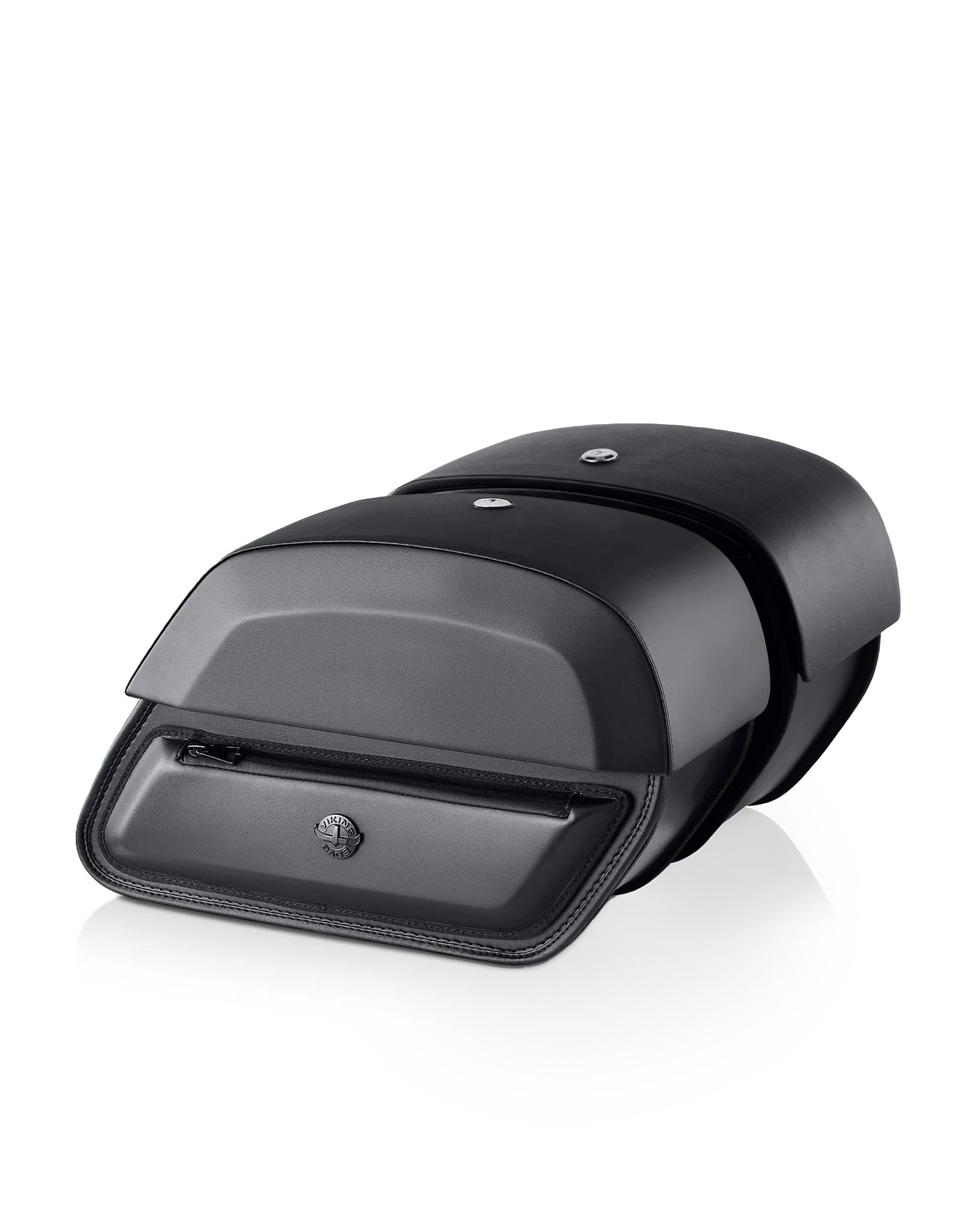
- Rider-carried storage: A properly adjusted backpack adds space without requiring a scooter-specific rack. Viking Bags' motorcycle backpack collection covers different carrying capacities. For someone commuting with a laptop and everyday items, the Trident 32L motorcycle backpack includes a padded laptop sleeve and organizational pockets. It is mentioned here as a backpack worn by a rider, not as a tested Skyliner-mounted bag.
- Scooter-mounted storage: A top case or luggage system requires a rack, mounting hardware, clearance and load rating suitable for the specific Skyliner. Viking Bags' scooter luggage overview is a category starting point, not a confirmed Skyliner fitment list. Confirm the exact scooter model and mounting instructions before ordering.
Avoid attaching cruiser saddlebags, luggage racks or generic straps simply because a product is described as “universal.” A step-through scooter has different bodywork, rear clearances and mounting points from a cruiser. Keep weight low and secured, never obstruct lights or suspension movement, and follow both the scooter's and the luggage manufacturer's load limits.
9. Is a Skyliner worth buying now?
If you want a straightforward, older automatic commuter and can find a well-maintained example with available spares, a Skyliner may be worth considering. The 125 makes the most sense for local trips; larger variants may suit different road speeds and licensing categories. The 2014 S offers a more modern city-focused package, but it is not interchangeable with the older generation.
It is a weaker choice if you need a factory warranty, the latest electronics, long-distance highway performance from a 125, or effortless access to original bodywork. Price should reflect condition, verified service records, local registration rules and the availability of parts—not the assumption that every Yamaha-related scooter must be a bargain.
10. Skyliner motorcycle FAQs
Is the Skyliner a Yamaha or an MBK?
The model is generally called the MBK Skyliner. MBK became part of the Yamaha group, and Skyliner scooters have closely related Yamaha Majesty counterparts. Check the badge, year and model code when searching for parts.
Is there a new 2026 or 2027 Skyliner motorcycle?
I could not verify an official newly launched 2026 or 2027 Skyliner motorcycle. The clearly documented name refers to older MBK scooters, including the 2014 Skyliner S. Treat social posts advertising an entirely new Skyliner as unconfirmed unless a manufacturer announcement is available.
What engine sizes did the MBK Skyliner have?
Period records list 125cc, 150cc, 180cc and 250cc versions. The exact model lineup, specification and availability depended on market and production year.
Does a Skyliner have manual gears?
The commonly documented Skyliner scooter versions use an automatic V-belt/variator transmission rather than a rider-operated motorcycle clutch and manual gearbox.
Are Skyliner and Yamaha Majesty parts interchangeable?
Some components may be related, but interchangeability is not automatic. Match the year, engine size, chassis code and exact manufacturer part number before buying parts. Do not assume the 2014 S shares every component with an older 125.
Can a Skyliner 125 handle highway riding?
Its strength is urban and local-road use. Sustained high-speed highway travel is not its ideal job. Road access laws, minimum speeds and licensing requirements vary by location, so check local rules and the condition and capability of the specific scooter.
How much is an MBK Skyliner worth used?
There is no useful worldwide price for a Skyliner. Local supply, model year, displacement, documentation, service history and condition can change the value substantially. Compare recent sold examples in your market rather than relying on one asking price.
11. Final verdict
The Skyliner isn't a mystery new motorcycle. It is a name that connects a family of practical MBK scooters with Yamaha's Majesty lineage. For anyone shopping secondhand, the smartest move is to identify the exact generation first, inspect its condition second, and only then compare features or add luggage. That approach is more useful than chasing a single horsepower, fuel-range or price figure that may belong to a different Skyliner altogether.


Leave a comment
All comments are moderated before being published.
This site is protected by hCaptcha and the hCaptcha Privacy Policy and Terms of Service apply.