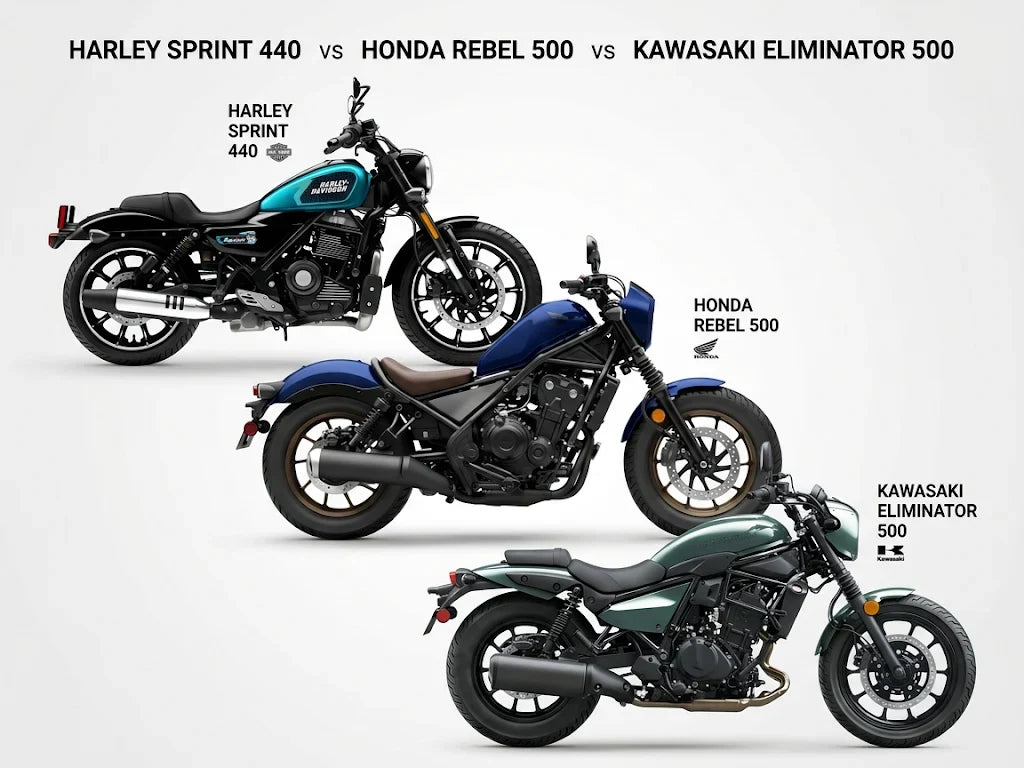
Quick answer: Start with the Sprint 440 if a low seat is your priority (26.4 inches laden; 26.9 inches unladen on a regional specification page). Consider the Rebel 500 for a low-seat parallel twin (27.2 inches), or the Eliminator 500 ABS for the lowest published curb weight here (388.1 lb). Seat-height methods differ, so sit on each motorcycle before deciding.
Table of contents
There is an appealing idea behind Harley-Davidson's new Sprint 440: you should not need a large motorcycle, a big budget or years of experience to enjoy a cruiser with the Harley badge. But a low seat and a tempting price are only the beginning of a good buying decision.
Imagine the same rider comparing three bikes on a Saturday morning. The Sprint looks accessible. The Honda Rebel 500 has the familiarity of a twin-cylinder cruiser. The Kawasaki Eliminator 500 is light for its class and has a taller, more upright-looking stance. Which one will feel right in traffic, on a weekend ride or while carrying a bag to work?
Rather than declare a winner from a spec sheet, this guide compares published manufacturer data and the practical compromises buyers should test for themselves. It uses the 2027 Sprint 440, the U.S.-market 2026 Rebel 500 and the U.S.-market 2027 Eliminator 500 ABS. Those are the model years for which the referenced U.S. specifications were available when this comparison was prepared.

1. At a glance: Which small cruiser fits which rider?
- Harley-Davidson Sprint 440: Consider it first if reaching the ground easily, a relaxed single-cylinder character and a traditional Harley look are your priorities.
- Honda Rebel 500: Put it on your list if you want a low-seat, twin-cylinder motorcycle with a three-gallon fuel tank and a straightforward everyday riding setup.
- Kawasaki Eliminator 500 ABS: Try it if you want the lowest published curb weight of these three and do not mind a noticeably higher seat.
None is automatically the safest beginner motorcycle or the best fit for every rider. Seat shape, control reach, riding skill, footwear and confidence at a stop matter just as much as the figures below.
2. Harley Sprint 440 vs Rebel 500 vs Eliminator 500: Published specifications
| Specification | Sprint 440 (2027) | Rebel 500 (2026) | Eliminator 500 ABS (2027) |
|---|---|---|---|
| Engine | 440cc air/oil-cooled single | 471cc liquid-cooled parallel twin | 451cc liquid-cooled parallel twin |
| Published weight | 412 lb ready to ride | 414 lb curb | 388.1 lb curb |
| Seat height | 26.4 in laden; approximately 26.9 in unladen | 27.2 in | 28.9 in |
| Fuel capacity | 2.4 gal | 3.0 gal | 3.4 gal |
| Transmission | 6-speed manual | 6-speed manual | 6-speed manual |
| ABS | Standard | Standard | Standard on this trim |
| U.S. price status | $5,999 reported; final U.S. MSRP not shown on official U.S. page checked | $6,799 base MSRP; $600 destination | From $6,799 base MSRP; $650 destination |
| U.S. availability | Spring 2027 planned | 2026 model offered | 2027 model listed |
Specifications are manufacturer-published for the named markets and model years. The $5,999 Sprint starting price is reported, not an MSRP displayed on the official U.S. page checked. Kawasaki lists different base prices for the two displayed 2027 Eliminator 500 ABS color options. Seat-height and weight definitions may differ; the figures are not a substitute for an in-person fit check. Tax, title, dealer charges and other applicable fees are extra.


2.1 Seat height: Why the Sprint's low numbers are not the whole story
A seat that's low enough to reach the ground is reassuring, especially on a first motorcycle. Harley quotes the Sprint 440's 26.4-inch laden seat height, measured with a rider aboard, and a regional specifications page lists 683 mm (about 26.9 inches) unladen. Honda lists the Rebel 500 at 27.2 inches and Kawasaki lists the Eliminator 500 ABS at 28.9 inches. Because these numbers use different or unspecified measurement conventions, the differences are directional rather than an exact fit ranking.
Those numbers suggest the Sprint is worth trying if you have a shorter inseam. But being able to place both feet flat on the pavement is not the only test of control. A wide saddle can make a low motorcycle harder to straddle, while a narrower but taller saddle may work better for someone with a different leg length.
Harley also offers Reach and Tallboy accessory seats for the Sprint, which change the rider's position. That's useful information, but don't assume an alternative seat will resolve every ergonomic issue. The right move is to sit on each candidate with your riding boots, grip the bars, work the levers and see how confidently you can support and steer it at walking speed.

2.2 Which one is easier to handle in a parking lot?
The U.S.-listed Sprint and Rebel weights are close: 412 lb ready to ride versus 414 lb curb weight. The Kawasaki is lighter at 388.1 lb in its 2027 ABS specification. That's a meaningful difference when pushing a motorcycle around the garage, but it isn't a complete handling verdict.
The Sprint's low seat may help some riders feel comfortable at stops. The Kawasaki's curb weight may appeal to riders who regularly maneuver through tight parking spaces. The Honda combines a low seat with a familiar upright-to-relaxed cruiser riding position.
Before deciding, try three things with the engine off and appropriate supervision: getting on and off; walking the motorcycle back from a parking place; and turning the handlebars nearly to full lock while keeping the bike balanced. A two-minute parking-lot exercise can tell you more about confidence than a single weight figure.
2.3 Single-cylinder Harley or twin-cylinder rivals: What changes on the road?
The Sprint's 440cc air/oil-cooled single is rated by Harley-Davidson at 27 horsepower at 6,000 rpm and 28 lb-ft at 4,000 rpm. Harley positions it for accessible everyday riding rather than outright performance. Harley advertises fuel economy of up to 80 mpg, but that is a manufacturer claim, not an independently measured result for every rider.
The Honda Rebel 500 and Kawasaki Eliminator 500 use liquid-cooled parallel twins. Kawasaki's U.S. 2027 specification lists 51 hp measured using an ISO method; it should not be compared as though both motorcycles had been tested on the same dynamometer under the same standard. Honda's current U.S. model page does not provide an official horsepower number for the 2026 Rebel 500, so there is no need to invent one for the comparison.
For buyers, the more useful question is how the engines respond at speeds you ride every day. If much of your route is stop-and-go traffic, pay attention to clutch feel, throttle smoothness and low-speed response. If you frequently use faster highways, evaluate acceleration for merging and passing with the load you normally carry.
The Sprint has a six-speed gearbox, but six gears do not guarantee relaxed high-speed cruising. Gearing, wind resistance, engine characteristics and rider weight all influence that experience. An authorized test ride will matter more than claiming a cruising speed that has not been independently verified here.
2.4 What does the lower advertised Sprint price really buy?
The Sprint has a reported U.S. starting price of $5,999. Harley's U.S. information reviewed for this comparison confirms the spring 2027 arrival and final assembly in York, Pennsylvania, but did not display a final U.S. MSRP. Treat the media figure as a reported price until Harley publishes the applicable U.S. retail price.
For reference, Honda lists the 2026 Rebel 500 at $6,799 base MSRP with a $600 destination charge. Kawasaki lists its 2027 Eliminator 500 ABS starting at $6,799 base MSRP for one color option, with a $650 destination charge; another displayed color is priced higher. Those prices are not all-inclusive dealer quotes and can change.
A realistic budget includes insurance, registration, dealer charges, a suitable helmet and other protective riding gear, planned servicing and any accessories you expect to install. Two motorcycles with similar sticker prices can have different ownership costs once those details are included.
It is also worth reading the detailed Sprint 440 price and specification breakdown if you want its complete launch information. This comparison is about choosing between three motorcycles rather than repeating every Sprint launch detail.

2.5 Is the Sprint 440 a better daily commuter than the Rebel or Eliminator?
For short commutes, each motorcycle has a credible case. All three have ABS in the trims compared here, manual six-speed transmissions and accessible cruiser proportions. None comes with a universal guarantee of comfort or ease of use; those depend on the rider and route.
Think about your routine. Do you spend ten minutes filtering through congestion, or fifty minutes on an exposed highway? Are you stopping frequently? Do you need room for a laptop, rainwear and a lock? Do you often carry a passenger?
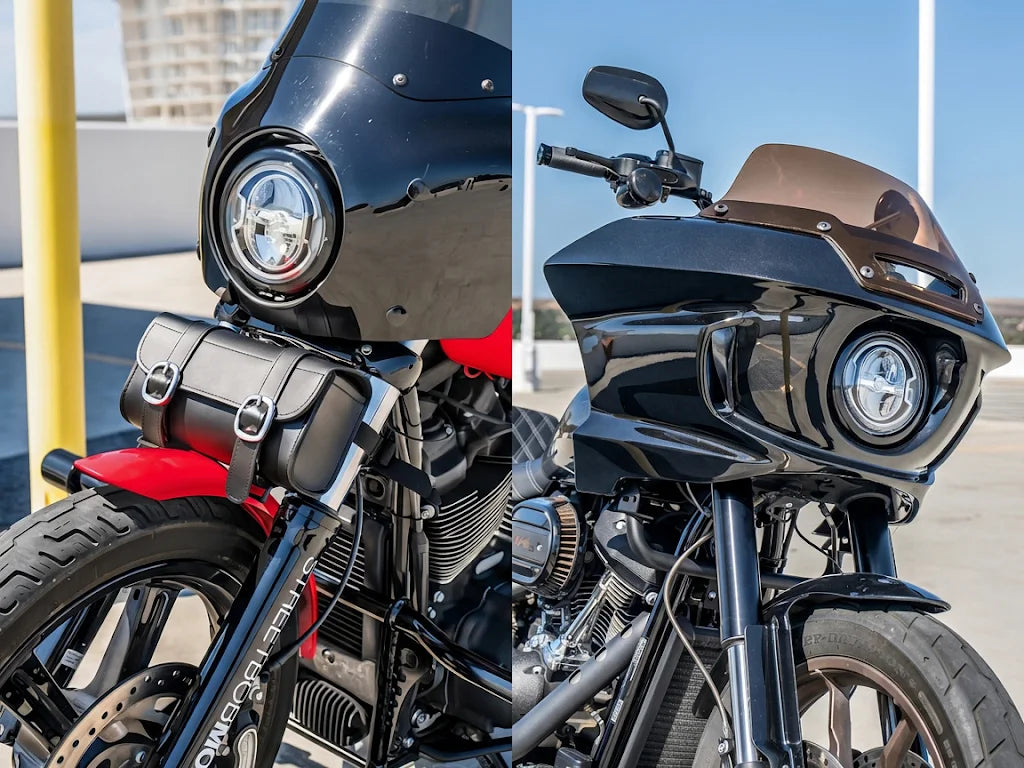
For light commuting essentials, a suitable riding backpack can be simpler than adding model-specific mounting hardware. Compare motorcycle backpacks if portable storage would help, and check pack fit, load and comfort. For heavier or longer-duration loads, properly fitted on-bike luggage may be more comfortable once compatibility is verified.
If you regularly use a fast interstate, consider the extra passing power you want, the amount of wind protection available and whether the ergonomics still feel comfortable after a sustained ride. The best urban bike isn't necessarily the best all-day highway bike.
2.6 Can you fit saddlebags or touring luggage to these motorcycles?
The answer is different for an established model and a newly launched one. Harley-Davidson has published Sprint-specific throw-over saddlebags, with 7 liters of combined volume across both bags and a maximum load of 6 lb per bag. The modest capacity is an important reality check: a small commuter bag is not the same thing as a full-size touring case.
A Sprint-specific factory bag does not establish fitment for Viking Bags' Harley Softail, Sportster or other model-specific saddlebags. The new motorcycle's frame, rear suspension, exhaust, passenger equipment and mounting points must all be checked against the exact product hardware before recommending a fitment.
The Honda Rebel 500 is a different situation: Viking Bags already lists a Rebel 500 saddlebag collection with model-specific options. Riders should still select their exact motorcycle year and configuration and check mounting instructions, clearances and any passenger-seat requirements before ordering.
If you are still deciding how much storage you need, browse the broader motorcycle luggage collection to compare carrying formats, then verify fitment for the exact motorcycle before purchasing. The point is to choose storage that suits both the ride and the actual mounting arrangement, rather than buying a large bag simply because it looks good in a picture.
2.7 What about passenger riding and longer weekend trips?
All three motorcycles can be considered by solo riders, but two-up use and luggage change the decision. Check whether the exact model and seat configuration allow a passenger, what passenger accommodations are included or optional, and the motorcycle's permitted maximum load. Never estimate capacity from the motorcycle's size or engine displacement alone.
The Sprint's 2.4-gallon tank, Rebel's 3.0 gallons and Eliminator's 3.4 gallons are confirmed capacity figures. They are not comparable mileage-range estimates: real fuel economy, riding conditions and safe reserve differ by motorcycle. Harley's advertised up-to-80-mpg figure should not be multiplied by tank capacity and presented as guaranteed range.
For occasional travel, think about where your luggage will sit and how its weight affects balance, suspension preload and rear visibility. Larger bags do not create extra payload. For long trips with a passenger and luggage, a more touring-oriented motorcycle may be the wiser choice if these small cruisers don't meet your needs.
2.8 Which cruiser should you choose? A practical decision guide
Start with the Harley Sprint 440 if the low saddle, Harley styling and simple single-cylinder character appeal to you. It deserves particular attention if your inseam makes other cruisers feel tall. The U.S. arrival is scheduled for spring 2027, so buyers in that market may need to wait to assess it in person.
Start with the Honda Rebel 500 if you want a low-seat parallel-twin alternative with an established model family, and you value the ability to plan model-specific accessories now. The 2026 U.S. model has standard ABS, a 27.2-inch seat and a 3.0-gallon tank.
Start with the Kawasaki Eliminator 500 ABS if a lighter published curb weight and a different, taller riding posture sound attractive. Its 28.9-inch seat may suit some riders and feel too tall to others. Its reported peak output comes from Kawasaki's specified measurement method; don't reduce the buying decision to a horsepower contest.
Still unsure? Compare insurance quotes for all three, ask for written out-the-door prices, and sit on each bike before signing. That is more useful than picking a winner from the smallest difference in seat height or the largest quoted horsepower figure.
3. Frequently asked questions
Is the 2027 Harley-Davidson Sprint 440 actually a beginner motorcycle?
It is designed to be approachable, with a low seat, standard ABS and a manageable published weight. That doesn't make it automatically appropriate for every beginner. Training, fit, confidence and the roads you use should guide the decision.
Is the Sprint 440 cheaper than the Honda Rebel 500?
The Sprint's widely reported U.S. starting figure is $5,999, while Honda lists a $6,799 base MSRP plus $600 destination for the 2026 Rebel 500. Verify the Sprint's final U.S. MSRP when published and compare complete dealership prices, not only headlines.
Which has the lowest seat: Sprint 440, Rebel 500 or Eliminator 500?
The Sprint has the lowest published figure at 26.4 inches laden. A regional Harley specification page also lists about 26.9 inches unladen. Honda and Kawasaki publish 27.2 inches and 28.9 inches respectively, but the stated measurement methods are not fully comparable. Try all three for a real fit assessment.
Which of these cruisers weighs the least?
The U.S.-market 2027 Kawasaki Eliminator 500 ABS has the lowest cited curb weight at 388.1 lb. The Sprint is 412 lb ready to ride and the 2026 Rebel 500 is 414 lb curb weight.
Will Harley Sportster saddlebags fit the 2027 Sprint 440?
Compatibility is not established merely because both motorcycles carry the Harley-Davidson name. Check the exact Sprint-specific mounting requirements and wait for confirmed compatibility before ordering model-specific aftermarket saddlebags.
Is a 440cc single-cylinder motorcycle enough for highway riding?
That depends on route, speed, terrain, rider and luggage load. The Sprint's stated 27 hp can support everyday road riding, but riders who regularly need strong passing power should assess the bike's real highway performance on a permitted test ride before deciding.
When will the Sprint 440 reach U.S. dealers?
Harley-Davidson says spring 2027, with final assembly for U.S.-market motorcycles in York, Pennsylvania. Dealer availability and timing may vary.
4. Final thoughts: Buy the cruiser that fits your actual life
There is no shame in choosing a smaller motorcycle, and no automatic prize for picking the one with the most horsepower. The Sprint 440 makes the Harley-Davidson badge more accessible; the Rebel 500 offers a low-seat twin-cylinder alternative; and the Eliminator 500 brings its own combination of light weight and a taller riding position.
Choose by fit, real road use, total ownership cost and the equipment you need to carry. The motorcycle you genuinely enjoy riding on an ordinary weekday will often be a better choice than the one that merely wins on paper.
Research note: This comparison uses published manufacturer specifications and announced availability information. It is not a firsthand three-motorcycle road test. Manufacturer specifications and prices may change; confirm exact details for your market before buying.



Leave a comment
All comments are moderated before being published.
This site is protected by hCaptcha and the hCaptcha Privacy Policy and Terms of Service apply.