
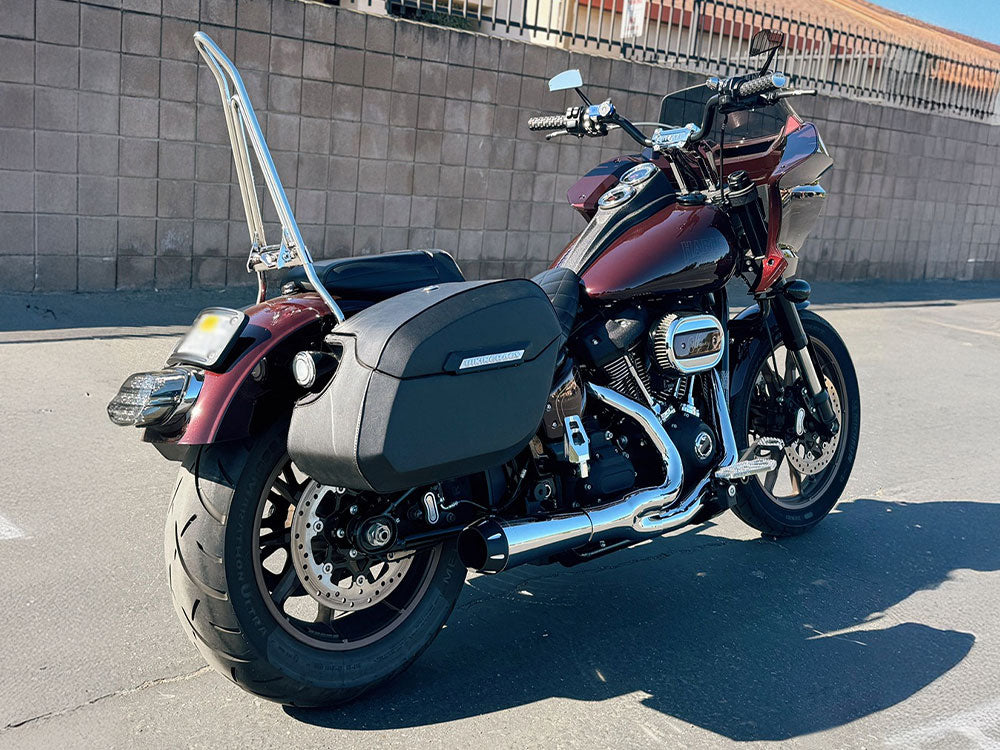
Harley-Davidson saddlebag fitment depends on the exact motorcycle, not just the Harley family name. Learn how model year, platform, mounting hardware, exhaust, suspension, turn signals, accessories, and clearance affect compatibility, plus how to verify fitment before buying or installing saddlebags.
Buying Harley saddlebags is not just a matter of finding a bag labeled for your motorcycle. The exact model, model year, chassis or platform, mounting system, exhaust, rear suspension, turn signals, and existing accessories can all change what will actually work.
A saddlebag can bolt on and still be a poor fit if it sits against the exhaust, crowds the turn signals, interferes with suspension movement, or leaves too little room around the wheel and belt. The safest way to check Harley saddlebag compatibility is to work through the motorcycle first, then the bag.
Table of contents
1. Why Harley Saddlebag Fitment Depends on More Than the Model Name
Two Harleys that share a family name can have different mounting points, frame geometry, shock locations, fender shapes, or accessory requirements. Model-year changes can matter just as much as the badge on the tank.
That is why “fits Softail,” “fits Sportster,” or “fits Dyna” should be treated as a starting point rather than complete fitment information.
A useful fitment chain is:
Make/family → exact model → year → platform/submodel → existing accessories or modifications → mounting system → physical clearance
Think of fitment in four layers:
Physical fit: Can the saddlebag and its hardware attach to the motorcycle?
Functional fit: Can the motorcycle be operated normally after installation?
Clearance fit: Does the bag stay clear of the wheel, tire, suspension, exhaust, belt or chain, signals, and other components?
Accessory fit: Does the setup work with the sissy bar, luggage rack, passenger equipment, seat, license-plate arrangement, or other installed parts?
There is also an aesthetic question—how far the bag sits from the fender, how it angles, and how wide the finished motorcycle becomes—but that should come after mechanical fitment is confirmed.

2. How to Identify Your Exact Harley Saddlebag Fitment
1. Start with the exact model
Do not stop at “Harley-Davidson.” Identify the actual motorcycle: Dyna Street Bob, Dyna Wide Glide, Sportster Iron 883, Sportster 1200, Heritage Softail, Softail Slim, Road King, Street Glide, Road Glide, or another specific model.
2. Confirm the model year
The same model name can span multiple generations, and a saddlebag system designed around one year range may use different supports or docking hardware on another.
3. Identify the platform or generation
The Dyna family was retired after the 2017 model year, and Harley-Davidson introduced an all-new Softail chassis for the 2018 model year. That makes the model year and chassis especially important when a bag listing crosses the Dyna/Softail boundary.
4. Check the submodel
Trim and submodel differences can change exhaust routing, rear suspension, fender shape, signal position, or available mounting points. If the manufacturer's fitment chart lists a submodel separately, use that exact application.
5. List your modifications
Before ordering, write down anything that changes the rear of the motorcycle: aftermarket exhaust, relocated turn signals, custom shocks, side-mount license plate, sissy bar, luggage rack, passenger foot controls, fender modifications, or other custom brackets.
A bag that fits a stock motorcycle may need different hardware—or may not fit at all—after those components are changed.
6. Check the manufacturer's exact fitment listing
Use the manufacturer's application chart or product fitment information for the exact motorcycle. A marketplace title, product photo, or generic “Harley compatible” description is not enough to establish compatibility. The listing should agree with your model, year, platform or generation, and any stated hardware or accessory requirements.
A useful example of what an exclusion looks like: Harley-Davidson's current U.S. listing for rear turn signal relocation kit P/N 67801349 says the kit is required for saddlebag installation on some models and lists '18-'25 FXLR and FXLRS applications, with an exception for '25-later FXLRS. That kind of model-and-year carve-out is why a broad family label is not enough.
Fitment listings can also vary by market. If the motorcycle or part is being sourced outside the market covered by the listing you are reading, use the fitment information for that market rather than assuming the same exclusions apply everywhere.
Treat a “universal fit” claim as a starting description, not proof of plug-and-play compatibility. Universal hardware may still need to be positioned around the specific motorcycle’s exhaust, suspension, signals, and mounting space.
3. Harley Saddlebag Fitment by Motorcycle Family
The motorcycle family is useful for narrowing the search, but it is not enough for final compatibility. Use the family as the first filter, then verify the exact model and year.
Harley Dyna saddlebags
Dyna saddlebag applications can vary around the rear shocks, supports, and the motorcycle's particular exhaust layout. The Dyna family ended after the 2017 model year, but the individual models did not all use identical mounting arrangements. Street Bob, Wide Glide, Low Rider, Fat Bob, Switchback, and other Dyna applications should be matched to the exact year and mounting system rather than treated as one universal fit.
For Dyna hard bags, also check how the bag's mounting hardware works around the shocks and whether the exhaust leaves enough room for the bag and support. A “Dyna” label alone does not establish that every Dyna model uses the same mounting setup.

Harley Sportster saddlebags
Sportster saddlebag options are not one universal application. Different XL generations and configurations can change the available mounting space, signal and license-plate location, axle-cover clearance, and exhaust relationship. That is why a Sportster bag listing should be checked against the exact model and year instead of assuming every XL uses the same hardware.
Sportster riders considering hard bags should verify both the mounting hardware and the clearance around the rear suspension. If the motorcycle has a 2-into-1 exhaust or another non-stock configuration, check the manufacturer's application notes before assuming the stock setup applies.

Harley Softail saddlebags
With Softail, the first fitment question is often which generation you have. The available Softail fitment options should be matched to that generation.
Heritage, Softail Slim, Deluxe, Breakout, Street Bob quick-mount options , Low Rider S, and other Softail models should therefore be checked against the exact application rather than grouped together simply because they carry the Softail name.
For a Heritage Softail or another model using hard bags, confirm the support brackets, exhaust clearance, turn-signal position, and any interaction with detachable accessories before ordering. Riders comparing Low Rider S luggage setups should also verify the exact exhaust and mounting configuration.

Harley Touring saddlebags
Touring motorcycles use a different luggage architecture from the cruiser families above. Road King, Street Glide, Electra Glide, and Road Glide applications still need model- and year-specific fitment. A factory replacement is generally tied to the motorcycle's original mounting arrangement, while an aftermarket replacement can change the bag dimensions or hardware; stretched or extended designs can also change the bag's relationship to the fender and exhaust. Treat those as different fitment applications rather than assuming a replacement bag and an extended design interchange.
For stretched or extended Touring bags, the altered lower shape can affect exhaust clearance and the motorcycle's finished width or length, so the product's exact application matters.

4. How Saddlebag Mounting Changes Harley Fitment
A saddlebag, its support brackets, and its docking hardware are not necessarily interchangeable parts. The bag may be designed around a specific support geometry, while detachable systems may also depend on model-specific docking points.
Replacing Factory Harley Saddlebags vs. Adding New Ones
Replacing an existing saddlebag and adding saddlebags to a motorcycle that did not originally use them are different fitment jobs.
For a replacement, concentrate on the original mounting points, bag dimensions, latches or docking points, and whether the replacement is intended for the same model and year. For a new installation, you may also need supports, brackets, docking hardware, signal relocation, and clearance checks around the exhaust, suspension, wheel, and accessories.
OEM vs. Aftermarket Harley Saddlebags
Factory replacement bags are built around a defined motorcycle application. Aftermarket bags can use different mounting hardware, support brackets, dimensions, or positioning. “OEM-style” does not automatically mean the same fitment as a factory part. Treat the complete bag-and-hardware combination as the application you need to verify.
Fixed or hard-mounted saddlebags
Fixed systems are attached to dedicated supports or mounting hardware and are intended to stay on the motorcycle. Because the mounting position is defined by the hardware, bracket compatibility and correct alignment matter as much as the bag itself.
Quick-mount or detachable saddlebags
Detachable systems add another layer: docking hardware. The bag must engage the correct docking points and latch securely. Existing detachable accessories can also affect which docking hardware is required.
This is why a quick-release saddlebag should be checked as a complete system—bag, supports, docking hardware, and the motorcycle's existing accessories—not as a bag shell by itself.
Throw-over saddlebags
Throw-over bags can look simpler because they do not require the same fixed mounting arrangement, but they still need careful clearance checks. Harley installation documentation calls for adequate clearance around the rear wheel, mufflers, drive chain or belt, sprocket, brake components, swingarm, and rear shocks.
The yokes and straps also need to be positioned so the bags remain secure during riding and do not move into a component that can damage them.
5. Harley Saddlebag Clearance: What the Bag Must Clear
Exhaust
Exhaust routing is one of the most common reasons a bag that appears compatible can become a problem after installation. Compare the actual pipe position with the bag's lower edge, mounting hardware, and any heat-sensitive areas.
Rear shocks and suspension movement
The bag must remain clear through suspension movement, not just while the motorcycle is sitting unloaded. Harley installation procedures for some saddlebag and support systems use rear-wheel or suspension positioning during installation to provide access and establish clearance.
Do not use a universal clearance number for every Harley. The required space depends on the motorcycle, bag, support, suspension, and exhaust configuration.
Rear wheel, tire, belt, or chain
The inner side of the bag and its supports must remain clear of moving drivetrain and wheel components. Throw-over saddlebag instructions specifically call for clearance from the wheel, drive chain or belt, sprocket, brake components, swingarm, and shocks.
Cornering clearance matters too. A bag that looks clear while the motorcycle is upright can occupy more of the available space as the suspension moves and the motorcycle leans, especially when a wider bag or altered mounting position is used.
Turn signals
Signal placement can determine whether a saddlebag can sit in its intended position. Some applications require relocation, while others are designed around the original signal location.
Rear fender
The fender establishes the shape and height of the mounting area. A bag can attach to the supports yet sit at an undesirable angle or position if the bracket geometry does not match the motorcycle.
Seat, passenger equipment, and luggage accessories
Check the relationship between the saddlebag, passenger seat, sissy bar, luggage rack, foot controls, and other rear-mounted equipment. Detachable accessories may require additional or different docking hardware.
6. How Aftermarket Parts Change Harley Saddlebag Fitment
Aftermarket parts can turn a straightforward fitment into a custom installation. The most important changes usually happen around the rear of the motorcycle.
Aftermarket exhaust can move the heat and pipe position closer to the saddlebag.
Custom shocks can change the bag's relationship to the suspension.
Relocated turn signals can create or remove interference.
A custom fender or rear bodywork can change mounting geometry.
A side-mount license plate can occupy space that a saddlebag system expects to use.
A sissy bar or luggage rack can change docking-hardware requirements.
Custom brackets may alter the bag's width, height, or mounting angle.
When a product page says a bag fits a particular Harley, compare your motorcycle to the listed stock configuration. If your bike has been modified, verify the exceptions instead of assuming the published fitment carries over.
Why a Harley Saddlebag Can Fit but Still Sit Wrong
A bag may attach to the supports while sitting too far outward, too low, too close to the shock, or at an angle that looks wrong beside the fender. Common causes include the wrong support bracket, incorrect spacers, mismatched docking hardware, or an accessory interfering with the intended mounting position.
If both bags appear equally misplaced, inspect the mounting system first. If only one side is wrong, look for bracket alignment, hardware, or a motorcycle-side difference that is affecting that mounting point.
Do not force a latch or pull a bag into position with excessive hardware tension. Correct the underlying alignment and confirm that the mounting points are the intended ones for the motorcycle.
Harley Saddlebag Fitment Decision Tree
Fitment step |
What must be true |
1. Exact motorcycle |
Exact model, year, and submodel identified. |
2. Manufacturer fitment |
The manufacturer's fitment information lists that exact application. |
3. Complete mounting system |
Required bag supports, brackets, and docking hardware are identified. |
4. Existing modifications |
Exhaust, shocks, signals, license plate, brackets, and rear accessories are accounted for. |
5. Clearance |
The installed bag clears moving and heat-producing components. |
6. Final alignment |
The bag and hardware align without forcing the latch or mounting points. |
How to Check Saddlebag Clearance Before Riding
1. Install the specified supports, brackets, and docking hardware.
2. Position the bag according to the manufacturer's installation instructions.
3. Check the exhaust side for adequate space and heat exposure.
4. Check the wheel, tire, belt or chain, and other moving components.
5. Check the rear shocks and suspension movement rather than judging clearance only while the bike is stationary.
6. Check turn signals, the fender, seat, passenger equipment, and detachable accessories.
7. Confirm the bag cannot contact a hot or moving component during normal operation.
8. Recheck fasteners and mounting points after installation.
9. Follow the manufacturer's final inspection and test-ride instructions before normal riding.
“Fits” and “sits correctly” are not always the same thing.
7. Harley Saddlebag Mounting Problems and What to Check
The latch will not close
Confirm that the bag is the correct application and that it is fully seated on the mounting points. For more on saddlebag installation mistakes , check docking-point alignment, support position, spacers, and accessory interference before adjusting the latch.
The bag touches the turn signal
Check whether the application requires signal relocation and whether the mounting hardware is installed in the specified position. Do not simply bend the signal or bag into place without confirming the intended clearance.
The bag sits too wide
Inspect the support width, spacers, docking hardware, and mounting angle. A bag that sits farther out than expected may be using the wrong support or hardware combination.
The bag is close to the exhaust
Verify the actual exhaust configuration against the bag's fitment information. If the pipes are aftermarket, do not assume stock exhaust clearance applies.
The bag looks low or angled
Check the mounting bracket and the motorcycle's rear geometry. Shock placement, fender shape, spacers, and support position can all affect the final angle.
8. Harley Saddlebag Fitment Checklist Before You Buy
Use this checklist before placing an order:
Exact Harley-Davidson model identified
Exact model year confirmed
Platform or generation confirmed
Submodel or trim checked
Current exhaust configuration noted
Rear shock and suspension setup checked
Turn-signal location checked
Rear fender and wheel clearance checked
Belt or chain clearance checked
Saddlebag supports or brackets confirmed
Docking hardware confirmed when required
Sissy bar or luggage rack compatibility checked
Seat and passenger-equipment clearance checked
License-plate arrangement checked
Saddlebag width and mounting angle considered
Manufacturer's specific fitment notes reviewed
If one of these items does not match the published application, stop and verify the fitment before ordering.
9. Harley Saddlebag Fitment FAQ
Will any saddlebags fit a Harley-Davidson?
No. Harley saddlebags are not universally interchangeable across every Harley model. Fitment can depend on the exact model, year, mounting system, supports, exhaust, turn-signal position, suspension, and accessories.
How do I know what saddlebags fit my Harley?
Start with the exact model and year, then check the saddlebag manufacturer's fitment information. After that, verify the mounting system, required supports or docking hardware, exhaust, signals, suspension, and existing accessories.
Do Harley saddlebags fit different years of the same model?
Sometimes, but you should not assume they do. Model-year changes can alter mounting points, frame or platform details, hardware, or accessory requirements.
Do I need saddlebag supports?
It depends on the saddlebag and motorcycle. Some systems use dedicated supports, while others use different mounting hardware or a throw-over design. Check the requirements for the exact application.
Can I put saddlebags on a Sportster?
Yes, many Sportster models can use saddlebags . The exact model and year determine the mounting and clearance requirements, and some applications may require signal or license-plate relocation.
Can I put hard bags on a Dyna?
Some Dyna models can use Dyna hard-bag options , but the bag and mounting system must be matched to the particular Dyna. Check the model year, shocks, exhaust, signals, supports, and mounting points.
Do aftermarket exhausts affect saddlebag fitment?
Yes. An aftermarket exhaust can change the space and heat exposure around the saddlebag and its supports. Verify the actual exhaust configuration before installation.
Do I need to relocate my Harley's turn signals for saddlebags?
Sometimes. Some saddlebag applications require relocation while others are designed around the existing signal position. The exact product-and-motorcycle combination determines which applies.
Can I use saddlebags with a Harley sissy bar or luggage rack?
Often, but the mounting arrangement matters. Detachable saddlebags can require different docking hardware when other detachable accessories are already installed.
Why do my saddlebags fit but sit too far out?
Inspect the support brackets, spacers, docking hardware, and mounting position. Also verify that the supports are intended for that particular saddlebag and motorcycle.
Can I use the same saddlebag supports with different bags?
Not necessarily. Supports are part of the mounting geometry. Different bags can use different attachment points, widths, or hardware.
How much weight can I put in Harley saddlebags?
Use the weight capacity specified for the particular saddlebag and motorcycle. Do not assume capacity from the physical size of the bag, and do not exceed the manufacturer's stated limit.
Can a saddlebag fit but still be unsafe to use?
Yes. Physical attachment alone does not prove proper fitment. The installed bag also needs appropriate clearance from moving, hot, or otherwise interfering motorcycle components.
10. Finding the Right Harley Saddlebag Application
When shopping Viking Bags, use the same process outlined above: start with your exact Harley model and year, then verify the available bag, mounting hardware, and any stated accessory or clearance requirements. Family-level collections can narrow the search, but the specific product application should be the final fitment check.
The safest way to choose a Harley saddlebag is to start with the motorcycle, not the bag: match the exact model, year, and platform to the manufacturer's application, then account for the mounting system, existing modifications, and available clearance.
A saddlebag is only a proper fit when the bag, supports, hardware, and motorcycle work together without interference. If any part of that application does not match, resolve the fitment before ordering.



Leave a comment
All comments are moderated before being published.
This site is protected by hCaptcha and the hCaptcha Privacy Policy and Terms of Service apply.