Kawasaki is now America’s best-selling motorcycle brand, with Harley-Davidson third. Here is what the 2025 data shows, why cheaper bikes are winning, and how to equip the bike you choose.
The top of the American motorcycle market looked different in 2025. Kawasaki finished 2025 as the best-selling motorcycle brand in the United States, Honda slipped to second, and Harley-Davidson dropped to third. The overall market shrank, yet certain bikes kept moving off showroom floors. That tells you something important: riders did not stop buying motorcycles, they changed which ones they buy.
This guide explains what the sales data actually says about the best-selling motorcycles in America, why it happened, what each popular type of bike is good at, and how to equip whichever one you choose. We checked every figure against published reporting and we flag where numbers differ between sources, because a good buying decision starts with accurate information.
Table of contents
1. Key Takeaways
- Kawasaki took the top spot in 2025, with sales up 14.2% year-to-date through September, while Honda fell about 8% and Harley-Davidson fell 15.9%.
- The overall U.S. market was down 6.5% in the same period, based on MotorCyclesData figures.
- Price is the biggest driver. Kawasaki, Honda and Yamaha all sell new bikes under $5,500, while the cheapest Harley-Davidson and Indian models start around $9,999.
- Indian also grew, up 4.9%, while most major brands declined.
- Each bike type has its own storage solution, and fitment depends on the exact model and year.
2. What the 2025 Sales Data Actually Says
The headline numbers come from MotorCyclesData year-to-date tracking through September 2025, as reported by Power Sports Business. In plain terms, "year-to-date" means January through September, not the full calendar year. In that window, riders bought about 401,035 new motorcycles, a 6.5% decline from the year before.
Brand |
Change vs. 2024 (Jan to Sept 2025) |
|---|---|
Kawasaki |
Up 14.2% |
Indian Motorcycle |
Up 4.9% |
Honda |
Down about 8% |
BMW |
Down 10.8% |
Suzuki |
Down 13.7% |
Harley-Davidson |
Down 15.9% |
There are two caveats worth knowing. First, different trackers measure sales differently. The Motorcycle Industry Council put the overall decline at 7.3% for the same period, and Jalopnik reported Harley-Davidson's first nine months as down by nearly 20%. Second, these are registration and sales-tracking estimates, not audited company results. The direction is clear in every source. The exact percentage varies.
3. Why Kawasaki Overtook Honda and Harley-Davidson
Kawasaki did not win with a single hero bike. Industry coverage credits strong demand for its Ninja sportbike line and the Vulcan S cruiser, which cover very different buyers. That breadth matters. A brand with an approachable sportbike, a naked bike, a cruiser and dual-sport and dirt models can catch riders at several points in their lives.
Honda, the 2024 leader, fell about 8% but remains a major force, particularly in small and entry-level bikes. Harley-Davidson's drop was the largest of the big three. The brand still leads heavyweight touring and cruising, but its price point makes it a harder first purchase.


4. Why Value Is Winning
The most useful statistic in the whole story is the price gap. Kawasaki, Honda and Yamaha each sell new motorcycles below $5,500, according to the Power Sports Business report, while Harley-Davidson's and Indian's cheapest bikes start around $9,999. When household budgets are stretched, a gap of roughly $4,500 can easily decide whether someone buys now or waits.
Price is not the only force, though. Three others matter:
- Accessible bikes are easier to learn on. Lighter weight, lower seat heights and friendly power delivery make it less intimidating for new riders.
- Ownership costs scale with the bike. A cheaper bike usually means a smaller loan, lower insurance and cheaper tires, which leaves room in the budget for protective gear and accessories.
- The rider base is older. The Motorcycle Industry Council's 2018 Owner Survey put the median owner age at 50. Riders in that range tend to value comfort, a fair price and a bike that fits their body over raw performance. That survey is several years old, so treat it as a trend marker rather than a current figure.
There is also a loyalty effect. A rider who has a great first experience on an affordable bike often buys another bike from the same brand later. For manufacturers, winning the entry-level buyer is how you earn the future premium buyer.
5. The Best-Selling Motorcycles in America, Explained by Type
Sales rankings by individual model differ between sources and change month to month, so we are not going to publish a ranked top ten. What stays consistent across reports is the type of bike that is selling. Understanding each type helps you work out which one fits your riding, and what you will need to carry on it.
5.1. Entry sportbikes and naked bikes (Ninja 500, Z500)
A sportbike has a full fairing and a forward-leaning riding position. A naked bike has the same kind of engine and chassis with no fairing and a more upright seat. Kawasaki's Ninja 500 and Z500 are examples of each, and both use a roughly 450cc twin-cylinder engine that is light, manageable and cheap to run. They appeal to new riders who want sporty looks without a frightening amount of power.
The trade-off is storage. These bikes are built light, with a short tail and little room for hardware. That is why most owners rely on bags that sit on the passenger seat or tail section, plus a backpack. Our guide to luggage for street and sport bikes covers the options in detail.

5.2. Mini and small-displacement bikes (Honda Grom)
The Grom is a 125cc mini-motorcycle. It is popular because it is inexpensive, forgiving and fun at low speeds, and it appeals to a wide range of riders. It is a city and neighborhood bike rather than a touring bike, so most owners carry a small backpack and little else.

5.3. Middleweight naked bikes (Yamaha MT-07)
The MT-07 uses a 689cc twin-cylinder engine and is widely recommended as a one-bike-does-everything choice. The idea behind a middleweight is simple. A literbike is expensive and has more performance than most riders use on public roads, while a 300cc bike can feel limiting after a season or two. The 700cc class sits in between, which explains why it keeps showing up on shortlists.

5.4. Middleweight adventure bikes (Yamaha Ténéré 700)
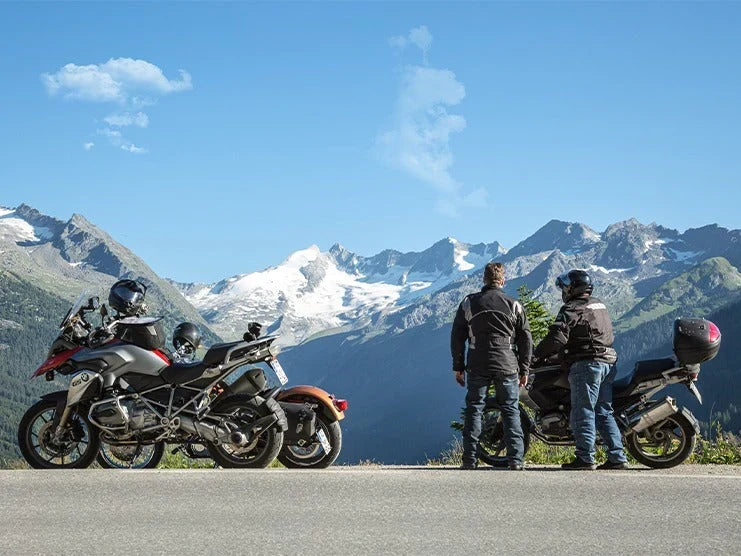
An adventure bike is built for pavement and unpaved roads, with long-travel suspension, a tall seat and a comfortable upright riding position. The Ténéré 700 shares its 689cc twin with the MT-07 and is a well-known example. The category appeals to riders who want one bike for commuting, touring and weekend dirt roads.
Adventure riding also has the most luggage choices, and the right answer depends on terrain more than anything else. Our guide on how to choose adventure motorcycle luggage by riding style walks through the trade-offs. If you want to browse, start with adventure luggage bags or adventure hard side cases.

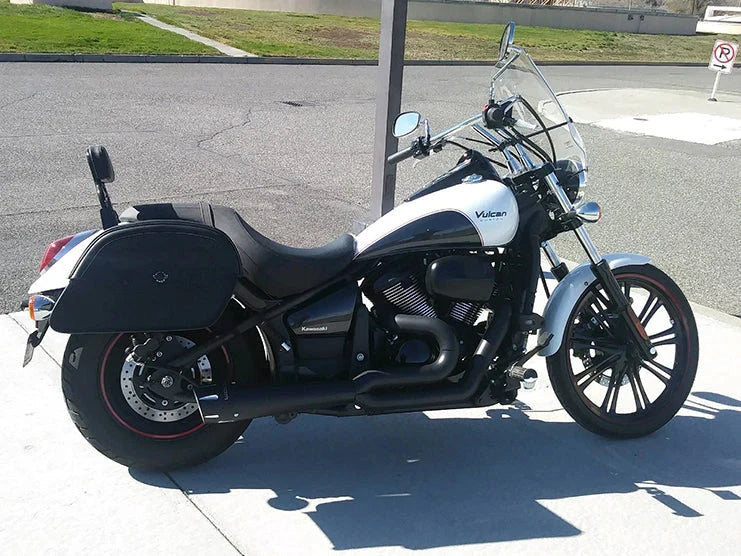
5.5. Entry cruisers (Honda Rebel 500, Kawasaki Vulcan S, Kawasaki Eliminator)
A cruiser has a low seat, forward-mounted foot controls and a relaxed riding position. Those traits make cruisers easy to handle at parking-lot speeds, which is why so many first-time buyers choose them. The Rebel 500 has a roughly 470cc twin and is often described as a beginner-friendly cruiser. The Vulcan S has a roughly 650cc twin and adjustable ergonomics, which helps different rider sizes get a good fit. The Eliminator is Kawasaki's newer, entry-level cruiser, with a roughly 450cc engine.
If you are comparing cruiser types, our guide to which cruiser motorcycle is right for you explains how fit and riding style matter more than seat height alone.
5.6. American V-twins and touring bikes (Indian Scout, Harley-Davidson Street Glide)
The Indian Scout and the Harley-Davidson Street Glide were both listed among the top-selling models of 2025 by Cycle Trader. They are different bikes for different riders. The Scout is a mid-size V-twin cruiser. The Street Glide is a full-size touring bike with a frame-mounted fairing and factory saddlebags.
6. What the Harley-Davidson and Indian Numbers Really Mean
A 15.9% drop sounds dramatic, and it is a real decline, but it does not mean Harley-Davidson is going away. The brand still leads heavyweight touring and cruising, and its flagship touring models continue to sell. The more useful reading is about who the buyer is. Harley-Davidson's cheapest bikes start around $9,999, which makes it hard to compete for buyers who are shopping below $5,500.
Indian grew 4.9%, which Power Sports Business described as a bright spot. The same report notes Indian was recently sold to private equity, so the brand is in a period of change. If you are curious about where Harley is heading next, our overview of the 2027 Harley-Davidson models separates what is confirmed from what is rumored.
7. How to Carry Gear on Each Type of Bike
Once you have chosen a bike, storage is the first upgrade most riders make. Different bikes suit different luggage, and the terms can be confusing, so here is what each one actually is.
Luggage type |
What it is |
Suits |
Main trade-off |
|---|---|---|---|
Saddlebags (panniers) |
Bags that hang on each side of the rear wheel |
Cruisers, tourers, adventure bikes |
Add width and are usually model-specific |
Tail bag |
A bag strapped to the passenger seat or rear rack |
Sportbikes, naked bikes, cruisers |
Limited capacity and needs a flat mounting area |
Sissy bar bag |
A bag that straps to a sissy bar, the upright backrest frame behind the seat |
Cruisers fitted with a sissy bar |
Mounted high and far back, so overloading affects handling |
Tour pack (top case) |
A lockable trunk on the rear of a touring bike |
Harley-Davidson tourers and similar |
Adds weight to the rear |
Backpack |
Worn on your back or strapped to the bike |
Any bike |
Puts extra load on your shoulders over long distances |
Tank bag |
A small bag that sits on the fuel tank |
Sport and adventure bikes |
Small capacity |
Our guide to saddlebags, tour packs and sissy bar bags compares these in more depth, and our article on choosing a sissy bar bag size and mount explains how to check whether a bag will actually fit your bar.
7.1. Which luggage suits which popular bike
- Sportbikes and naked bikes: A tail bag is the most common solution. Viking's range runs from roughly 20 to 57 liters. For items you carry off the bike, a motorcycle backpack works well.
- Entry cruisers: Saddlebags make the biggest difference here. For the Rebel 500, Viking offers saddlebags in fixed-mount, quick-disconnect and throw-over styles, in sizes from about 10 to 30 liters.
- Mid-size American cruisers: Check the model year first. Viking's Scout Bobber saddlebags are for 2018 to 2024 bikes, and 2025 and newer Scouts use different bags.
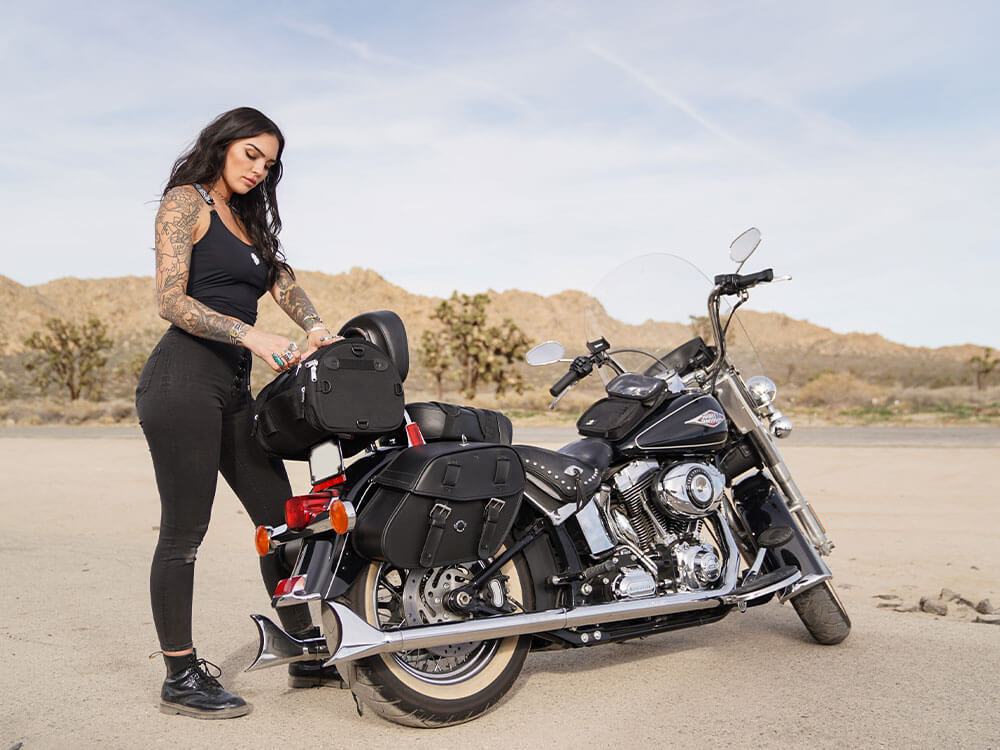
- Harley-Davidson tourers: Most already have factory saddlebags, so many owners add a rear trunk. See Viking's Harley tour packs.
- Adventure bikes: Terrain decides. Hard cases suit road-heavy riding, and soft or rackless setups suit dirt.
7.2. Mounting styles, explained
Mounting is the part most buyers overlook. According to Viking's product pages, there are three common styles:
- Fixed mount gives the tightest fit and the most integrated look.
- Quick disconnect lets you take the bags off fast, though they sit slightly farther from the bike.
- Throw-over uses straps and is the simplest, non-permanent setup.
If you remove your bags every day, quick disconnect is usually the better fit. If you want a clean, permanent look, fixed mount makes sense. If you do not want to modify the bike, throw-over is the easy route.
7.3. Capacity in plain terms
Capacity is measured in liters. As a reference point, Viking lists a 20-liter pair as holding about 28 cans and a 24-liter pair as holding about 33. A smaller bag suits a commute. A weekend trip usually needs more, and heavy loading changes how a light bike handles, so bigger is not automatically better.
7.4. Fitment mistakes to avoid
- Assuming one model year fits all. Mounting points change between generations.
- Ignoring turn signals and lights. Some bags list whether turn signals need to be relocated, so read the product page.
- Overloading a sissy bar or tail rack. Check the weight limits for your hardware.
If you are unsure, use shop by bike to narrow the list to your exact model.
8. A Practical Checklist for Buying a Bike in 2026
- Add up the full cost. Include insurance, registration, protective gear and accessories, not just the price on the tag.
- Take a rider course. Programs such as the Motorcycle Safety Foundation's Basic RiderCourse typically provide a training motorcycle, and completing one can help with licensing. Check your state's requirements for a motorcycle endorsement.
- Sit on it before you buy. Reach to the bars and how flat your feet sit on the ground matter more than horsepower.
- Be honest about your riding. Mostly commuting points to a naked bike or cruiser. Weekend dirt roads point to an adventure bike.
- Check dealer and service support. A bargain bike is only a bargain if you can get it serviced.
- Inspect any used bike carefully. Avoid bikes with visible crash damage, and have a technician check it before you pay.
9. Three Myths About the 2025 Sales Shift
"A cheaper motorcycle is a worse motorcycle." Not necessarily. Entry-level bikes trade top speed and features for weight, price and ease of use, which suits many riders better than a high-performance machine.
"Harley-Davidson is finished." No. Its sales fell, but it remains the leader in heavyweight touring and cruising, and the Street Glide was still listed among 2025's top sellers.
"A first bike must be as big as possible." There is no single displacement cutoff that works for everyone. Fit, weight and how confident you feel matter more than engine size.
10. Frequently Asked Questions
What is the best-selling motorcycle brand in America?
Kawasaki led U.S. sales in 2025, up 14.2% year-to-date through September, according to MotorCyclesData figures reported by Power Sports Business. Honda was second and Harley-Davidson third.
What was the best-selling motorcycle in America in 2025?
There is no single official model ranking that every source agrees on. Cycle Trader lists the Indian Scout and Harley-Davidson Street Glide among the top sellers, and industry coverage credits Kawasaki's Ninja line and Vulcan S for its brand growth.
Is Harley-Davidson still the top-selling brand?
No. In 2025, Harley-Davidson fell to third place behind Kawasaki and Honda, with sales down 15.9% through September. It remains a leader in heavyweight touring and cruising.
Why are Kawasaki motorcycles selling so well?
Reporting points to strong demand for the Ninja lineup and Vulcan S, a wide range of models, and entry-level pricing below what premium American brands charge.
Are cheap motorcycles worth buying?
Often yes, particularly for new and returning riders. The key is choosing a bike that fits your size and riding, and budgeting for gear and insurance as well as the purchase price.
What is the cheapest new motorcycle I can buy?
Kawasaki, Honda and Yamaha all sell new bikes under $5,500, according to Power Sports Business. Prices change by model year and region, so confirm the current price with a dealer.
What luggage fits a sportbike or naked bike?
Most owners use a tail bag strapped to the passenger seat or rear section, often with a backpack for items carried off the bike. Check that straps will not touch the exhaust or block the rear light.
Do saddlebags fit every model year?
No. Mounting points change between generations, so always confirm your exact model and year before ordering.
Is the U.S. motorcycle market shrinking?
In 2025, yes. MotorCyclesData reported a 6.5% decline through September, and the Motorcycle Industry Council measured 7.3% for the same period.
11. Sources and Notes
We checked the figures in this article against the following published sources. Figures may be revised as full-year data is released.
- Power Sports Business: "Kawasaki surges to No. 1 in the U.S. motorcycle market as Harley falls to third" (December 2025)
- Jalopnik: "America's top-selling motorcycle brand in 2025 isn't Harley-Davidson"
- Cycle Trader: "Best selling motorcycles of 2025" (January 2026)
- Motorcycle Industry Council 2018 Owner Survey results, as summarized by RideApart
We have not quoted manufacturer prices for individual models, because they vary by trim, year, region and dealer fees.
12. Final Thoughts
The 2025 sales story is really about accessibility. Riders are choosing bikes that are affordable to buy, easy to ride and cheap to own, and brands that built those bikes are growing while premium-priced rivals struggle. Whichever bike you end up with, think about how you will carry your gear before you ride away, and make sure anything you buy fits your exact model and year.



Leave a comment
All comments are moderated before being published.
This site is protected by hCaptcha and the hCaptcha Privacy Policy and Terms of Service apply.