
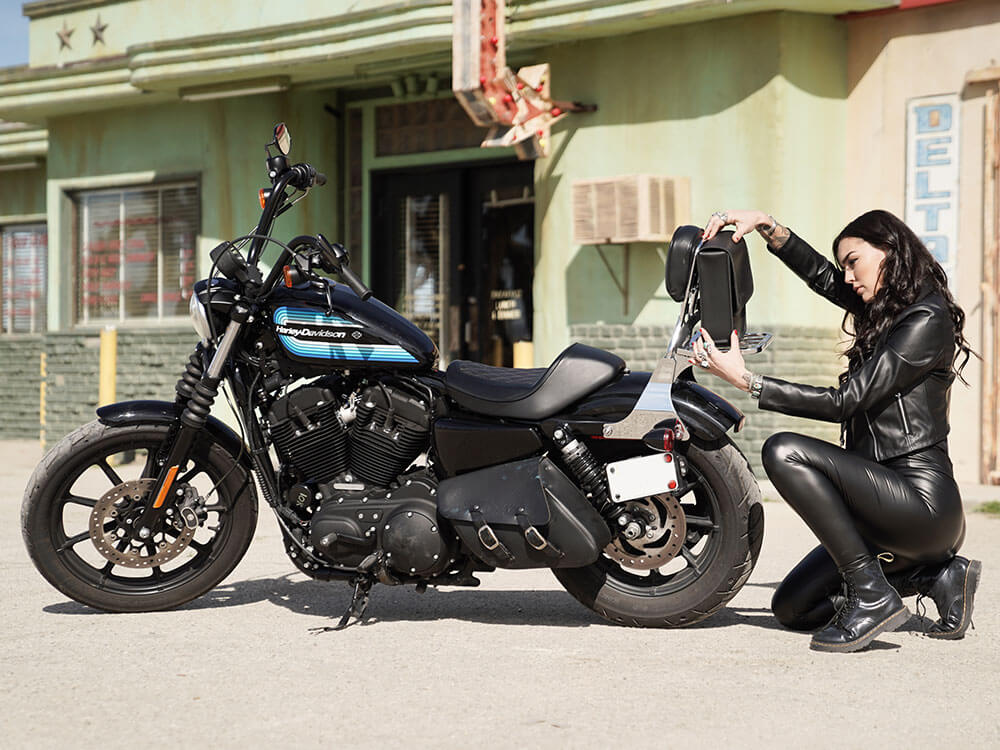
Which sissy bar bag is right for your motorcycle? The right choice depends on more than capacity. This guide explains how to measure your sissy bar, check bag fitment and clearance, understand mounting systems, compare practical bag sizes, and stay within the correct weight limits. It also covers passenger clearance, weather protection, installation, troubleshooting, and how sissy bar bags compare with other motorcycle luggage.
Table of contents
A sissy bar bag that looks right in a product photo can still be wrong for your bike. If it doesn't match your sissy bar's height, tip shape, or weight rating, it won't sit right no matter how good it looks online. Some riders call this style of bag a backrest bag when it's mounted alongside a passenger backrest pad, but the fitment questions are the same either way. Capacity matters, but it's only half the decision. This guide covers the half most buying guides skip: whether a bag will actually mount to your specific sissy bar, and how much weight it can safely carry once it's there.
1. What Size Sissy Bar Bag Do You Actually Need?
Sissy bar bag capacity, or cargo capacity if you're comparing it against other luggage types, generally splits into three rough tiers, and trip length matters more here than bike type.
- Day-use bags, roughly 10 to 20 liters: enough for a rain layer, tools, a lock, and a few personal items. This size keeps the bag's profile low and reduces the amount it affects handling.
- Weekend bags, roughly 20 to 40 liters: sized for a two- or three-day trip, sitting between a day bag and a full touring load, enough for a change of clothes and basic overnight gear without going oversized.
- Extended-trip bags, roughly 40 to 60 liters: sized for multi-day travel. A main compartment around 50 liters is commonly cited as enough for clothes, a laptop, a camera, and toiletries for trips of three days to a week. Bags built for two weeks or longer generally need to be on the larger end of that range or supplemented with additional luggage.
Capacity alone doesn't tell you whether a bag will physically sit correctly on your bike, which is what the next two sections cover. Actual capacity needs also depend on what you're carrying, not just trip length: cold-weather riding gear and electronics take up more room than summer clothing and toiletries, and riders running saddlebags alongside a sissy bar bag generally need less sissy bar capacity than someone relying on it as their only luggage.

2. How Do You Measure Your Bike for a Sissy Bar Bag?
A few minutes with a tape measure before ordering catches most fitment problems.
- Measure your sissy bar's height, from its base to the top. Compare this against the bag's listed height so the bag doesn't sit awkwardly low on a short bar or leave unused space on a tall one.
- Measure the bar's width at the point where straps will wrap around it. Very wide or very narrow bars can affect how snugly an adjustable strap system cinches down.
- Check the distance from the seat to the bar, and from the bar back to the rear fender. This tells you how much the bag can safely extend without contacting the seat, a passenger, or the fender.
- Identify your strap attachment points. Note whether your setup has just the bar itself, a backrest pad attached to the bar, or a rack surface, since this affects which mounting style will actually secure the bag.
- Check clearance to the wheel and fender with the bag test-fitted, the same way you would for saddlebags, since a bag that clears everything while empty can shift closer once loaded or when the suspension compresses under real riding load.
Finishing these five checks tells you whether a specific bag's listed dimensions will actually work on your bike, rather than relying on a "universal fit" label alone.
3. Does a Sissy Bar Bag Fit Any Sissy Bar?
Not automatically. Sissy bars vary in height, typically sold in short, medium, and tall options, and this variation affects how a bag sits once mounted. A bag sized for a tall sissy bar can sit awkwardly low on a short one, or fail to use the available space efficiently on a tall one if it was built for a shorter bar.
Tip shape matters too, more than most buyers expect. Sissy bars generally come with either a rounded (U-shaped) tip or an angled, pointed (V-shaped) tip. A rounded tip makes it easier to slide straps around the bar's circumference, while a pointed tip is angled specifically to help catch and hold luggage straps so they're less likely to shift loose over bumps. Neither shape is universally better, but it's worth knowing which one your bar has before assuming a strap-mount bag will slide on the way it did in a product video. Viking Bags' own motorcycle sissy bars come in both tip styles across short, medium, and tall heights, if you're shopping for the bar itself alongside the bag.
Some sissy bars, particularly on bikes like the Sportster, are sold with a foldable luggage rack built into the design specifically to make mounting a bag easier, folding out to create a flat surface for straps rather than relying on the bar's shape alone. If your bike has this style of bar, check whether the bag you're considering is meant to sit on that folded rack surface or strap directly to the bar itself, since the fit and stability can differ between the two.
Most sissy bar bags are marketed as compatible with most sissy bars, racks, and backrests, which is generally accurate for bags using an adjustable strap system, but "most" isn't "all." If you have an unusually short, unusually tall, or nonstandard sissy bar, it's worth confirming compatibility directly rather than assuming a universal-fit label covers every case.
Fixed and detachable sissy bars introduce another variable. A detachable or quick-release bar can be removed from the bike entirely, which is convenient for cleaning or storage, but it also means the bag's mounting straps need to accommodate the bar's specific quick-release hardware rather than a plain fixed post. Some bikes also add a backrest pad to the bar for passenger comfort, which changes the available strap-wrapping surface and is worth checking against the bag's mounting instructions before assuming a straightforward fit.
Bike family can affect the available space, but model year and the specific sissy bar configuration matter more than the badge on the tank. The same motorcycle family can use different bar heights, widths, racks, and mounting hardware across trims and years, so measure the actual setup on your bike rather than assuming it matches what another rider with the "same" model has.
How the sissy bar itself mounts to the bike matters too. A frame-mounted or axle-mounted bar is generally the more stable base for a loaded bag. A swingarm-mounted bar, common on some bobber and chopper builds, moves with the rear suspension rather than staying fixed relative to the frame, and taller swingarm-mounted bars can vibrate noticeably over bumps. That vibration is worth factoring in before choosing a large or heavy bag for a swingarm-mounted setup, since a shorter or medium bar generally handles the load more predictably.
4. How Do Sissy Bar Bags Actually Mount?
Most sissy bar bags use a strap-based mounting system rather than requiring a separate bracket or rack, which is part of why they're a popular no-drilling option. The typical setup includes:
- A wide adjustable belt or strap, often around 1.5 inches wide, that wraps around the sissy bar itself with a hook-and-loop closure for adjustment.
- Secondary D-ring straps, usually one on each side, that cinch the bag tight against the bar or backrest to stop it from shifting or sagging once loaded.
- Quick-release buckles, common on the front closures, that let you open the bag without unstrapping the whole mount.
This is generally described as a "no rack needed" system, and for most sissy bars, backrests, and luggage racks, that's accurate. It's still worth checking the specific product description rather than assuming every sissy bar bag mounts identically, since some bags are designed specifically for a rack-top mount rather than wrapping around the bar itself. A bag built to wrap around the bar relies on strap tension against the bar's own structure to stay put; a bag built to sit on a rack instead relies on the flat rack surface for support and uses its straps mainly to prevent shifting rather than to bear the bag's full weight. Confirming which type you're buying matters more than the general "how many straps" question, since using a bar-wrap bag on a rack, or the reverse, generally leaves it less stable than intended.
Some sissy bar bags also come with removable backpack straps, so you can unclip the bag from the bar and wear it off the bike instead of leaving it mounted. This is worth checking if you'd want to carry the bag into a hotel or a gas station rather than leaving it strapped to the bike unattended, though it adds a second thing to verify: the backpack straps themselves need to be comfortable and sturdy enough for actual walking use, not just present as an extra feature on the spec sheet.
Once mounted, keeping the bag centered and evenly tensioned matters as much as the mounting system itself. Tighten both side straps to roughly equal tension rather than cinching one side down hard and leaving the other loose, since uneven tension is the most common reason a bag leans or drifts to one side once you're moving. After the first few miles of a ride, it's worth stopping to recheck strap tension, since straps on a new bag can settle and loosen slightly once the bag has bounced around on real road surfaces.
5. How Much Weight Can You Actually Put in a Sissy Bar Bag?
This is where most buying guides give an incomplete answer, because there are two different weight numbers involved, and they're not the same thing.
The sissy bar's own structural rating describes how much weight the bar and its mounting hardware can support before stressing the fender strut or frame connection. Manufacturer documentation for sturdy sissy bars commonly cites structural capacities well above 200 pounds, but that number is specific to the bar and mounting system it was measured on rather than a universal rating for all sissy bars.
The bag manufacturer's weight limit is a separate specification, and it's the one that actually controls what you should put in the bag. Compact sissy bar bags are sometimes rated as low as 15–20 pounds total, far below the structural figure a sturdy bar can handle — always check the specific bag's own listed rating rather than assuming it scales with the bar underneath it.
The practical takeaway: a high structural rating on your sissy bar doesn't tell you what your bag can carry. Your bag's own manufacturer weight limit is a separate specification and should be treated as the controlling limit for the bag itself, regardless of how much the bar underneath it can technically bear. Check the specific bag's listed weight rating, and keep in mind that an overloaded bag can also affect handling and fuel economy the same way an overloaded saddlebag or tour pack does, independent of whether the mounting hardware itself is technically rated to hold the weight.
Where the weight sits inside the bag matters too. Packing heavier items low and toward the bar, rather than high or hanging off the back, keeps the load closer to the bike's structure and reduces how much it shifts the bike's balance. A sissy bar bag already sits higher and further rearward than a saddlebag by design, which is exactly why excess weight here tends to affect handling more noticeably at low speed and in corners than the same weight carried lower and more centrally. A technically secure bag — straps tight, buckles closed, within its rated limit — can still make a bike feel noticeably different to ride when heavily loaded, which is a balance issue rather than a mounting failure.
6. What's a Complete Installation Sequence for a Sissy Bar Bag?
Working through mounting in order, rather than tightening straps as you go, produces a more secure result:
- Position the bag against the sissy bar or rack in roughly its final location.
- Center it side to side so it isn't offset toward one edge of the bar.
- Route the main mounting strap around the bar or through the rack's attachment points.
- Secure the main attachment points first, before touching the secondary straps.
- Attach the secondary D-ring straps on both sides.
- Tighten both sides evenly, checking that tension feels roughly equal by hand on each side.
- Check seat and passenger clearance with someone sitting in the normal riding position, if you ride two-up.
- Check fender and rear wheel clearance, both at rest and with the suspension compressed, since a bag with adequate clearance when empty can sit closer to the fender or wheel once loaded or once the suspension compresses under real weight.
- Load the bag with your actual gear, then recheck strap tension, since a loaded bag settles differently than an empty one.
- Do a final visual check for anything loose, twisted, or positioned near a moving part before riding.

7. What Should Two-Up Riders Check Before Adding a Sissy Bar Bag?
A sissy bar bag sits directly behind the seat, in the same general area a passenger's back rests against or where a backrest pad attaches. Before adding one on a bike you ride two-up, check that the bag doesn't crowd the passenger's seating space, block access to a backrest pad they rely on for comfort, or sit tall enough to interfere with their head or helmet on a bump. A day-use bag mounted low and close to the bar is generally less disruptive to a passenger than a large, tall, multi-day bag, which is worth factoring into sizing if you regularly carry a passenger rather than sizing for solo trips alone.
8. Weather Protection and Realistic Security Expectations
"Water-resistant" and "waterproof" aren't the same claim. Water-resistant construction and treated zippers hold up to light rain and road spray but aren't built for sustained heavy rain or submersion, while a genuinely sealed compartment or a separate rain cover is what actually keeps gear dry in a real downpour. If a listing doesn't specify which one applies, it's reasonable to assume water-resistant rather than fully waterproof, and to pack anything rain-sensitive in a dry bag or plastic liner inside the bag regardless.
On security, a sissy bar bag is luggage, not a safe. Most aren't lockable in any meaningful way, and straps and zippers can be opened by anyone with a few seconds and no supervision. Treat it the way you'd treat a saddlebag: fine for gear you're not worried about, not the place for anything valuable left unattended at a stop where you can't see the bike.
9. Troubleshooting: Why Is Your Sissy Bar Bag Not Sitting Right?
Why does the bag lean to one side? This is almost always uneven strap tension on the two sides rather than a defect in the bag. Loosen both straps and retighten them to matching tension, checking by hand that neither side feels noticeably tighter than the other.
Why do the straps keep loosening? New straps, especially hook-and-loop closures, often settle after the first few miles of real vibration and need a re-tightening check partway through a ride. Straps that keep loosening well after that point may indicate the bag is heavier than the strap system is designed to hold steady, worth rechecking against the manufacturer's weight rating.
Why does the bag sag? Sagging is generally a sign the bag is loaded beyond what its support straps can hold rigid, or that the secondary D-ring straps weren't cinched as tight as the main strap. Redistributing weight lower in the bag and confirming all straps, not just the main one, are tightened usually resolves this.
Why is the bag rubbing against the motorcycle? This points to a clearance problem rather than a mounting problem, most often the bag's height or width doesn't match the available space measured in the fitment steps above. Rubbing against the fender or wheel specifically should be treated as a stop-and-fix issue, not something to ride through.
Why does the bag sit too high? A bag sized for a taller sissy bar than the one it's mounted on will generally sit higher than intended. Checking the bag's height against your bar's actual height before buying, as covered in the measuring section, is the fix; after the fact, a shorter bag is usually a better solution than trying to force a tall bag lower on the bar.
What if my sissy bar is shorter than the bag needs? A day-use or smaller-capacity bag is generally a better match for a short bar than trying to make a large touring bag work on limited bar height. Forcing an oversized bag onto a short bar tends to produce the sagging and instability issues described above.
What should I check if the bag feels unstable while riding? Work through it in order: confirm both side straps are evenly tightened, confirm the load isn't concentrated high or to one side, confirm the bag's weight is within its manufacturer rating, and confirm nothing has shifted since your last stop. Most instability traces back to one of these four rather than a bag defect.
10. Sissy Bar Bag vs. Other Motorcycle Luggage: When Does It Actually Make Sense?
| Sissy Bar Bag | Saddlebags | Tail Bag | Tour Pack | |
|---|---|---|---|---|
| Mounting | Straps to the sissy bar or rack | Throw-over or hard-mounted beside the rear wheel | Straps to the seat, rack, or subframe | Usually mounted to a dedicated luggage rack or support system |
| Weight position | Higher and further back | Low and split evenly | Low, close to the seat | Highest and furthest back |
| Access while riding | Not accessible without stopping | Not accessible without stopping | Not accessible without stopping | Not accessible without stopping |
| Passenger impact | Can affect backrest access and seating space | Minimal | Minimal | Sits directly behind passenger |
| Installation | No drilling, straps only | Throw-over needs no hardware; hard-mount needs a bracket | No drilling, straps only | Requires a dedicated rack or mounting system |
| Best fit | Bikes with a sissy bar and limited fender room | Most cruiser and touring bikes | Any bike, including ones with no other mounts | Touring bikes, two-up riding |
A sissy bar bag makes the most sense when your bike already has a sissy bar installed for another reason — passenger comfort or towing use — and you want to add storage without drilling into the fender for saddlebag brackets. It makes less sense as the sole reason to install a sissy bar in the first place, since a tail bag solves a similar problem with less added hardware. For a fuller comparison of how these luggage types relate to each other, see Viking Bags' motorcycle luggage guide. If you're leaning toward saddlebags instead, the saddlebag buying guide walks through that sizing and fitment process the same way this article does for sissy bar bags.
Ready to shop? Browse Viking Bags' full motorcycle sissy bar bags collection, sized and bike-specific from day-use to extended-trip capacities.

10.1. Basic Maintenance for a Sissy Bar Bag
A few habits keep straps and hardware reliable over time: wipe the bag down and let it dry fully before storing it, rather than packing it away damp, since trapped moisture degrades stitching and hardware faster than normal wear does. Periodically check strap stitching, buckle function, and D-ring attachment points for fraying or corrosion, the same way you'd check saddlebag hardware. When not in use for extended periods, storing the bag out of direct sun helps slow UV-related fading and material breakdown, particularly on synthetic materials.
10.2. Pre-Ride Safety Check
Before riding with a loaded sissy bar bag, a quick check covers most real risks:
- Bag centered and not leaning to one side
- All straps secure and evenly tightened
- Buckles fully closed
- Total weight within the bag manufacturer's rated limit
- Nothing loose enough to shift or swing
- Confirmed fender and wheel clearance
- Confirmed passenger clearance, if riding two-up
- No strap hanging near the wheel, belt, chain, or exhaust
Where the bag manufacturer's instructions and general practice differ, such as a lower weight limit than you'd expect from the sissy bar's own rating, follow the bag manufacturer's instructions. They apply specifically to the hardware actually holding the bag on.
11. Frequently Asked Questions
Does a sissy bar bag fit any sissy bar?
Most sissy bar bags use an adjustable strap system that fits a wide range of sissy bars, backrests, and racks, but not every combination is guaranteed. Unusually short, tall, or nonstandard bars are worth confirming compatibility on directly.
How do I measure my sissy bar for a bag?
Measure the bar's height from base to top and its width at the strap-wrap point, then check the distance to your seat and rear fender. Compare these against the bag's listed dimensions before ordering, which the measuring section above walks through in full.
How much weight can a sissy bar bag hold?
This depends on the specific bag's own manufacturer rating, not the sissy bar's structural rating, since the two are different numbers. Some compact bags cap out around 15–20 pounds even though sturdy sissy bars themselves are often rated well over 200 pounds structurally. Check the bag's own listing rather than assuming the bar's capacity applies.
Will a sissy bar bag fit a passenger backrest?
Often yes, but a backrest pad changes the available surface for straps to wrap around compared to a bare bar, so it's worth checking the bag's mounting instructions against a backrest-equipped setup specifically rather than assuming it's identical to mounting on a plain bar.
Can I use a sissy bar bag without a luggage rack?
Yes, most sissy bar bags are designed to strap directly to the bar itself and don't require a separate rear rack, though it's worth confirming this on the specific product since some are built for a rack-top mount instead.
Can I use a sissy bar bag on a detachable sissy bar?
Generally yes, but detachable or quick-release bars have different hardware at the mounting point than a fixed post, so confirm the bag's straps are compatible with that hardware rather than assuming a fit built for fixed bars transfers directly.
Can a sissy bar bag be worn as a backpack?
Some models come with removable backpack straps built in, letting you unclip the bag and carry it off the bike. Check that the backpack straps are actually built for walking comfort, not just included as a bonus feature, if this matters to you.
What size sissy bar bag do I need for a weekend trip?
A bag in the 20 to 40 liter range generally covers a weekend, sitting between the smaller day-use bags and the larger 40 to 60 liter bags built for week-long travel.
Can a heavy sissy bar bag damage the motorcycle?
Excessive weight is more likely to stress the bag's own straps and hardware, or the sissy bar's mounting point over time, than to cause sudden damage. Staying within both the bag's and the sissy bar's rated limits, and not treating either rating as optional, avoids this.
Does a heavy sissy bar bag affect motorcycle handling?
Yes, more noticeably than the same weight in saddlebags, since a sissy bar bag sits higher and further back on the bike. Staying within the bag's own rated weight limit and packing heavier items low in the bag helps minimize this effect.



Leave a comment
All comments are moderated before being published.
This site is protected by hCaptcha and the hCaptcha Privacy Policy and Terms of Service apply.