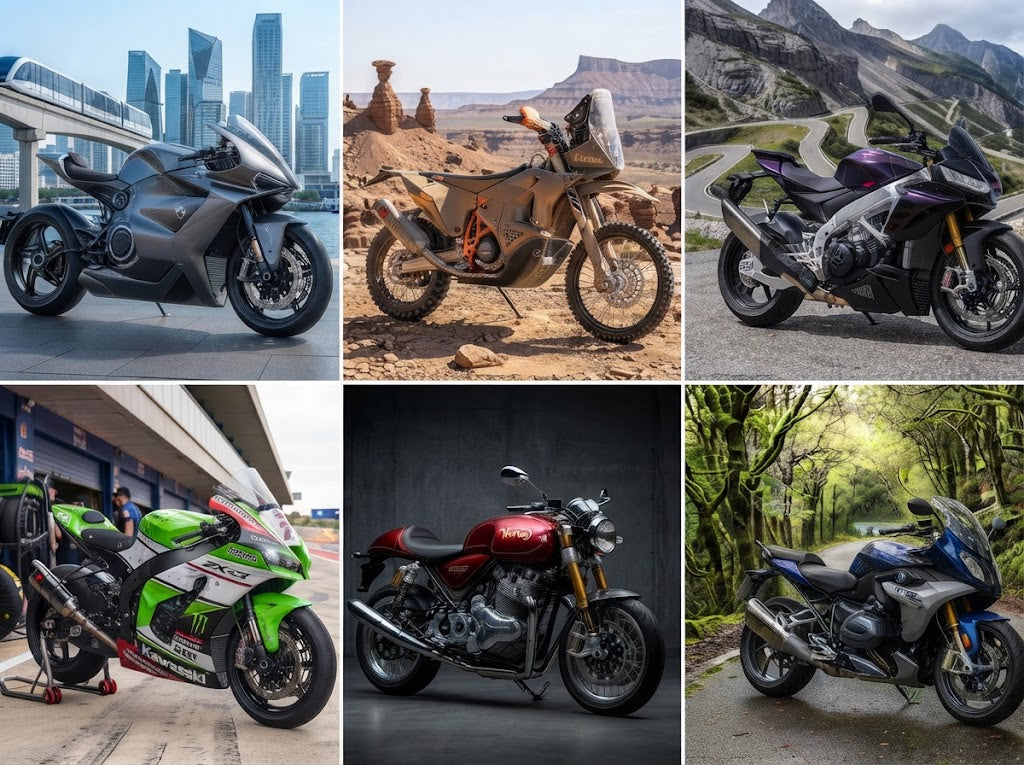
Shopping for sport motorcycles for sale? The best sportbike isn't the fastest one you can afford. It's the one that fits how you ride and what you can really spend. This 2026 buying guide helps you choose between a light 300-500cc bike, a modern middleweight like the R7 or RS 660, a 600cc supersport and the GSX-R750, with current U.S. prices for each. You'll also learn what a used sportbike should be checked for, what to budget beyond the bike, and the mistakes that cost buyers the most. It's a buying guide, not a listing site, so you can decide before you start browsing ads.
Shopping for sport motorcycles for sale? The best sportbike isn't the fastest one you can afford. It's the one that fits how you ride and what you can really spend. This 2026 buying guide helps you choose between a light 300-500cc bike, a modern middleweight like the R7 or RS 660, a 600cc supersport and the GSX-R750, with current U.S. prices for each. You'll also learn what a used sportbike should be checked for, what to budget beyond the bike, and the mistakes that cost buyers the most. It's a buying guide, not a listing site, so you can decide before you start browsing ads.
Table of contents
1. Which sportbike should you search for?
What you want |
Start your search with |
New U.S. starting MSRP (2026 model year) |
|---|---|---|
A manageable, affordable sportbike |
Yamaha R3, Kawasaki Ninja 500, Aprilia RS 457 |
Ninja 500: $5,399; R3 around the mid-$5,000s |
Sporty street riding |
Yamaha R7, Aprilia RS 660, Triumph Daytona 660 |
R7: $9,399 |
A high-revving 600cc supersport |
Kawasaki ZX-6R, Honda CBR600RR, Suzuki GSX-R600, used Yamaha R6 |
ZX-6R: $11,599; CBR600RR: $11,499; GSX-R600: $12,199 |
More engine without going to a liter bike |
Suzuki GSX-R750, Yamaha R9 |
GSX-R750: $13,249; R9: $12,499 |
Maximum acceleration |
Liter-class sportbikes (superbikes) |
Varies widely by brand |
Long-distance riding |
Sport-touring motorcycles |
Varies widely by brand |
The best value |
A well-documented used bike in clean condition |
Compare each bike, not just the model |
These are starting points, not rankings. Prices are U.S. MSRPs before destination, taxes, registration and dealer fees, and they change, so confirm them on the manufacturer’s site. Suzuki has since announced 2027 pricing of $12,499 for the GSX-R600 and $13,549 for the GSX-R750.
2. What is a sport motorcycle?
A sport motorcycle is built around responsive handling, performance, relatively low weight and a riding position that gives you precise control. That covers a huge range. A Yamaha R3 and a BMW S 1000 RR are both sport motorcycles, but they are built for very different riders. Think of “sportbike” as a family of motorcycles, not one type.
2.1 Sportbike vs. Supersport vs. Superbike vs. Street bike
- Sportbike is the broadest term, from small fully faired bikes to track-focused machines.
- Supersport usually means the high-performance 600-class bikes such as the R6, ZX-6R, CBR600RR and GSX-R600.
- Superbike usually means the liter-class (about 1,000cc) end of the market.
- Street bike is a loose term for a road-oriented motorcycle, which can include sportbikes and naked bikes.
- Sport-touring bikes blend sporty handling with comfort, range and luggage capacity.
- “Crotch rocket” is slang, not a technical category. A search for a crotch rocket motorcycle for sale usually turns up 600cc supersports, liter bikes and other fully faired sportbikes.
The useful question is not which label fits. It is what the motorcycle was designed to do.
3. Which type of sportbike is right for you?
The first decision is not horsepower. It is how you will actually ride.
- Want manageable and affordable? Start with 300–500cc bikes.
- Want sporty street performance? Look at modern middleweights.
- Want a high-revving four-cylinder? Shop the 600cc supersport class.
- Want much more acceleration? Look at liter-class bikes, but only if you have the experience to use them.
- Want to ride long distances or carry a passenger? Consider sport-touring.
- Buying used? Put condition and history ahead of the model name.
If you mostly commute and ride normal highway trips, a road-focused middleweight is often more enjoyable than an aggressive supersport. If you spend weekends on twisty roads and want something light, a 400–700cc bike gives you plenty to work with.
4. How to choose the right engine size
Displacement is a starting point, but it does not tell you how a bike feels. Weight, gearing, engine layout, chassis and electronics all change the experience. A 650cc twin and a 600cc inline-four deliver power very differently.

4.1 300 - 400cc sportbikes
The Yamaha R3 and Aprilia RS 457 let you learn braking, cornering and throttle control without a huge amount of power waiting for you. They are not beginner toys. An experienced rider can enjoy using nearly all of a light bike’s performance on a real road, which is often more fun than owning far more power than the road allows.
4.2 500 - 700cc sportbikes
This is where the market gets interesting. The Kawasaki Ninja 500 is the approachable end of the range, and the Yamaha R7, Aprilia RS 660 and Triumph Daytona 660 move toward stronger performance. For many street riders these bikes are not a stepping stone to a 1000cc machine. They are the destination, with enough performance to be exciting without constantly chasing high revs. If you are considering the Ninja 500, our guide to how fast a Ninja 500 goes covers its real-world performance.
4.3 600cc supersports
The classic formula is a high-revving four-cylinder, a light chassis, an aggressive riding position and performance-oriented suspension and brakes. A 600 can feel calm around town, then come alive as the revs climb. That is exactly what some riders want, and exactly why others prefer a middleweight twin or triple with more low- and midrange response.
4.4 750cc sportbikes
The Suzuki GSX-R750 sits between a 600 and a liter bike. It keeps the compact, 600-class handling but adds torque and acceleration. It is a logical cross-shop if you keep thinking, “I wish this 600 had a little more power.”
4.5 900 - 1000cc and larger
Liter-class sportbikes are serious machines, and bigger does not automatically mean better. For an experienced rider with the skill and the environment to use it, a superbike can be fantastic. If you are buying one because you assume you will “grow into it,” think that decision through again.
4.6 Engine layout matters as much as engine size
- Parallel twin: strong, easy low- and midrange power.
- Inline-four: smooth and eager to rev, the heart of the classic 600 supersport.
- Triple: a mix of midrange response and top-end character.
- V-twin: its own distinct feel and delivery.
When you compare two bikes, ask where the engine makes its useful power, how often you will be shifting, how easy the throttle is to manage and whether you simply like how it delivers its performance.
5. Are modern middleweight sportbikes better than an old 600?
Not always, but they deserve serious attention. Assuming an older 600 supersport is automatically the performance bargain is one of the easiest shopping mistakes to make.
- Yamaha R7: a sporty, road-usable parallel twin that suits riders who want performance without living near the top of the tachometer.
- Aprilia RS 660: sits toward the performance end of the middleweight class, with more technology than an entry-level bike but without jumping to a liter machine.
- Triumph Daytona 660: a three-cylinder with a different balance of midrange and top-end than a twin or a 600 four.
- Yamaha R9: an 890cc triple that sits above the traditional middleweight range but is not a conventional superbike. With a 2026 U.S. MSRP of $12,499, it is a key cross-shop if you want modern electronics and a broader engine character than a 600 supersport.
6. 600cc sportbike showdown: R6 vs. ZX-6R vs. CBR600RR vs. GSX-R600
If you are specifically shopping for a 600, these four deserve more attention than a generic “best sportbikes” list.
Yamaha R6. One of the defining 600 supersports, known for a high-revving engine and sharp handling. The street-legal R6 is now a used-bike purchase in the U.S., so the individual example matters enormously. A carefully maintained street R6 is a very different purchase from one that has been crashed, tracked and rebuilt. Buy the cleanest one you can find, not automatically the cheapest.
Kawasaki ZX-6R. Kawasaki has used both 599cc and 636cc versions. The current 636cc model gives better road manners and midrange than a traditional 600, which suits riders who spend a lot of time on public roads. The 2026 ZX-6R starts at $11,599 (non-ABS) and $12,599 (ABS). For more detail, see our Kawasaki Ninja ZX-6R buyer’s guide.
Honda CBR600RR. A refined, balanced take on the classic formula. It is still a performance bike, not a relaxed commuter. The 2026 model starts at $11,499, with an ABS version at $12,499.
Suzuki GSX-R600. A long-running favorite with a large used market and plenty of owner and parts knowledge. Suzuki still sells it new in the U.S., at $12,199 for 2026. An established model is not a guaranteed good used purchase, though. A cheap GSX-R600 with a poor history is still a poor purchase.
6.1 Which 600 should you buy?
There is no universal winner. Choose the R6 for sharp, high-rpm character (and inspect it carefully), the ZX-6R for supersport feel with broader road manners, the CBR600RR for a refined and balanced package and the GSX-R600 for an established platform with plenty of choice. And remember: a clean example of your second-choice motorcycle is usually a better purchase than a neglected example of your favorite.
7. What is the best sportbike for a beginner?
There is no magic displacement that makes a bike a beginner bike. Look at power delivery, weight, seat height and reach, throttle response, braking, riding position, insurance, maintenance costs and parts availability.
A 300–500cc sportbike is usually easier to learn on than a 600 supersport, but not just because the engine is smaller. A lighter bike with predictable power lets a new rider focus on braking, cornering, traffic awareness and smooth control. Good starting points are the Yamaha R3, Kawasaki Ninja 500 and Aprilia RS 457. For a deeper comparison of two older learner favorites, read Ninja 300 vs. 250R, and if you are weighing a bigger first bike, see can you start on an 800cc motorcycle.
Safety gear and a rider-training course are worth the money on any sportbike, whatever your experience.
8. How much do sport motorcycles cost?
There is no single average price. New and used bikes sit in different price bands, and used prices vary widely with year, mileage and condition.
For new bikes in the U.S., 2026 MSRPs run roughly from the mid-$5,000s for the R3 and Ninja 500, to $9,399 for the R7, to about $11,500–$12,600 for the ZX-6R, CBR600RR and GSX-R600, and $12,499 for the R9 and $13,249 for the GSX-R750. Those figures exclude destination charges, taxes, registration and dealer fees.
8.1 What to budget besides the bike
- Insurance. Sportbikes can cost more to insure than other motorcycles, and rates vary by age, location, record and model. Get quotes before you buy. Our guide to cheap motorcycle insurance is a useful place to start.
- Gear. Helmet, jacket, gloves, pants and boots.
- Tires and maintenance. See how long motorcycle tires last so a worn set does not surprise you.
- Registration, taxes and a repair cushion.
If you spend every dollar on the motorcycle, you have not finished budgeting for it.
8.2 Cheap sportbike vs. cheap to own
A $4,000 bike that immediately needs tires, brakes, a chain and sprockets and a major service can cost more in the first few months than a $5,500 bike that was maintained properly. When a sportbike is cheap, ask why. Sometimes the seller just wants it gone. Sometimes it needs normal maintenance. And sometimes the price is hiding a title problem, crash history or a mechanical issue.
9. Should you buy a new or used sportbike?
Buying new gives you a known history, current equipment and, depending on the maker, warranty coverage.
Buying used opens up far more bikes, including models no longer sold as new street bikes, such as the road-going R6. It also requires a different mindset: you are not choosing a model, you are choosing one specific motorcycle. A well-maintained older bike can be a better purchase than a newer one that has been crashed, modified and neglected.

9.1 Dealer vs. private seller
Neither is automatically better. A dealer may offer more structure, an inspection or a warranty depending on the market. A private seller may offer a lower price and detailed knowledge of the bike’s history. Compare what you actually get. A slightly pricier bike with good records, a clean history and a thorough inspection beats a cheaper one with unanswered questions.


10. How to judge a sportbike listing
Before you drive across town, study the listing. Look for clear photos from several angles, the VIN, title information, mileage, service records, tire and chain condition, disclosed modifications and damage, the reason for selling and how the bike was used.
Be wary of beautiful photos with almost no information. “Runs perfect, serious buyers only” tells you nothing. A seller who can explain when the tires, battery, fluids and major services were done gives you something to evaluate. Compare several listings of the same model, and if one is dramatically cheaper than the rest, ask why.
11. What to inspect on a used sportbike
The model tells you what a motorcycle is supposed to be. The inspection tells you what this motorcycle actually is. If you are not comfortable judging mechanical condition yourself, pay a qualified motorcycle mechanic for a pre-purchase inspection.
- Crash damage. Check the frame, swingarm, fork tubes, wheels, engine covers, foot controls, bars, levers, subframe and fairing mounts. Mismatched bodywork, fresh paint or suspiciously new plastics can signal prior damage. A scratched fairing is not automatically a dealbreaker; deeper damage is.
- Cold start. Inspect before the seller warms the bike up. Listen for unusual mechanical noise and watch the exhaust.
- Leaks. Check around the engine, cooling system and fork seals.
- Suspension. Look for leaking seals, damaged fork tubes and neglect. Suspension affects braking, stability and cornering confidence.
- Chain and sprockets. Look for rust, damaged teeth, tight spots and excessive wear.
- Tires and brakes. Check tread, tire age, discs, pads and controls, and factor any immediate replacement into the price.
- Steering and wheels. Move the bars through their range and check the wheels for impact damage.
- Electrical. Test lights, indicators, horn and dash, and inspect any aftermarket wiring carefully.
- VIN and title. Verify the VIN and check for salvage, rebuilt, theft or other issues. A questionable title can make a bike hard to insure, register or resell.

11.1 Is low mileage really that important?
It matters, but it is not everything. A low-mileage bike with poor storage, old tires, neglected fluids and an unknown history is not automatically better than a higher-mileage bike that was properly maintained. Ask how it was stored, how often it was serviced, how many owners it has had, whether it was crashed or tracked, what was modified, and how old the tires and battery are. Treat mileage as one piece of evidence.
11.2 What about a used stunt bike?
Be especially careful. A stunt-used bike may have been dropped repeatedly or heavily modified. Look for repeated crash damage, fresh bodywork hiding older damage, modified controls, altered wiring or cooling, frame or subframe damage, and a heavily modified engine or ECU. A stunt history does not make a bike worthless, but you need to understand it before treating the bike as an ordinary used street motorcycle.
12. Are sportbikes comfortable, and can you tour on one?
Sportbikes trade comfort for control, but many riders do cover real distance on them. A middleweight with a more relaxed riding position suits commuting and weekend trips, while a pure supersport is tougher over long days. If long rides, passengers and luggage are part of the plan, consider a sport-touring motorcycle instead. Our guide to two-seater motorcycles explains what changes when you carry a passenger.
Luggage is the usual obstacle on a sportbike, because the tail section and exhaust leave little room. Model-specific motorcycle luggage and saddlebags are designed around a bike’s mounting points, so they fit securely and keep weight away from hot exhaust parts. If you ride a Ninja or ZX-6R, browse our Kawasaki saddlebags, and see our guide to the best luggage bags for Kawasaki motorcycles. For planning longer trips, read our tips for long-distance motorcycle riding.
13. Street riding vs. track riding
A track-focused bike is not automatically the best street bike. On a track you can use aggressive suspension settings, high-rpm power, strong brakes and extreme cornering ability. On the street you care more about midrange torque, ergonomics, low-speed behavior, heat, fuel range, visibility, maintenance and practicality. That is why modern middleweights are so appealing: plenty of performance without feeling like you are riding a race bike to the grocery store. Weight also affects handling and parking, so it is worth checking how much a motorcycle weighs before you commit.
14. Common sportbike buying mistakes
- Buying the most powerful bike you can afford. More engine does not mean a better ride.
- Spending the whole budget on the bike. Leave money for gear, insurance, registration and repairs.
- Assuming low mileage means excellent condition. It does not.
- Ignoring ergonomics. A mechanically perfect bike can still be wrong for your body.
- Buying on looks alone. Looks should help you choose between good bikes, not convince you a bad one is worth it.
- Ignoring modifications. Some are harmless; others reveal a bike that was crashed, raced or heavily tuned.
- Assuming every 600 is the same. The R6, ZX-6R, CBR600RR and GSX-R600 have different personalities and model-year histories.
- Forgetting insurance. It can change what a sportbike really costs to own.
15. A simple 8-step process for buying a sport motorcycle
- Set your real budget, including taxes, registration, insurance, gear and immediate maintenance.
- Decide how you will ride: commuting, weekend rides, touring, track days or a mix.
- Pick your engine character: twin punch, inline-four rush or triple versatility.
- Choose new or used. If used, condition becomes a main buying criterion.
- Build a short list of three or four bikes. You do not need twenty.
- Compare actual motorcycles for sale by year, mileage, service history, modifications, title and condition.
- Inspect before you buy, and consider a pre-purchase inspection.
- Keep money in reserve for tires, service and surprises.
16. Frequently Asked Questions
What is the best sportbike for a beginner?
The Yamaha R3, Kawasaki Ninja 500 and Aprilia RS 457 are common starting points because they are light and have manageable power. Fit, confidence and training matter as much as the model.
What is the cheapest new sportbike?
Among the models covered here, the Ninja 500 starts at $5,399 and the R3 sits around the mid-$5,000s before destination, taxes and fees. Used prices vary widely.
How much does a sportbike cost?
New U.S. MSRPs in this guide run from about $5,400 to about $13,500. Used prices depend on year, mileage and condition. Budget for insurance, gear and maintenance as well.
Is a 600cc sportbike good for a beginner?
It can be, but it is usually more demanding than a 300–500cc bike because of its high-revving power delivery and aggressive riding position. Honest self-assessment and training matter more than the number on the fairing.
Is 1000cc too much for a sportbike?
Not for an experienced rider with the skill and environment to use it. For most riders on public roads, a smaller bike is more usable and more fun.
How many miles is too many for a used sportbike?
There is no single number. A well-maintained high-mileage bike can beat a low-mileage one that was neglected, so look at service records, tires, storage and crash history together.
Is it a good idea to buy a used sportbike?
Yes, if you buy the specific bike rather than the model. Check the VIN and title, look for crash damage and consider a professional inspection.
What is a crotch rocket?
It is slang for a sportbike, usually a fully faired performance model such as a 600 supersport or a liter-class bike. It is not a technical category.
Are sportbikes expensive to insure?
They can be, depending on your age, location, record and the model. Get quotes for the exact bikes on your shortlist before you buy.
Can you carry luggage on a sportbike?
Yes. Model-specific saddlebags, tail bags and tank bags can add practical storage if they are mounted securely and kept clear of the exhaust.
17. Final advice
The best sport motorcycle for sale is not automatically the newest, fastest or most expensive. Maybe it is a lightweight R3 or RS 457, the road-focused R7, RS 660 or Daytona 660, a clean used ZX-6R, CBR600RR, GSX-R600 or R6, the extra engine of a GSX-R750 or R9, or a sport-touring bike that matches how you really ride. The important part is knowing why you are choosing it. Sit on the bike, think about your roads, check insurance and maintenance costs, and if you are buying used, look hard at the specific bike’s history and condition.
When a bike fits your riding, stays within your real budget and has a clean history and sound mechanical condition, you are much closer to a smart purchase than any generic “top sportbikes” list will get you.



Leave a comment
All comments are moderated before being published.
This site is protected by hCaptcha and the hCaptcha Privacy Policy and Terms of Service apply.