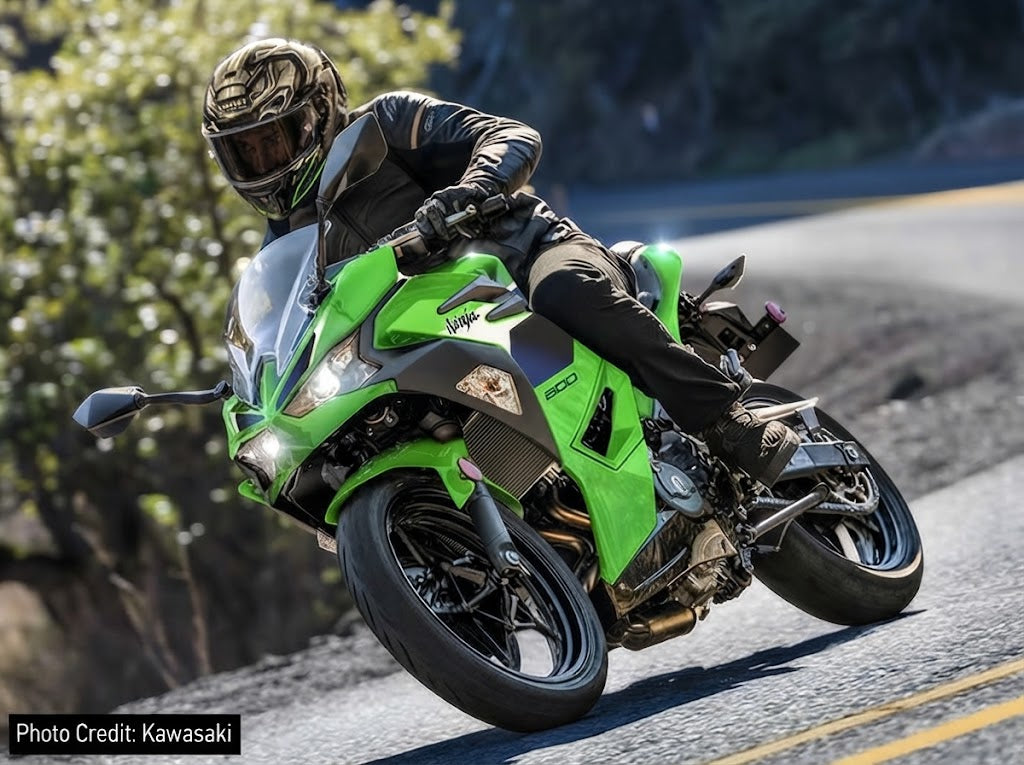
How fast is the Kawasaki Ninja 500? About 115–120 mph in stock form, and it gets to 60 mph in roughly four seconds. Kawasaki doesn't publish an official top speed, so we show where the real-world numbers come from and why riders report different results. Inside: horsepower (51 hp or 45 hp?), 2026 specs and pricing, MPG, the older EX500 and Ninja 500R, the "limiter" question, and whether it can carry a passenger.
The Kawasaki Ninja 500 top speed is about 115–120 mph (roughly 185–193 km/h) in stock form, and 118 mph is the figure most often cited. Kawasaki doesn't publish an official top-speed number, so treat that as a reported figure, not a factory spec.
There are two different bikes behind the name. The current Ninja 500 is a 451cc parallel twin sold from 2024. The older Kawasaki EX500 / Ninja 500R is a 498cc twin built from 1987 to 2009. Both land in a similar speed range, which is why the searches get mixed together. This guide covers both.
Table of contents
1. How Fast Does a Kawasaki Ninja 500 Go?
| Bike | Years | Engine | Typical top speed |
|---|---|---|---|
| Ninja 500 (current) | 2024–present | 451cc parallel twin | About 115–120 mph |
| EX500 / Ninja 500 / Ninja 500R | 1987–2009 | 498cc parallel twin | About 110–118 mph |
For a stock current-generation bike, use 115–120 mph as the realistic range. Owners report anything from about 110 mph to the low-to-mid 120s, and individual results depend on conditions.

1.1. Why does the Ninja 500 top speed vary?
- Wind: a headwind can cost you several mph.
- Rider position: tucked in behind the screen is faster than sitting upright.
- Road and conditions: gradient, elevation and temperature all matter.
- Bike condition: tire pressure and wear, chain, and fuel load.
- Measurement: a speedometer reading isn't GPS speed. Our guide on how accurate motorcycle speedometers are explains why the dash usually reads high.
So don't promise anyone exactly 118 mph. Expect 115–120 mph in good conditions, and treat anything higher as one rider's result.
2. How Fast Is a Ninja 500 From 0–60 mph?
Most tests put the Ninja 500 at about four seconds from 0–60 mph. Launch, surface and rider weight change that by a few tenths.
Acceleration is strong at normal speeds. It tapers off past 100 mph, because near the top most of the engine's power goes into pushing through the air. That's why the bike feels quick without matching a 600cc supersport.
3. Kawasaki Ninja 500 Specs (2026)
| Specification | Ninja 500 |
|---|---|
| Engine | 451cc liquid-cooled DOHC parallel twin |
| Power | 51 hp @ 10,000 rpm |
| Torque | 31.7 lb-ft @ 7,500 rpm |
| Transmission | 6-speed, chain drive |
| Curb weight | About 373–382 lb, depending on trim |
| Seat height | 30.9 in |
| Wheelbase | 54.1 in |
| Fuel capacity | 3.7 gal |
| Tires | 110/70-17 front, 150/60-17 rear |
| 2026 U.S. MSRP | $5,399 non-ABS, $5,799 ABS, $6,499 SE ABS (before destination) |
Kawasaki increased displacement over the Ninja 400 with a longer stroke, 58.6mm on the same 70.0mm bore. The Ninja 400's top speed is usually quoted around 116 mph, so the 500 is a small step up rather than a new category.

3.1. Ninja 500 horsepower: 51 hp or 45 hp?
Kawasaki's U.S. figure is 51 hp at 10,000 rpm. You'll also see about 45 hp quoted, mostly in UK and India listings. Those markets publish different power figures for the same 451cc engine, and the UK version is positioned as an A2-licence-friendly bike. For a U.S. bike, 51 hp is the number to use. Either way, the top-speed range doesn't change much, because drag matters more than a few horsepower at the top end.
4. Ninja 500 Top Speed Without a Limiter
Kawasaki doesn't publish a limiter spec, and there is no Kawasaki statement confirming an electronic speed limit on U.S. bikes. Some regional listings quote about 190 km/h, which is roughly 118 mph. That matches the usual real-world number.
Don't assume that removing a "limiter" gets a 115–120 mph bike to 130. At the top end, aerodynamic drag decides the result. Exhaust, intake, ECU or gearing changes can improve throttle response and acceleration, but they rarely add much to maximum speed. If you're weighing modifications, our guide to motorcycle performance mods that actually work is a good place to start.


5. How Fast Is the Kawasaki EX500 / Ninja 500R?
The older bike is about as quick. The EX500 / Ninja 500R top speed is roughly 110–118 mph. One period road test of the 1994-generation bike recorded a 118 mph top speed and a 12.98-second quarter mile at 99 mph.
5.1. Kawasaki EX500 / Ninja 500R specs at a glance
- Names: Kawasaki sold it as the EX500 until 1993, renamed it Ninja 500 in 1994, and added the "R" in 1998. Overseas it's also called the GPZ500S.
- Production: 1987 to 2009. 2009 was the last year.
- Engine: 498cc liquid-cooled DOHC parallel twin with dual carburetors and a six-speed gearbox.
- Power: period listings quote about 60 hp at the crank. Dyno tests put it around 50 hp at the rear wheel.
- Weight: the 1994–2009 bikes weigh about 437 lb wet, around 55–60 lb more than the current Ninja 500.
- Wheels and brakes: the 1994 redesign moved from 16-inch to 17-inch wheels and added a rear disc. That makes tires much easier to find.
5.2. Does the model year matter (2001, 2002, 2003, 2005, 2008)?
Mechanically, very little changed across the 1994–2009 generation. A 2001 Ninja 500, a 2003 Kawasaki Ninja 500R, a 2005 Ninja 500R and a 2008 Ninja 500 are essentially the same machine apart from graphics and wear. Their top speeds are similar too, so condition, tires, chain and carburetor tuning matter far more than the year.
5.2.1. 1987–1993: EX500
The original bike. It has 16-inch wheels and a rear drum brake, and it weighs less than the later models (about 409 lb wet). Parts are still easy to find, but tire choice is narrower.
5.2.2. 1994–1997: Ninja 500
The redesigned bike with 17-inch wheels and a rear disc. If you want an older Ninja 500 with modern tire options, this is where it starts.
5.2.3. 1998–2009: Ninja 500R
The "R" badge arrived in 1998. A 2002 EX500 or 2005 Ninja 500R shares this chassis and engine. When buying used, check the chain and sprockets, carb sync, coolant and tires. If you're comparing it with a modern bike, the main differences are the current bike's fuel injection and lighter weight. Our guide to fuel-injected vs carbureted motorcycles explains what that means day to day, and the Kawasaki maintenance schedule covers upkeep.
6. Kawasaki Ninja 500 MPG
Kawasaki doesn't publish an EPA fuel-economy rating for motorcycles. Owners commonly report about 50–60+ mpg, and the older EX500 was known for roughly 50 mpg. Steady cruising gets better mileage than hard acceleration or sustained high speed. For more ways to stretch a tank, see these mods and methods to increase motorcycle fuel economy.

7. Is the Kawasaki Ninja 500 a Good Beginner Bike?
Yes, for most new riders. It's light, the power is easy to manage, the seat is moderate, and ABS is available. The performance is real, though, because a bike that can reach about 120 mph can still get a new rider into trouble.
For a full breakdown, read our Ninja 500 beginner-bike guide. If you're still choosing, how to choose your first motorcycle is the place to start. For a quick comparison, how fast a 250cc motorcycle goes shows how much extra the 500 gives you.
8. How Does the Ninja 500 Handle Highway Riding?
At 65–75 mph it's comfortable, with a full fairing and a six-speed box. It still has reserve above 80, though the engine works harder and wind or a passenger is more noticeable. If highway riding is new to you, read our tips on learning to ride a motorcycle on the freeway. It also helps to know when to shift gears and at what RPM.
9. Ninja 500 vs. Ninja 400 vs. Ninja 650
9.1. Ninja 500 vs. Ninja 400
The Ninja 500 replaced the Ninja 400 for 2024. The 500 gives a little more engine and the same easy character.
9.2. Ninja 500 vs. Ninja 650
This is the step up. The 650 makes more power and torque and is better for regular highway or two-up riding, but it costs more (2026 MSRP $7,599 non-ABS) and is less forgiving. If you're still learning, the Ninja 500 is the easier bike. If you already know you'll ride two-up or carry luggage often, look at the 650.
10. Can Two People Ride a Ninja 500?
Yes, for occasional rides. It isn't a dedicated two-up bike, though. Regular long trips with a passenger and luggage strain the suspension, the passenger perch and the engine's reserve. If a passenger is central to why you're buying, our guide to choosing a two-seater motorcycle walks through what to look for, and our passenger etiquette rules cover how to ride well together.
10.1. What luggage works on a Ninja 500?
The Ninja is a sportbike, so luggage options are limited. Read are saddlebags on a sports bike a good idea before you buy anything. Many riders use soft luggage that straps to the passenger seat, such as a motorcycle backpack or sissy bar bag. Our sissy bar bag sizing guide covers fit and mounting.
11. Is the Ninja 500 Considered a Sportbike?
Yes. It has sportbike styling and a full fairing, but the riding position is relaxed and the power is gentle compared with a 600cc supersport. If you want to understand the category, read what a crotch rocket is.
12. Ninja 500 Top Speed FAQ
What is the top speed of a Kawasaki Ninja 500?
About 115–120 mph for the current bike, with 118 mph commonly cited. Kawasaki publishes no official figure.
How fast does a Ninja 500 go in km/h?
Roughly 185–193 km/h.
What is the Kawasaki EX500 or Ninja 500R top speed?
About 110–118 mph. A period road test recorded 118 mph.
Does the Ninja 500 have a speed limiter?
Kawasaki doesn't state one. Some regional listings mention about 190 km/h, but there is no Kawasaki confirmation.
How fast is a Ninja 500 from 0–60?
About four seconds, depending on rider and conditions.
How much is a Ninja 500?
The 2026 U.S. MSRP is $5,399 for the base model, $5,799 with ABS and $6,499 for the SE ABS, before destination and dealer fees.
13. So, How Fast Is the Ninja 500?
Plan on about 115–120 mph from a stock current Ninja 500, and about 110–118 mph from an older EX500 or 500R. The more useful point is what that speed says about the bike. It's light, quick enough to stay fun after the beginner stage, and practical every day, though it isn't built for heavy two-up touring. If that's your plan, start with our two-seater motorcycle guide.



Leave a comment
All comments are moderated before being published.
This site is protected by hCaptcha and the hCaptcha Privacy Policy and Terms of Service apply.