Table of Content
The experience of motorcycling is one of the most exciting things that can happen to new riders. Also, selecting the right motorcycle to ride may be an overwhelming process. There are just too many kinds of motorcycles on the market. So, how do you know which one best suits your needs as a beginner?
The main secret of choosing a safe bike and making a good decision is to know what factors to take into consideration before buying your first motorbike. In this beginner rider’s guide, we will take you through what you should know when choosing your first motorcycle.
1. The Importance of a Correct Motorcycle Choice
As a beginner, it is not only necessary to find the most fashionable or the most powerful motorcycle. Instead, your preferences should be safety, comfort, and gaining riding confidence. Motorcycle riding is a skill. The riding experience and learning to ride on an appropriate bike can make a lot of difference as to how fast you learn and how safe you feel on the road.
The best motorcycle will enable you to form good riding skills, maintain control, and reduce the chances of accidents. When you are just starting to ride, you do not require the most powerful machine to ride on the road. Instead, consider a bike that is easy to ride. Also, your first motorbike must enable you to develop your riding skills progressively.
2. Seat Height: The Comfort and Control Key
Seat height is one of the most significant factors to keep in mind while buying your first beginner motorcycle. Seat height is the height of the saddle above the ground. This will be crucial in finding out how comfortable and confident you would be on the bike.
Touching the ground with both feet when seated on the bike is crucial to new riders. It gives balance and control when braking or parking. When you cannot touch the ground, it may be challenging to manage the motorbike when you are new to it.
One thumb rule is to get a bike on which you can rest the balls of your feet on the ground while sitting. This will make you much safer, especially when braking and accelerating. Some of the low-end motorcycles have an adjustable seat height, which may be a good choice to achieve a perfect fit.
Must Read: Top 5 Best Cruisers for Beginners in 2025
3. Engine Size and Power: Make the Right Choice
Being a novice rider, one is tempted to check out the most powerful bikes. Nonetheless, high-performance bikes are usually more difficult to manage, and they need great skills to ride them safely. When getting your first bike, it is always advisable to get a motorbike of moderate power, as this will make learning easy and fun.
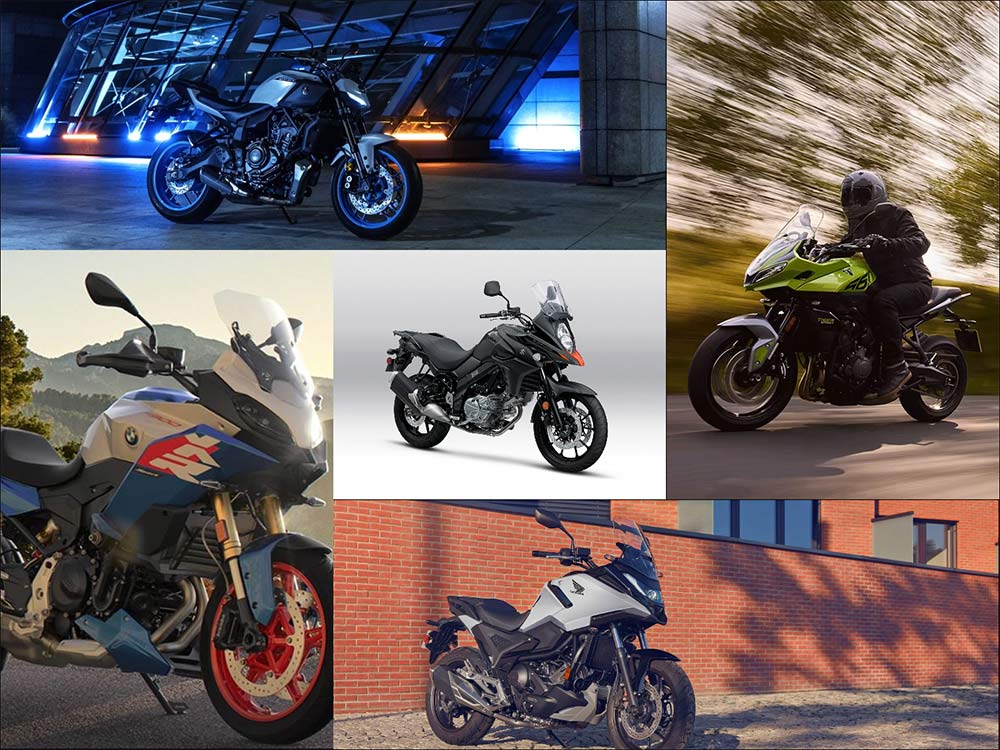
The majority of entry-level motorcycles are within 250 cc to 500 cc of engine size. These bikes are not too powerful to be used by beginners, but they are powerful enough to enable you to ride on highways and busy roads with comfort. Other common starter bikes are the Honda Rebel 300, Yamaha V-Star 250, Kawasaki Ninja 400, Yamaha MT-03, and Honda CB300R. All of these top beginner bikes are great in terms of power, control, and user-friendliness.
Considering power, you should not think that the higher the power, the higher the fun, particularly when you are a new rider. An overpowering motorbike is intimidating, and it is more likely to be challenging to control. Rather, look at a bike that will allow you to practice your skills and slowly gain confidence on the road.
Must Read: Can I Start on an 800cc Motorcycle?
4. Weight and Handling: Light and Agile
Another aspect to be considered is the weight of the motorcycle, particularly among beginners. The larger bikes are also quite bulky to maneuver, especially for shorter or new riders. When you are still a learner, you need to get a bike that is light and easy to maneuver so that you can turn and stop very quickly when the need arises.
Lightweight motorbikes are easy to handle and maneuver at low speeds. Thus, they make a perfect option for new riders. The Honda Rebel 300, in particular, has a lightweight frame and smooth handling, making it a perfect choice for a beginner.
When selecting your bike, sit on it and move it around, and see how it feels. Ensure that you can balance the bike and maneuver it easily. You must be in a position to maneuver the bike without feeling that it is heavy or bulky.
5. Safety Features: Safety Should Be Number One
Safety when riding motorcycles is of utmost importance for all riders. However, if you are new to riding, you have to be more careful with your actions and decisions. Seek entry-level motorcycles that have modern safety features installed, like Anti-lock Braking System (ABS). This feature does not lock up the wheels when hard braking is applied. Thus, the risk of skidding is reduced. ABS comes in handy on wet or slippery surfaces.
Traction control is another significant feature that aids in keeping the vehicle balanced on a slippery or uneven road by ensuring that the wheels do not slip. It is an especially valuable feature for those who are starting out on a bike.
Also, there are bikes with adjustable suspension systems, which contribute to the comfort of the ride and control, particularly on uneven surfaces or on bumpy roads. Although these features may increase the price of the bike, they could mean a lot to you in terms of your safety and comfort.
6. Riding Position: It Is All About Comfort
The way you sit on a motorcycle is a massive factor that determines the comfort of your ride. In case you intend to ride a long distance, then comfort is even more essential. There are two basic riding positions:
Sportbike Position / Aggressive Riding Position : This is a more forward riding position. Riders have to sit while leaning forward to grab the handlebars. Also, the foot controls are backward-mounted, enabling kinked-up legs.
Cruiser Position / Comfortable Riding Position : This is a more relaxed, upright riding position that imposes less stress on your back and wrists. The foot controls are also forward-mounted, ensuring enough legroom space.
The cruiser riding position is generally more comfortable for novice riders. It is less stressful on your back and arms, in case you intend to ride for long hours. Cruiser-type bikes such as Yamaha V Star 250 and Honda Rebel 300 have a more upright sitting position, which makes them the best bikes to start with.
But in case you want a sportier bike, you can also find plenty of sportbikes with more comfortable ergonomics, like the Kawasaki Ninja 400. All you need to remember is that speed and style come later; comfort and control are more significant at first.
7. Maintenance and Costs: Don’t Forget the Budget
It is also easy to get carried away by the joy of purchasing your first motorcycle. However, remember to factor in the cost of maintenance and the long-term costs associated with owning and operating a motorbike. The ownership of the motorcycle is also accompanied by a number of responsibilities, such as regular oil changes and tire replacements, as well as replacement of parts. Not all bikes are easy to maintain and cost less to repair.
Also, motorcycle insurance will differ in cost, depending on the make and model of your bike and your riding record. You will also find that, as a novice, you will have to pay higher premiums on your insurance until you have attained more experience as a rider. When planning your budget, you should consider the kind of bike you want to buy because it will determine the amount of money you will pay for insurance.
Finally, there is the price of safety equipment. You need a good helmet, a riding jacket, gloves, and boots to protect and keep you comfortable. They are a form of safety investment, and hence, you should not compromise on their quality.
8. Test Ride: Learn How the Bike Feels to Ride
After you have reduced your choices, you can go ahead and test ride the motorcycle. One of the most effective methods of establishing whether the bike fits you is through testing. When going for the test ride, you will need to consider a few things:
How do you feel on the bike?
Do you find it easy to access the handlebars and the controls?
Do you feel confident or not when accelerating or braking the bike?
What is its low-speed behavior?
Ensure that you are comfortable with the bike and that you have a sense of control over it at both low and high speeds. Do not fear to ask the dealer or seller questions to know about the features of the bike and any special maintenance needs. The aim is to make sure the bike fits well with your body and style of riding.
9. Take a Motorcycle Safety Course
One of the most efficient ways to learn how to ride safely on a motorcycle is to take a motorcycle safety course before hitting the road. The courses are meant to accommodate novice riders, and they will instruct you on the following basic skills:
The control of the throttle, brakes, and clutch.
Turning and cornering.
The way to move across the traffic and obstacles safely.
Most states have safety classes that also give you an opportunity to test ride a bike in the course. It is a wonderful chance to obtain some experience and learn more about riding on the road without going out on the road.
10. Conclusion: Choose Your First Motorcycle with Confidence
Selecting the first motorcycle is a fun experience, but one should make the right choice. When we take into consideration such things as seat height, engine size, power, safety features, and comfort, you can find a bike that fits your needs and makes you feel confident that you will be able to ride it safely.
Keep in mind that it is always advisable to ride on a motorcycle that is easy to manage, especially as a novice rider. Train yourself and enhance your confidence gradually. When you are prepared, you can shift to a more powerful bike. The correct bike and the right attitude towards riding will enable you to have a pleasant and safe experience.



Leave a comment
All comments are moderated before being published.
This site is protected by hCaptcha and the hCaptcha Privacy Policy and Terms of Service apply.