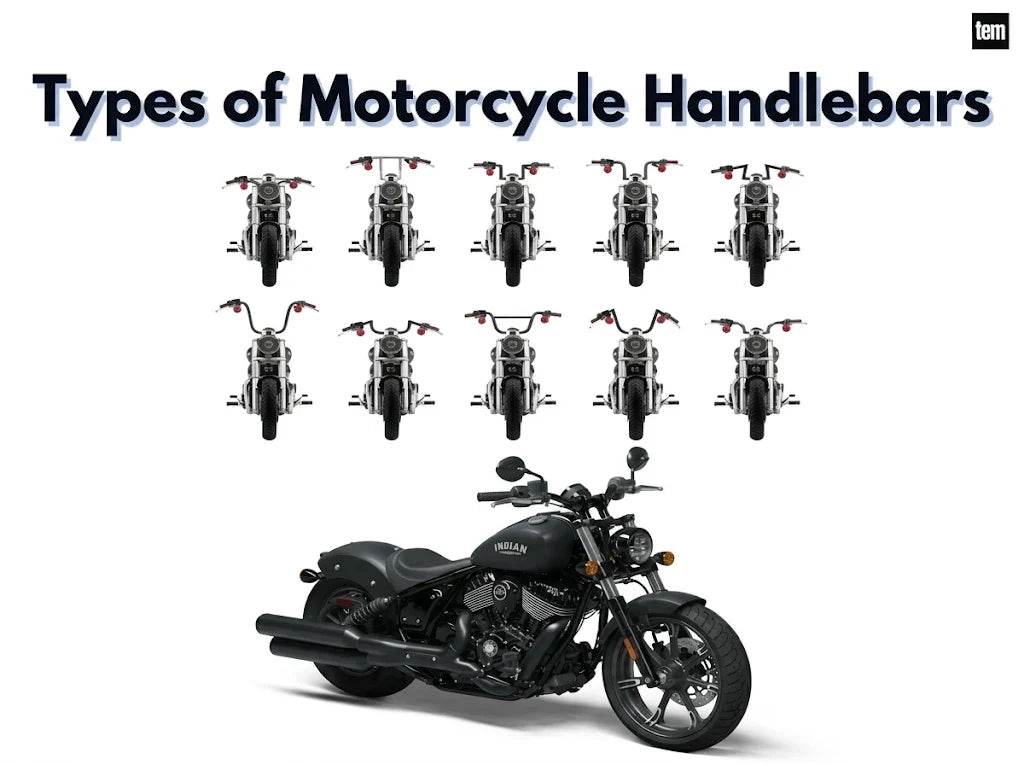
Not sure which motorcycle handlebar fits you? This guide walks through ape hangers, T-bars, beach bars, drag bars, clip-ons, Z-bars and stock bars. For each one you get the riding feel, the trade-offs, and the kind of rider it suits. It also covers grip-height laws, cable length, and the mistakes people make when swapping bars. Read it before you buy.
Table of contents
Your handlebars are the one part of the bike you never stop touching. They decide where your hands, shoulders and lower back sit for the whole ride, and they say a surprising amount about you before you’ve taken your helmet off. Ape hanger riders get teased for airing out their armpits, beach bar riders for moving at a leisurely pace, and clip-on riders for looking ready to qualify at a track while stuck in traffic. All of it is good-natured, and a little of it is true.
This guide goes through the motorcycle handlebar types riders compare most. For each one you’ll see how it feels, where it works, where it doesn’t and who it suits, so you can choose by how you actually ride.
1. Quick answer: the main motorcycle handlebar types
- Ape hangers: tall bars that put your hands at or above shoulder height.
- T-bars: a drag-style bar on built-in risers, common on baggers.
- Beach bars: low, wide and swept back for a relaxed posture.
- Drag bars: flat, low-rise bars with a forward lean.
- Clip-ons: two short bars clamped to the fork tubes, for sport riding.
- Z-bars: angular, welded bars with a custom look.
- Stock bars: the handlebars the factory fitted.
If you remember one rule, make it this one: choose for your riding position first and your looks second.
2. What a handlebar actually changes
A handlebar changes three things:
- Reach: how far forward you lean to hold the grips.
- Rise: how high your hands sit compared with your shoulders.
- Pullback: how far the grips sweep back toward you.
Low, forward bars put weight on your hands and wrists and connect you to the front wheel. Tall, swept-back bars sit you upright, which looks relaxed but loads your shoulders and arms differently. Neither is wrong, they just suit different bikes and riders. If you want the physics of how height changes weight distribution and handling, we cover it in how handlebar height affects motorcycle handling.


i. Ape hangers: the hands-up classic
Ape hangers lift the grips to roughly shoulder height or higher. Shorter versions are usually called mini apes, and full-size apes generally start around 12 inches of rise.
How they ride: You sit upright with your arms raised. On a long straight highway that can feel open and comfortable. In parking lots and slow turns it takes more effort.
The catch: Keep your hands above heart level for a long stretch and your fingers can tingle or go numb. Tall bars also make low-speed handling harder, which is why beginners are usually told to wait before going tall. Many ape hangers also need longer cables and brake lines.
Check your state’s law: Grip height rules vary. New Jersey, for example, prohibits grips higher than the operator’s shoulder height when seated, and Arizona has a similar shoulder-height rule. Other states measure a set distance above the seat. Rules change, so confirm your state’s current limit before you buy. For sizing, pullback and fit, see our guide to buying ape hangers, and for inspiration, our roundup of Harley-Davidson motorcycles with high handlebars.
Best for: riders who want the full chopper look, ride mostly open roads, and have the experience to handle the extra height.

ii. T-bars: tall, tough and bagger-friendly
A T-bar is essentially a drag bar welded onto its own risers, so the top bar forms a “T.” It lifts your hands higher than a plain drag bar and gives a more upright, relaxed posture than leaning forward over low bars.
How they ride: Upright and planted. They’re a common choice on modern baggers because they give a show-bike profile without going full ape hanger.
The catch: Swapping to T-bars often means longer cables, brake lines or wiring, so the price of the bar isn’t the whole cost. Wide, tall bars also take up more room in tight spaces.
Best for: riders who want a tall, aggressive front end on a bagger or custom bike and have budgeted for the extra hardware.

iii. Beach bars: the “nowhere to be” bar
Beach bars are low and wide, then sweep back toward the rider, so your hands sit comfortably in front of you instead of reaching up or leaning forward.
How they ride: Relaxed. They suit traditional cruisers and Softail-style bikes where you want to sit back and let the miles roll by. Slow-speed handling is much friendlier than on tall bars.
The catch: They’re wide, and they’re built for comfort, not for aggressive sport riding.
Best for: easy cruising, relaxed daily riding and anyone who likes a classic low, wide look.

iv. Drag bars: straight lines and a forward lean
Drag bars are flat, low and fairly wide, with little rise (usually an inch or a few) and almost no pullback. The name comes from drag racing, where the rider stays tucked forward.
How they ride: Sporty and raw. Your weight shifts forward onto your hands and wrists. They give a clean, low look, and because they sit close to stock height, stock cables often still reach.
The catch: The forward lean can wear on your wrists and lower back over long rides, and the reach to the controls can feel long. A common fix is a set of handlebar risers, which raise the bars without a full swap. If you’re weighing that route, our post on the pros and cons of riser handlebars explains the trade-offs.
Best for: riders who want a stripped-down, low stance and don’t mind leaning forward.

v. Clip-ons: sport bike territory
Clip-ons are two short, separate bars that clamp onto the fork tubes (some designs mount at the top triple clamp). They put you low and forward over the tank, the position sport bikes are designed around.
How they ride: Tucked and focused, with a strong feel for the front end at speed. In traffic and on long commutes, the weight on your wrists and the bend in your back add up quickly.
The catch: They’re the least comfortable choice for relaxed daily riding, and they rarely make sense on a cruiser or tourer.
Best for: sport riders, track-day riders and café-style builds where posture and speed matter more than comfort.

vi. Z-bars: sharp angles, custom attitude
Z-bars are built from straight, mitered sections welded at sharp angles, so the bar rises, turns and runs out to the grips. They’re popular on narrow choppers and custom builds, and the rise height varies from short to tall.
How they ride: Compact and narrow compared with wide bars, so they suit slimmer bikes. A short Z-bar and a tall one feel very different.
The catch: Their appeal is mostly visual, so decide how much rise you actually want. A Z-style bar taller than about 12 inches is generally treated as an ape variant, which brings the same legal checks as ape hangers.
Best for: custom and chopper builds where an angular front end is part of the design.

vii. Stock bars: the underrated starting point
Stock bars are what the manufacturer designed for your bike, with the geometry, cable lengths and controls all matched. They’re often dismissed as boring, but cables fit, controls line up and the bike behaves predictably.
The catch: They’re built for an average rider, so if you’re particularly tall or short, they may not suit you. Our guide to handlebars for short arms covers that situation in detail.
Best for: new riders, commuters and anyone still working out what they’d change. Living with stock bars for a while tells you.

3. Which handlebar is right for you?
| Handlebar | Rise | Posture | Best use |
|---|---|---|---|
| Ape hanger | Tall (about 12"+) | Upright, hands high | Open-road cruising, chopper look |
| T-bar | Tall | Upright, bold | Baggers, show builds |
| Beach bar | Low | Relaxed, swept back | Easy cruising |
| Drag bar | Very low | Forward lean | Sporty, stripped-down builds |
| Clip-on | Very low | Tucked, head down | Sport and track riding |
| Z-bar | Varies | Narrow, angular | Custom and chopper builds |
| Stock | Factory | Matched to the bike | Daily riding, beginners |
Treat this as a guide, not a rulebook. Your height, arm length and the bike’s geometry all change how a bar feels.
4. What to check before you swap
- Clamp diameter. Common sizes are 7/8 inch, 1 inch and 1 1/4 inch. Many Harleys use 1 inch and many metric cruisers use 7/8 inch, so confirm yours.
- Your height and arm length. The same bar can sit at chest height on one rider and shoulder height on another.
- Cables, brake lines and wiring. Taller or more swept-back bars often need longer ones.
- Turning clearance. Make sure the bars reach full lock without touching the tank or fairing.
- Local law. Height rules differ by state.
Our Motorcycle Handlebars 101 Guide walks through mounting and sizing in more detail.
5. Handlebars at Viking Bags
If you’re ready to shop, start with the motorcycle handlebars collection. According to the product pages, the bars are stainless steel, V-shaped with a flattened bottom, about 33.6 inches wide, and built as a single piece with no assembly required. They’re hollow so wiring can be pulled through, and they borrow from ape, Z and drag bar styling. They’re designed as universal fits but come in a limited number of fixed sizes, so check the dimensions against your body before ordering. A free installation guide is available to download.
Riding a Harley? Browse the dedicated Harley-Davidson handlebars page, and the Harley handlebar risers if you only need a bit more height.
6. Finish the setup
Handlebars are one piece of the riding position. The seat and your cargo setup complete it:
- Seat: if your back or tailbone complains before your hands do, look at your motorcycle seats (or the Harley-Davidson seats). Our guide on how to choose a motorcycle seat explains what to look for, and the top comfort upgrades for long-distance rides puts bars and seats in context.
- Luggage: handlebar bags are designed to fit different handlebar shapes, and the motorcycle saddlebags page lists bags that are key-lockable.
7. Common mistakes
- Buying for looks only. A bar that strains your wrists ends up in the garage.
- Going too tall too fast. Jump straight to full apes and slow-speed handling can surprise you.
- Forgetting the cables. The bar is only part of the cost if lines and wiring must change.
- Ignoring the law. A ticket or failed inspection is an expensive way to learn your state’s limit.
- Changing bars and ignoring the rest. Bars, seat and footpegs work together.
8. FAQs
What are the most common motorcycle handlebar types?
Ape hangers, T-bars, beach bars, drag bars, clip-ons, Z-bars and stock bars. Others, like buckhorn, clubman and moustache bars, are variations on the same ideas.
Which handlebars are the most comfortable?
It depends on the rider, but moderate-rise, swept-back bars such as beach bars and mid-height T-bars keep your arms in front of you and your back fairly upright. Very tall or very low bars are the usual sources of fatigue.
Are ape hangers bad for your hands or back?
Not automatically, but holding your hands above shoulder level for long periods can cause fatigue and numbness for some riders. The right height, pullback and sizing make a big difference.
Are ape hangers legal?
It depends on the state. Some tie the limit to shoulder height while seated, others measure above the seat. Check your state’s current rules before installing tall bars.
What’s the difference between a T-bar and a drag bar?
A drag bar is flat and low. A T-bar is built like a drag bar on its own risers, so it sits much higher and gives a more upright position.
Can I put drag bars on a cruiser?
Yes. They’re commonly used on bobbers, choppers and cruisers. Expect a forward lean, and consider risers if the reach feels long.
Do I need new cables when I change handlebars?
Sometimes. Bars close to stock height, like drag bars, often work with existing cables. Taller or more swept-back bars like ape hangers and T-bars often need longer cables, brake lines or wiring.
Should a beginner start with stock bars?
It’s a sensible choice. They’re matched to the bike and predictable, and they show you what you’d want to change.
9. The bottom line
There’s no single best handlebar, only the best one for your bike, your body and your riding. Ape hangers are for the hands-up look, T-bars for bold baggers, beach bars for easy cruising, drag bars for a low stripped-down stance, clip-ons for sport riding, Z-bars for custom angles and stock bars for learning what you like. Work out how you really ride, then pick the bar that supports it.



Leave a comment
All comments are moderated before being published.
This site is protected by hCaptcha and the hCaptcha Privacy Policy and Terms of Service apply.