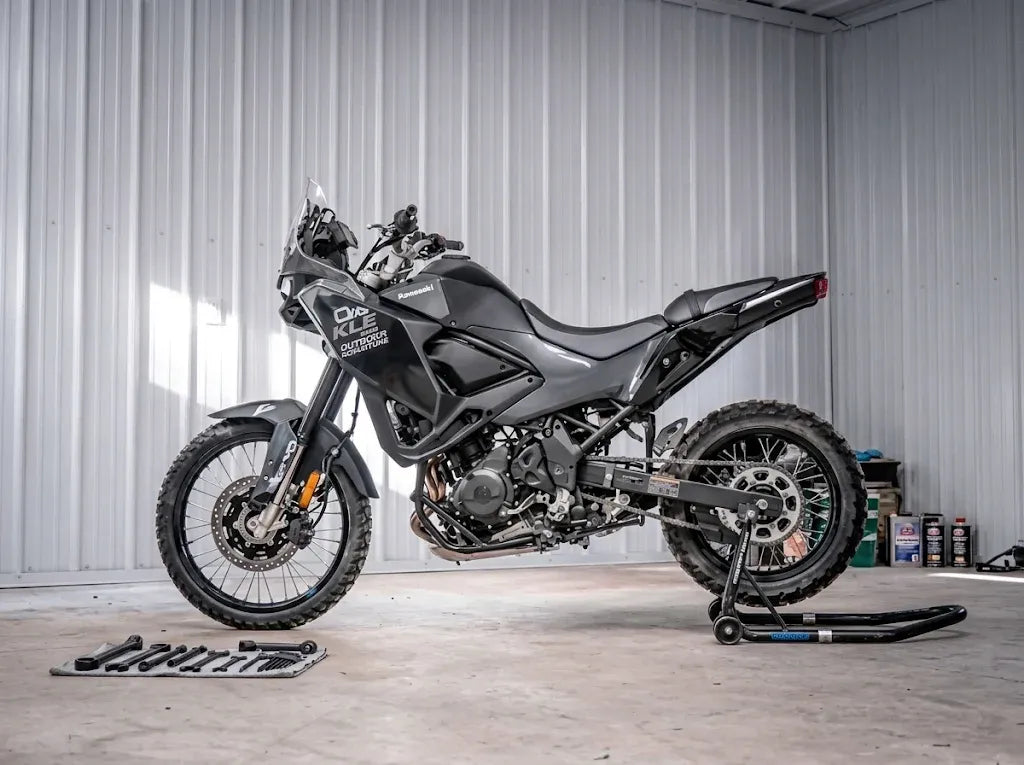
The Kawasaki KLE500 is a full-size, A2-friendly adventure bike that is surprisingly good as an everyday road bike. We break down the engine, light slip-assist clutch, 21-inch front wheel handling, brakes, seat height, UK and US pricing, the new 2027 SE Smartride, and how it stacks up against the Honda NX500, CFMoto 450MT and Triumph Scrambler 400 XC. We also cover the best ways to carry gear on it, from rider-worn backpacks to tail bags and waterproof luggage systems.
Table of contents
Everybody has talked about what the Kawasaki KLE500 can do in the dirt. Far fewer people have asked the question most buyers actually care about: what is it like on a Tuesday morning, in traffic, on a wet road, with a bag on the back?
That is what this guide covers. We went through Kawasaki’s official specifications, UK and US pricing, and independent first-ride reports to answer one question: can the KLE500 be your everyday bike?

1. Quick answer
Yes. The KLE500 is a very capable daily road bike. The 451 cc twin is flexible at low revs and fun when you open it up, the clutch is light enough for heavy traffic, and the tall suspension and 21-inch front wheel make rough roads far less annoying. Where it falls short is in sharp braking, electronics (it has none beyond ABS) and serious off-road ground clearance.
2. Kawasaki KLE500 at a glance
Spec |
Kawasaki KLE500 / KLE500 SE |
|---|---|
Engine |
451 cc liquid-cooled parallel twin |
Power |
A2-compliant in the UK and EU; Kawasaki claims about 51 hp in the US |
Clutch |
Assist-and-slipper clutch (2027 SE Smartride adds a self-engaging starting clutch) |
Wheels |
21-inch front, 17-inch rear, spoked |
Seat height |
About 870 mm (34.3 in) |
Ground clearance |
185 mm (7.3 in) |
Kerb weight |
About 194 kg (base) and 195 kg (SE) with a full tank |
Fuel tank |
16 litres (4.2 US gal) |
Electronics |
Switchable ABS only. No traction control, no riding modes |
Price (UK) |
From £5,999 (SE from £6,599) |
Price (US) |
$6,599 (SE $7,499; 2027 SE Smartride $7,999) |
Figures from Kawasaki’s published specifications and UK and US launch pricing. Check your local dealer for current prices.
3. Is the Kawasaki KLE500 good on the road?
Yes, and it is better than the “rally” styling suggests. Adventure bikes aimed at the A2 licence class are usually compact and beginner-friendly. The KLE500 goes the other way. It has a long wheelbase (around 1,555 mm), a 21-inch front wheel and plenty of suspension travel, so it feels like a proper full-size adventure bike rather than a shrunken one.
That size gives you two things on the road. The first is stability: it feels planted at motorway speeds and unbothered by crosswinds and broken surfaces. The second, which surprises people, is that it does not feel lazy. The wide bars give plenty of leverage, so it turns in quickly despite the big front wheel. At under 200 kg, it is light enough to flick through a roundabout and heavy enough to feel substantial.
If your commute includes potholes, cobbles, speed humps or the odd gravel lane, this is where a tall, long-travel bike pays off.


4. What is the KLE500’s engine like?
The 451 cc parallel twin is shared with Kawasaki’s Ninja 500, Z500 and Eliminator 500, so it is a proven platform. In the UK and EU it is limited to the A2 power ceiling. In the US, it is rated a little higher, at about 51 claimed horsepower.
On the road it feels more versatile than the numbers suggest. There is usable torque low down, so it pulls away cleanly without any fuss. There is also headroom at the top: you can rev it out, and that is when it becomes properly entertaining on an open road.
One honest criticism: it uses a 180-degree crankshaft, which gives a smoother but less characterful sound and feel than some rivals. Bikes such as the CFMoto 450MT (270-degree crank) or the BMW F 450 GS (unusual firing interval) have more personality. It is not a deal breaker, but if you want something with more soundtrack, test ride a few.
5. Is the KLE500 good for commuting? The clutch answer
This is one of the bike’s best commuter features. The KLE500 uses an assist-and-slipper clutch. It does two jobs:
- Slipper: it helps prevent rear-wheel lock-ups on aggressive downshifts.
- Assist: it uses engine torque to clamp itself together under load, which means Kawasaki can fit lighter clutch springs, so the lever pull is light.
If you slip the clutch a lot in stop-start traffic, your left hand will thank you.
New for 2027: the KLE500 SE Smartride. Kawasaki has added a third version that pairs a small centrifugal starting clutch with the conventional wet clutch. You pull away and stop without touching the lever, which makes stalling very difficult, but you still change gear with the lever and foot pedal. It also comes with tubeless tyres on spoked wheels. In the US it is priced at $7,999. It is aimed at the same riders who like Honda’s electronic E-Clutch, though the two systems work differently (Kawasaki’s is mechanical, Honda’s uses electrical actuators).

6. Suspension, wheels and tyres
The 21-inch front and 17-inch rear are a road-friendly pairing: the big front is good at rolling over bumps, and the 17-inch rear is easy to find tyres for. One thing to check before you fit road-biased adventure tyres is the rear size. The standard rear is 140/70-17, which is a less common size and may limit your choices. Confirm availability before you order.
The standard bike runs tube-type spoked wheels, so remember that a puncture means a tube repair. The 2027 Smartride version is the one that gets tubeless.
7. How are the KLE500’s brakes and electronics?
Basic, and intentionally so. There is a single front disc with a two-piston caliper. That is typical for off-road-leaning adventure bikes: it gives progressive feel so you can search for grip on loose surfaces. The compromise is that it does not have the sharp bite of a sportier bike.
If you are used to a sports bike, expect to squeeze harder. If you are coming from an ordinary commuter, you will probably find it fine.
The electronics are just as simple: ABS and nothing else. There are no riding modes and no traction control. The ABS can be switched off with a large, easy-to-find button on the switchgear, so you can turn it off on loose ground without digging through menus. For some riders, fewer electronics means fewer things to go wrong. For others, it means missing the safety net of a more modern bike such as a KTM 390 Adventure.
One limitation to note: independent testers have described the ABS as all or nothing, so if you want to ride on dirt with the system off, you are off completely.
8. Comfort, seat and screen
The seat height is around 870 mm (34.3 in), which suits average and taller riders. If you are shorter, Kawasaki’s accessory range includes a rider seat that is 30 mm lower, plus a choice of passenger seat heights, which is unusual. Lower seats on rival bikes can leave your knees tightly bent and make standing up on the pegs awkward, so the higher stock position is a plus for taller riders over a long day.
The tank is slim where your knees grip, the bars are wide, and the footpegs have removable rubber inserts for street use. The SE has a taller screen with decent wind protection; the standard bike’s screen is shorter, so on motorways you will notice more wind.
Two small niggles: at least one tester heard a buzzing from the cockpit area that was annoying, and independent reviewers have mentioned a buzz in the bike generally. Neither is dangerous, and both are fixable (people often find a little foam between panels cures a rattle), but it is worth listening for on your test ride. The standard levers are also not adjustable, which matters if you have smaller hands.
9. Kawasaki KLE500 vs rivals
Bike |
UK price |
Power |
Kerb weight |
|---|---|---|---|
Kawasaki KLE500 |
£5,999 |
A2-compliant (estimated under 47 hp) |
194 kg |
Honda NX500 |
£6,899 |
47 hp |
196 kg |
CFMoto 450MT (Ibex 450) |
£5,699 |
41.6 hp |
175 kg |
Triumph Scrambler 400 XC |
£6,545 |
39.5 hp |
186 kg |
UK figures from Bennetts BikeSocial and manufacturer data. Prices as launched; check with a dealer.
The KLE500 sits in the middle on price. It is cheaper than the Honda NX500 (which comes with Honda’s electronic E-Clutch as an option on some versions) and more expensive than the CFMoto. If you load up a BMW F 450 GS with options, it will cost clearly more. The KLE500’s main advantages are its free-revving parallel twin and its full-size ergonomics, which is especially good news for taller A2 riders.
10. Which KLE500 should you buy?
- KLE500 (standard): the cheapest way in. Fine for a daily bike. Shorter screen and no TFT.
- KLE500 SE: adds a taller screen, reinforced hand guards, a heavier-duty skid plate, LED indicators and a colour TFT dash, plus the white and green paint option. The TFT is mostly a different way of showing the same information, since the only thing you control on the bike is the ABS. If you want a phone navigation setup, a good handlebar mount does the job just as well.
- KLE500 SE Smartride (2027): the one to pick if you do lots of traffic riding or want tubeless tyres.
In the UK, Kawasaki also offers accessory-pack editions of the SE for more money, so compare the individual accessories you actually want before paying extra.
11. How well does the KLE500 handle off-road?
It is a good gravel and light-trail bike, but not a hard-enduro machine. With 185 mm of ground clearance, it sits lower than the Royal Enfield Himalayan 450 (230 mm), and independent testers note the bash plate and footpegs will touch down. If your riding is mostly tarmac with occasional gravel, you will not miss much. If you want technical off-road riding, look elsewhere.

12. Best luggage for a KLE500 daily setup
A good commuter bike is only as useful as the gear you can carry on it. Because the KLE500 has a slim, rally-style tail and a long seat, soft luggage that straps on is usually the simplest approach, and it suits a bike you also use on gravel because it is light and tolerant of vibration.
Here are the options we would look at first:
- Motorcycle backpacks. Worn by the rider or strapped to the passenger seat, a good motorcycle backpack keeps your commute simple and your bike free of racks. Viking’s range comes in several sizes, from compact to extra large, and the Kawasaki adventure backpacks are made from waterproof TPU fabric.
- Tail and duffel bags. For the weekend, a roll-top Kawasaki adventure duffel and tail bag rides behind you and is simple to remove and take indoors.
- Waterproof luggage systems. If you tour regularly, Viking’s adventure touring luggage includes a quick-disconnect, waterproof Odyssey system in 80 L, 40 L and 10 L sizes that Viking says can be fitted to most adventure bikes without racks. See the Kawasaki adventure luggage system for the details.
- Backpack plus tail bag. Viking designs its backpack sizes to be combined with other luggage, which spreads weight and reduces fatigue on longer rides.
A note on fit: Viking’s Kawasaki adventure range lists specific models such as the Versys-X 300, KLR650 and KLX series. The KLE500 is new, so before you order a strap-on or mounted system, check the mounting method on the product page, or ask the Viking Bags team through chat. Backed by a 45-day money-back guarantee, you can also try your setup with confidence.
If you want more ideas, read our guide to the best motorcycle luggage bags for Kawasaki, and our look back at how the KLE was announced.
Why riders trust Viking Bags: the brand has served over 100,000 riders since 2007 and holds a 4.8 rating on Trustpilot across more than 6,000 reviews at the time of writing. Reviewers regularly mention build quality, durable materials, helpful customer service and straightforward installation. As with any brand, the best check is your own: read recent reviews and compare the sizes to what you actually carry.
13. Who is the KLE500 for?
13.1 It is a great fit if you:
- hold or are working toward an A2 licence and want a full-size bike
- are tall and find compact bikes cramped
- commute on rough roads and want comfort over sharp performance
- like a simple, low-tech bike
13.2 Look elsewhere if you:
- want sports-bike braking
- need traction control or riding modes
- plan hard off-road riding with low-speed technical sections
14. Frequently asked questions
Is the Kawasaki KLE500 good for daily commuting?
Yes. The light slip-assist clutch helps in traffic, the 451 cc twin is easy to ride at low revs, and the long-travel suspension copes with rough city streets. The 2027 SE Smartride makes stop-start riding easier still.
Is the Kawasaki KLE500 A2 licence friendly?
Yes. In the UK and EU it is offered in A2-compliant form, which is a big part of its appeal.
How tall is the Kawasaki KLE500?
The seat height is about 870 mm (34.3 in) on Kawasaki’s spec sheets. Kawasaki sells an accessory rider seat that is 30 mm lower.
How much does the Kawasaki KLE500 weigh?
About 194 kg for the standard bike and 195 kg for the SE with a full tank, according to Kawasaki’s figures. US curb weight is quoted at around 428 lb.
How much does the Kawasaki KLE500 cost?
In the UK, £5,999 for the standard bike and £6,599 for the SE. In the US, $6,599 and $7,499, with the 2027 SE Smartride at $7,999.
Does the KLE500 have traction control or riding modes?
No. It has ABS only, and the ABS can be switched off with a button on the switchgear.
What is the Kawasaki KLE500 SE Smartride?
It is a 2027 version with a self-engaging clutch. A centrifugal clutch lets you pull away and stop without using the lever, while you still change gears manually. It also has tubeless tyres.
Is there a bigger KLE?
Kawasaki has also announced a larger KLE650 with a 649 cc twin, so if you want more power, compare the two.
What luggage works for the Kawasaki KLE500?
Soft, strap-on options such as backpacks, roll-top tail bags and waterproof luggage systems are the simplest starting point. Always confirm the mounting method for your bike before ordering.
15. The verdict
The Kawasaki KLE500 is a better road bike than its adventure styling might suggest. It is comfortable, roomy and easy to ride, and its price puts it in reach of a lot of riders. It is not the sharpest brake or the most high-tech bike in the class, but for many riders that simplicity is exactly the appeal.
Pair it with a sensible luggage setup, and it becomes a bike you can use for the commute on Monday and a gravel weekend away on Saturday. If you are still choosing, take a test ride and bring your usual bag along to see how it sits.
Ready to carry your gear? Browse Viking Bags’ adventure touring luggage and motorcycle backpacks, or talk to the team about what fits your bike.



Leave a comment
All comments are moderated before being published.
This site is protected by hCaptcha and the hCaptcha Privacy Policy and Terms of Service apply.