

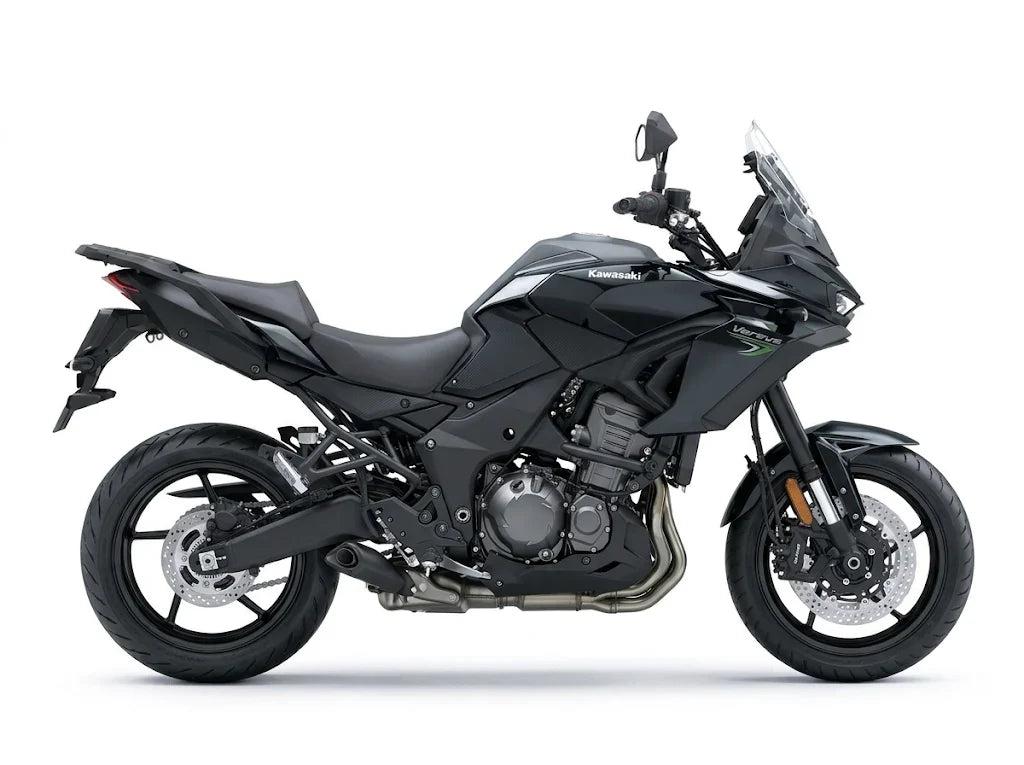
Quick answer: The 2027 Kawasaki Versys 900 SE LT ABS is the only Versys 900 coming to the U.S., with a $13,599 starting MSRP ($14,439 with Kawasaki's $840 destination charge) and expected U.S. availability in March 2027. It pairs a 948cc inline-four (claimed 120 hp) with radar-based cruise control, blind-spot detection and two standard 32-liter Shad hard side cases. The catches: its Adaptive Cruise Control Lite does not apply the brakes, and each side case is reportedly rated for only about 11 lb (5 kg). Curb weight and real-world range are not yet published.
Table of contents
There's a new motorcycle in the awkwardly perfect gap between a practical middleweight and an expensive flagship tourer. Kawasaki hasn't filled that gap with a detuned twin or another oversized adventure bike. It has put a four-cylinder engine in a road-focused Versys, given it radar assistance, and priced it $6,200 below the Versys 1100 SE LT.
Sounds compelling. But the details matter more than the launch-day excitement. Does the cruise control actually brake? How much can the standard luggage really carry? Which version do U.S. riders get? And what is still unknown until someone puts real touring miles on the bike?
Here are eight things worth knowing before you visit a dealer.

1. 2027 Kawasaki Versys 900 specs and price at a glance
| Item | Announced detail |
|---|---|
| U.S. model | 2027 Versys 900 SE LT ABS (single U.S. version) |
| U.S. starting MSRP | $13,599; $840 destination charge listed by Kawasaki ($14,439 combined), before tax, registration, options and dealer fees |
| Expected U.S. availability | March 2027, per launch coverage; confirm with a dealer |
| Engine | 948cc liquid-cooled, DOHC, 16-valve inline-four; six-speed gearbox |
| Claimed output | 120 hp at 9,500 rpm; 71.8 lb-ft at 8,000 rpm (European figures: 122 PS, 97.3 Nm) |
| Rider assistance | ACC Lite, forward collision warning, blind-spot detection, IMU-supported cornering ABS and traction control |
| Suspension | 43mm inverted fork (5.9 in travel, preload and rebound adjustable); rear shock (6.3 in travel, rebound and remote preload adjustable) |
| Brakes and wheels | Twin 310mm front discs, 260mm rear disc; 17-inch wheels front and rear |
| Comfort hardware | Two-position seat (825 or 845 mm in European specs), seven-position manual windscreen (48mm total range), 5.3-gallon (about 20-liter) fuel tank |
| U.S. luggage | Two 32-liter Shad hard side cases standard (reportedly about 11 lb / 5 kg each); 47-liter top case is an accessory |
| U.K. variants | Base £10,899; SE £11,799 (April 2027); panniers and top case are optional there |
Market-specific prices, equipment and specifications differ. Kawasaki's U.S. model page still says "full model specs coming soon," so curb weight and U.S. seat-height figures are unpublished as of November 17, 2026.
1.1 The price is attractive, but U.S. riders need the right number
The headline price circulating online is £10,899. That's real: Kawasaki announced it for the standard Versys 900 in the U.K., alongside a £11,799 SE. Those aren't U.S. prices, and converting pounds to dollars won't tell an American rider what the bike costs at a dealer.
Kawasaki's U.S. version is the Versys 900 SE LT ABS at a $13,599 base MSRP. Its model page also lists an $840 destination charge, for a published total of $14,439 before tax, registration, options and dealer charges. U.S. launch coverage points to March 2027; the U.K. announcement specifies April 2027. Actual dealer inventory may differ.
Here is why the price deserves attention. Kawasaki lists the 2027 Versys 650 LT at $10,599 and the Versys 1100 SE LT at $19,799. The 900 sits $3,000 above the 650 and $6,200 below the 1100, using starting MSRPs. It isn't the cheapest way to go touring, but it occupies a deliberate middle ground in the same family.
Who benefits? Riders who want more engine character and more touring electronics than the 650 offers without paying flagship Versys money. Don't choose on price alone: the three bikes differ in weight, hardware and how they deliver power.


1.2 The 948cc inline-four is the reason this bike feels different on paper
It is tempting to assume a tall touring motorcycle needs a twin or a triple. Kawasaki took another route: a 948cc inline-four inspired by its Z-family street engines, used as a stressed member of the new frame.
Kawasaki claims 120 hp at 9,500 rpm and 71.8 lb-ft of torque at 8,000 rpm ( 122 PS and 97.3 Nm in European units). These are manufacturer claims, not measured rear-wheel numbers. For context, Kawasaki lists the larger 1,099cc Versys 1100 at 133 hp. The 900's claimed output points to a lively, high-revving character, quite different from the Versys 650's parallel twin.
A six-speed gearbox with an assist-and-slipper clutch and a dual-direction quickshifter comes standard, and launch coverage says long final gearing is meant to keep cruising revs down. Whether that holds up at U.S. highway speeds, fully loaded and two-up, is something only a road test can answer.
It's tempting to call it a Z900 with luggage. That sells the idea short. The trellis frame, steering geometry, riding position and carrying requirements are specific to the Versys. Similar engine architecture does not mean an identical motorcycle or an identical tune.
1.3 Radar is standard, but Adaptive Cruise Control Lite has a limit
This is the feature that makes people stop scrolling. The Versys 900 is the first Versys with radar-based rider assistance, using front- and rear-facing sensors to run Adaptive Cruise Control Lite (ACC Lite), Forward Collision Warning (FCW) and Blind-Spot Detection (BSD).
ACC Lite uses a front radar to monitor the vehicle ahead and, when the gap gets too small, reduces speed through the electronic throttle valves. You choose a Near, Medium or Far following distance. What it cannot do is apply the motorcycle's brakes. Kawasaki says rider intervention is required when stronger deceleration is needed or when traffic ahead slows far below your set speed. Braking also cancels the system, and you press the RES button to resume.
Forward collision warning is a warning only: it flashes a red LED above the instruments and/or a message on the TFT, with timing you can set to Early, Medium or Late. Blind-spot detection uses the rear radar to light an LED in the mirror when a vehicle approaches in the lanes beside you, and the LED flashes if you signal a lane change. It does not alert you to vehicles directly behind the bike or ones moving away. The bike also has IMU-assisted cornering management, traction control and enhanced ABS, and European launch materials list an emergency stop signal as well.
On a long interstate day, fewer throttle adjustments and more information about surrounding traffic sound useful. But no electronic aid changes the basics: keep a safe following distance, check mirrors and shoulder before changing lanes, and stay ready to brake yourself.

1.4 A new trellis frame and 17-inch wheels say sport tourer, not dirt bike
A Versys sits tall, but that doesn't make it an off-road adventure bike. Kawasaki's new steel trellis frame, near-50:50 weight-distribution target, 17-inch front and rear wheels and road-oriented tires point toward paved-road versatility.
That matters when you picture where you'll actually ride. Winding back roads, rough urban pavement and long highway runs are its natural territory. Gravel driveways and well-maintained unpaved access roads are a different conversation from technical trails, deep ruts or loaded off-road travel. Wheel size alone doesn't settle capability, but it is a good clue to design priorities.
Suspension is long-travel and manually adjustable, not the electronically controlled semi-active system on the 1100 SE LT. The fork offers 5.9 inches of travel with preload and rebound adjustment; the rear shock has 6.3 inches of travel with rebound adjustment and a remote preload knob. If you regularly switch between solo, two-up and fully loaded riding, check how easily that preload can be set.
The braking hardware looks purposeful: twin 310mm front discs with radial-mount four-piston calipers and a 260mm rear disc. We would still want independent testing of braking feel, rough-road control and loaded stability before calling the chassis class-leading.
1.5 Wind protection, seating and fuel capacity could make or break touring comfort
You can have all the horsepower in the world and still dislike a motorcycle after two hours if the airflow hits your helmet the wrong way. Kawasaki gives the new Versys a few ways to adjust the fit.
The windscreen is manually adjustable in seven positions in 8mm steps, for a total of 48mm, according to Kawasaki's U.S. information. European materials describe a two-position seat, 825 mm or 845 mm (about 32.5 or 33.3 inches), changed without tools. Final U.S. seat specifications haven't been published, so confirm them and sit on the bike yourself.
The U.S. bike has a 5.3-gallon (about 20-liter) tank. Kawasaki hasn't published a range figure, and real-world fuel economy isn't known yet. As pure arithmetic rather than a Kawasaki claim, you can estimate your own range by multiplying 5.3 gallons by the mpg you actually achieve; 40 mpg, for example, would work out to roughly 210 miles. Speed, wind, temperature, load and throttle use can change that significantly.
A comfortable riding triangle on a showroom floor doesn't prove a comfortable 500-mile day. Before buying, check reach to the bars, knee angle, passenger space, screen buffeting and how the seat feels after sustained riding, not just in a five-minute sit.
1.6 The U.S. SE LT includes hard side cases, but check the weight rating
This is where the U.S. announcement becomes especially relevant to Viking Bags readers. The Versys 900 SE LT ABS comes with two 32-liter Shad hard side cases as standard equipment. That is 64 liters of nominal side-case capacity. Kawasaki offers a 47-liter top case as an accessory that can be mounted alongside the side cases, bringing nominal total volume to 111 liters. Kawasaki says the top case holds two full-face helmets.
Here's the detail that gets lost in the headlines: reported per-case load ratings are small. U.S. first-look coverage cites about 11 lb (5 kg) per side case, so roughly 22 lb across the pair. A 32-liter case can look huge and still be limited by weight, and by the shape of its opening. Check the owner's manual, each case's load rating, the bike's total payload allowance and any luggage-related speed guidance before packing. Our motorcycle saddlebag capacity guide explains why liters and safe carrying weight are separate questions.
The factory cases use Kawasaki's dedicated mounts, which include damping elements, and are locked and released with the ignition key. That does not establish compatibility with panniers or racks made for the older Versys 650, 1000 or 1100. A new frame and rear subframe can change the attachment points even when the family name is familiar. Our 2027 motorcycle luggage fitment guide explains what to check when a new chassis arrives.
If the 22 lb side-case allowance isn't enough, it helps to think in layers rather than one big bag. For gear you want with you after you park (laptop, documents, a jacket liner), a worn pack is the simplest add-on because it doesn't depend on any Versys 900-specific mount. Viking Bags' Kawasaki motorcycle backpacks are listed as fitting all models; the 32L Renegade Kawasaki dry backpack, for example, is Cordura, weather resistant (not waterproof), comes with a shoulder strap and measures 11.5 x 11.5 x 19 inches with an 11 x 11 inch lid opening. Test how a loaded pack feels over a full day, and never use it as a substitute for properly securing heavy or bulky loads.
For gear that should stay on the bike, strapped luggage is the other route, but check the mounting points on the 2027 frame first. Viking describes its adventure touring tail bags as universal designs, while its standard tail bags are designed around a sissy bar at least 24 inches high, so confirm what your setup offers before you order. Our backpack versus tail bag guide walks through that trade-off.
Fitment note: At the time of writing, Viking Bags' Kawasaki adventure touring luggage selector lists the Versys 650, 1000, 1000LT and Versys-X 300, with a separate collection for the Versys 1100, but nothing for the new Versys 900. Don't treat a Kawasaki category label as proof that a product fits this 2027 model.

1.7 The SE LT is well equipped, but it isn't a fully electronic flagship
The U.S. SE LT includes touring equipment that may cost extra on other bikes: heated grips, hand guards, auxiliary LED fog lights, a radiator screen, frame sliders, a center stand, a lower cowl, a helmet lock and hard side cases. Its electronics include power and riding modes, a dual-direction quickshifter, a 5-inch color TFT, smartphone connectivity through Kawasaki's Rideology app (voice command and turn-by-turn navigation are available) and a USB-C outlet.
There is an important trade-off. The Versys 900 does not have the electronically controlled semi-active suspension of the 1100 SE LT, and its ACC Lite doesn't brake for you. The 1100 SE LT, for its part, uses conventional electronic cruise control rather than radar. Each bike has something the other lacks, which is exactly why a spec sheet comparison only goes so far.
European shoppers see a different menu: a more basic Versys 900 at £10,899 and an SE at £11,799, with the SE adding the touring accessories. An SE badge in one region isn't necessarily identical to the U.S. SE LT specification. Always compare the local official build sheet rather than a foreign-market video.
The question is less "Does it have every possible gadget?" and more "Does it have the ones I will actually use?" For someone who commutes daily and travels on weekends, that may be a very persuasive package.
1.8 Who should buy it? The 650, 900 and 1100 solve different problems
Here is the 2027 U.S. Versys family at a glance:
| Model | U.S. starting MSRP | Buyer it could suit |
|---|---|---|
| Versys 650 LT ABS | $10,599 | Riders who want a lower-cost middleweight twin for commuting and touring |
| Versys 900 SE LT ABS | $13,599 | Riders seeking an inline-four, radar-based aids and standard hard cases |
| Versys 1100 SE LT ABS | $19,799 | Riders prioritizing the larger 1,099cc platform and semi-active suspension |
The 900 is interesting because it asks whether the middle option can be the sweet spot rather than a compromise. It adds the engine and technology some 650 owners wish for without the 1100's price. But a motorcycle is more than its spec sheet. A rider who feels more secure on one model after a test sit, or a frequent two-up tourer who values the 1100's suspension, could reach a different conclusion.
If you end up choosing the 650 or 1100 instead, Viking Bags already carries model-specific luggage for both: Versys 650 saddlebags and luggage in fixed-mount, quick-disconnect and throw-over styles, and Versys 1100 saddlebags and luggage, which includes panniers, aluminum side cases and a top case. Check the listed model years against your exact bike before ordering.
Outside Kawasaki, launch coverage has pointed to rivals such as the Yamaha Tracer 9 (reported at $12,599 with standard hard side cases) and the Ducati Multistrada V2. Compare on equal terms: don't set a U.K. base-model price against a U.S. rival, or a fully optioned bike against an unaccessorized one. Check luggage, suspension type, cruise-control functionality and real out-the-door price.
Choosing between Kawasaki's road and mixed-surface models? Our EICMA 2026 motorcycle roundup includes a short Versys 900 versus KLE650 comparison, plus the wider 2027 field, without repeating this model-specific breakdown.
2. What we still need to know after the reveal
The smartest thing about a first look is knowing where the facts end. Kawasaki has announced the architecture, electronics and U.S. price, but real ownership questions still need independent evidence:
- How smooth is the engine at 70 to 80 mph, and how well does it pull with a passenger and luggage?
- How effective is the screen across different rider heights and helmet shapes?
- What fuel economy and usable range can owners expect under mixed conditions?
- What is the final U.S. curb weight, and how manageable is the bike at parking-lot speed?
- How do the manually adjusted suspension and brakes perform fully loaded?
- What are the final U.S. service intervals, insurance costs and accessory-fitment options?
Until those details are verified, any declaration that the Versys 900 is the best touring bike is an opinion, not a tested result.
3. 2027 Kawasaki Versys 900 FAQs
How much is the 2027 Kawasaki Versys 900 in the U.S.?
Kawasaki lists the U.S. Versys 900 SE LT ABS at $13,599 starting MSRP. Its model page also lists an $840 destination charge, for a combined $14,439 before taxes and other dealer or government fees. The standard £10,899 model is a U.K. offering, not a U.S. base trim.
Is the £10,899 Kawasaki Versys 900 sold in the U.S.?
No. £10,899 is the U.K. starting price for the standard Versys 900. The only announced U.S. model is the better-equipped SE LT ABS at $13,599 MSRP before fees. Compare equipment lists rather than converting currencies.
When will the 2027 Kawasaki Versys 900 be available?
U.S. launch coverage gives March 2027 as the expected arrival window for the SE LT ABS. Kawasaki's U.K. announcement lists April 2027. These are market-specific windows, not guarantees of dealer inventory.
How much horsepower does the 2027 Versys 900 have?
Kawasaki claims 120 hp at 9,500 rpm and 71.8 lb-ft at 8,000 rpm from its 948cc inline-four. In European units that is 122 PS and 97.3 Nm. These are claimed figures, not measured rear-wheel numbers.
Does the Kawasaki Versys 900 have adaptive cruise control?
Yes, Adaptive Cruise Control Lite. It uses a front radar and the electronic throttle to help maintain distance from traffic ahead, but it does not apply the brakes, so the rider must brake whenever stronger deceleration is needed.
Does the Versys 900 come with panniers?
The U.S. SE LT ABS includes two 32-liter Shad hard side cases, each reportedly rated for about 11 lb (5 kg). Kawasaki offers a 47-liter top case as a separate accessory. In the U.K., panniers are optional.
How much weight can the Versys 900 side cases hold?
U.S. first-look coverage reports about 11 lb per side case, and Australian launch coverage quotes a 5 kg maximum load per case. Kawasaki's U.S. page doesn't state a rating yet, so confirm the rating in the owner's manual or on the cases themselves, and remember the motorcycle's total payload limit also applies.
Can I add more luggage to the Versys 900?
Kawasaki offers a 47-liter top case as an accessory. Beyond that, no aftermarket luggage has been confirmed for the 2027 frame yet. A worn backpack doesn't depend on bike-specific mounts, while strapped or bracket-mounted luggage should be checked against the bike's attachment points and the seller's fitment information for the 2027 Versys 900.
Is the Versys 900 good for off-road riding?
It is primarily a road-oriented sport tourer with 17-inch wheels and a street-biased chassis. Riders planning technical off-road routes should compare motorcycles built for that use rather than assume the Versys' tall stance means dirt-bike capability.
What engine does the 2027 Versys 900 use?
A 948cc liquid-cooled inline-four inspired by Kawasaki's Z-series street bikes, paired with a six-speed gearbox, assist-and-slipper clutch and dual-direction quickshifter.
Is the Versys 900 better than the Versys 1100?
Not universally. The 900 costs $6,200 less at base MSRP and adds radar-based aids and standard side cases in SE LT form. The 1100 SE LT has a larger engine and electronically controlled semi-active suspension. Riding style, passenger needs, fit and budget should decide.
Can I install older Kawasaki Versys saddlebags on the 2027 Versys 900?
Don't assume so. The new model has a new frame and its own luggage mounts. Only buy or install luggage that is explicitly confirmed for your exact 2027 Versys 900 variant, with the required hardware and load limits.
4. The verdict: one of the most interesting 2027 touring launches, on paper
Kawasaki has done something clever. Instead of reserving radar and touring amenities for a top-price flagship, it has put a substantial package on a motorcycle that starts at $13,599 in the U.S. That alone makes the 2027 Versys 900 worth watching.
The engine, chassis, standard side cases and electronic support systems give it a convincing reason to exist between the 650 and 1100. What we still need is a proper road test: loaded stability, wind protection, real-world range and comfort after a full day in the saddle. Until then, the best assessment is a promising, unusually well-equipped first look, not an unearned claim of perfection.
Research note: This first look is based on Kawasaki's U.S. 2027 Versys 900 SE LT ABS model page (checked November 17, 2026), Kawasaki's October 2026 U.K. announcement as reported by launch coverage, and U.S. first-look reports from Cycle News, Ultimate Motorcycling, RevZilla and Motorcycle.com. It is not a firsthand road test. We will update this article when Kawasaki publishes full U.S. specifications and when independent tests are available.



Leave a comment
All comments are moderated before being published.
This site is protected by hCaptcha and the hCaptcha Privacy Policy and Terms of Service apply.