

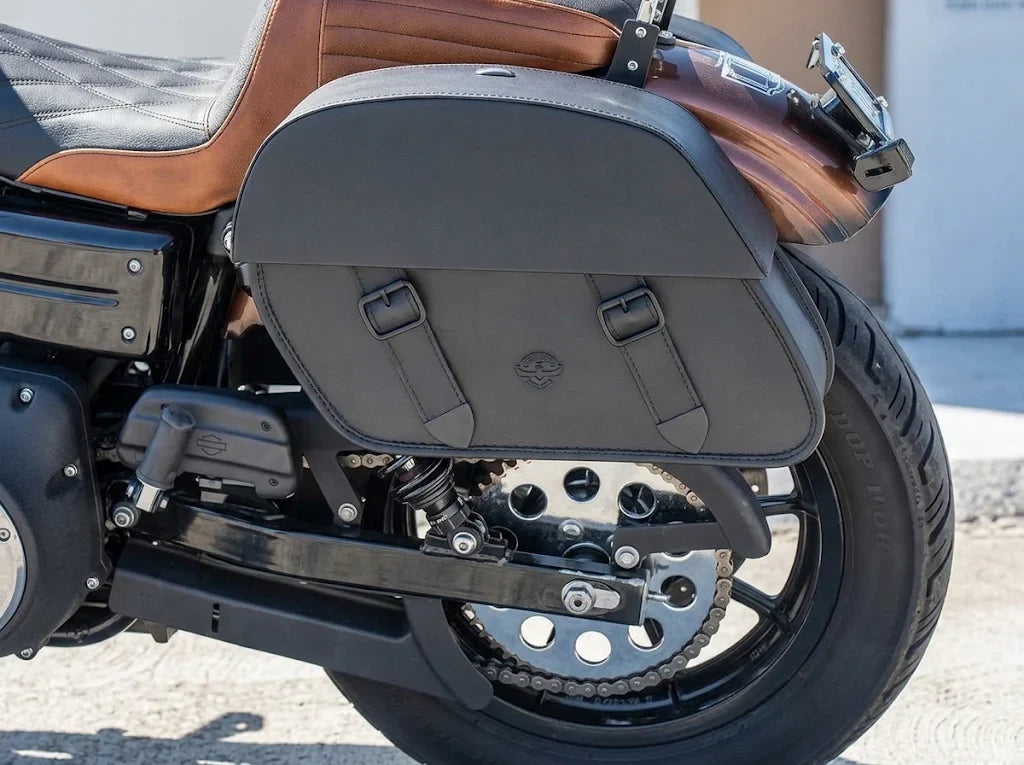
Quick answer: A scratched Harley saddlebag may only need cosmetic attention. A worn gasket, damaged latch or broken hinge may be replaceable if the right service part exists for your exact bag. But a cracked mounting area, bent support, insecure docking system or lid that will not latch is a safety concern. Stop using the affected bag until it has been inspected. Repair the failed component when it is safe and serviceable; consider a complete replacement when the structure is damaged, parts are unavailable or the total repair cost no longer makes sense.
Table of contents
A parking-lot tip-over can leave an ugly scrape on a Harley saddlebag. The mark is obvious. The harder question is whether anything underneath it has shifted, cracked or stopped holding the bag securely.
You do not always need to buy a whole new pair. Depending on the exact original-equipment (OEM) or aftermarket system, a lid, latch, hinge, seal or mounting component may be serviceable. Other failures require replacing the affected case, support or complete set. The useful distinction is between cosmetic damage, a failed replaceable part and damage to something that must carry or retain the bag.
This guide helps you work through that decision before you order parts, pay for paintwork or commit to a new luggage system.

1. First question: Is the damaged saddlebag safe to use?
Do not ride with a saddlebag that might detach, open unexpectedly or contact the tire, suspension or exhaust. Warning signs include a crooked or rocking case, a crack around a mounting point, a bent support or a lid that cannot latch securely. Leave the affected bag off the motorcycle when removal can be done safely under the proper instructions, or have a qualified technician assess it before riding.
A surface scratch is different. If the body is sound, the mounting system is intact, and the lid still closes and locks correctly, a small scuff may be a finish problem rather than a reason to replace the bag.
The important distinction is not how severe the scratch looks; it is whether the bag and its retaining hardware still do their jobs.
After a tip-over, examine the lid and its corners, the underside and attachment points, and the side facing the exhaust and tire. Take photographs before moving hardware. A quick ride is not a safe way to test a loose mount.
2. Harley saddlebag repair vs. replacement: Damage checklist
What you see |
What it may mean |
Sensible next step |
Light scuffs or paint scratches |
Cosmetic finish damage |
Assess cleaning, touch-up, or professional refinishing; check the underlying shell first |
Lid will not align or close |
Obstruction, bent hardware, warped lid, or damaged hinge/latch |
Empty the bag, inspect the closure, and identify the failed part; do not force it shut |
Broken latch, lock, or hinge |
Potentially serviceable component |
Look up the exact bag assembly and compatible service part; replace the part only if the surrounding structure is sound |
Water entering around the lid |
Worn or displaced seal, distorted lid, or another entry point |
Check seal and lid alignment; use a dry bag until the cause is resolved |
Bag rattles or sits unevenly |
Worn grommet, loose hardware, damaged docking point, or bent support |
Stop using the bag until the mounting system has been inspected and secured |
Crack around a mounting hole or docking area |
Possible structural failure at a load-bearing location |
Seek a professional assessment; full case or mounting-system replacement may be necessary |
Broken or bent support bracket |
Mounting hardware no longer carrying load correctly |
Replace or repair only as specified by the manufacturer; do not improvise a bracket fix |
Extensive cracking or a distorted body after a crash |
Case may not hold its shape, seal, or load safely |
Compare a correct replacement assembly with professional repair; prioritize secure function |
This table is a starting point, not a universal parts catalog. The available repairs depend on the motorcycle's year and the particular OEM or aftermarket bag.
3. Why a loose saddlebag does not always mean the bag itself is ruined
The saddlebag shell may not be the part that failed.
A saddlebag system may include supports, mounting screws, spacers, rubber grommets and retention hardware. Harley-Davidson's FLSTF Softail saddlebag kit instructions, for example, describe grommets and spacers separately from the case. A rattle can therefore come from hardware rather than a broken shell. That does not mean a loose bag is safe to keep using.
Do not substitute hardware just because it looks similar. Parts from different Harley model years, different bags or unrelated kits may not share the same dimensions or fastening requirements.
If a case has moved or tilted, identify the failed connection before doing anything else. Tightening a bolt will not repair a cracked attachment point or a bent support. Refer to the correct kit instructions and have any uncertain load-bearing damage inspected by a qualified professional.
For the broader question of model-year differences, exhaust clearance, and docking systems, see our Harley-Davidson saddlebag fitment guide. This article stays focused on assessing damage and deciding what is worth replacing.


4. Damaged Harley saddlebag lid, latch or hinge: Can one part be replaced?
Sometimes. For example, Harley-Davidson's older Dyna Saddlebag Kit instruction J02186 lists right- and left-side lids, a latch assembly, hinge assembly, lock and gasket as separate service parts. That is evidence that certain OEM assemblies were built with individual components—not a guarantee that those parts remain available or fit newer bikes. Confirm the exact motorcycle, bag assembly and part number before ordering.

4.1 If the lid is scratched but still closes properly
Look for damage beneath the finish, especially around hinge points and the closure. If the shell is solid and the gasket seats correctly, professional refinishing may make more sense than replacing the whole assembly. For cleaning and material-safe upkeep, our motorcycle saddlebag care guide covers the basics without confusing maintenance with structural repair.
4.2 If the lid is cracked, warped or will not sit flat
Some hard-bag systems have separately replaceable lids. Check which side you need, the exact bag generation, finish and features such as speakers or power locking. A lid made for another model may look similar but fail to align with the existing hinges and latches. Do not buy by photograph alone.
4.3 If the latch or lock fails
A sticking latch can be caused by something blocking the lid, misalignment, or a faulty component. Empty the bag and inspect it without forcing the mechanism. If the latch or lock is damaged, source the exact compatible part and follow the applicable service procedure. If the lid cannot be secured, do not ride with that bag installed.
4.4 If the hinge or lid tether breaks
Some assemblies use separate hinge and tether components. Check both the part and the points where it attaches. If the attachment material is cracked, fitting a new hinge alone may not fix the problem.
5. Why a Harley saddlebag leaks—and when to replace the seal
A leaking bag does not necessarily need a new shell. Look for water paths around a damaged gasket, a distorted lid, accessory holes or seams. Some systems list replacement gaskets, but seal design and serviceability vary by bag model.
Inspect the lid seal for pinching, tears, deformation, or debris; look for evidence of previous drilling or accessory work; and check whether the lid sits evenly all the way around. Avoid treating random silicone or glue as a universal fix. The wrong material can damage finishes, complicate later service, or fail to address a distorted lid.
For electronics, documents and other water-sensitive items, use a separate waterproof liner even after the obvious leak is addressed. Neither an intact-looking gasket nor a 'hard bag' label guarantees a watertight case in every riding condition.
6. When repair no longer makes sense: OEM or aftermarket replacement
Once the failed part is known, the choice is usually between restoring the original setup and replacing the luggage system.
Restore the original setup. This can preserve matching factory appearance and existing equipment when a correct lid, latch, gasket, bottom shell or complete OEM assembly can still be sourced. Confirm the exact fit and finish with an authorized parts source; 'OEM-style' is not the same as a verified OEM replacement.
Change to a complete aftermarket system. This can be sensible when damage affects multiple components, the original parts are unavailable, or you want different luggage capacity or removal features. Treat the bag and its mounting hardware as one application. Never assume an aftermarket pair reuses original brackets, lids, locks or docking points unless the product documentation explicitly says so.
When repair is no longer practical, compare Harley saddlebags by model and year rather than choosing a pair by appearance. Check the exact motorcycle, product fitment listing, mounting system and any required relocation hardware before ordering.
7. Replace one Harley saddlebag—or both?
Replacing only the damaged side can be sensible when the other bag is still structurally sound and an exact match is available. But compare more than the paint color. Check the body shape, lid style, mounting interface, lock system, finish, and whether any hardware must be replaced as a pair.
Replacing both may be more practical if the matching assembly is discontinued, the original system is heavily modified, both bags show age-related wear, or you want to change from factory-style cases to a different aftermarket mounting setup.
If the other side remains sound and a true match can be sourced, replacing one OEM component may preserve the original setup. If a matching part is discontinued or you intend to change the mounting system, a purpose-matched aftermarket pair may be easier to plan than combining unrelated parts. Verify fitment in either case.

8. Compare the total repair cost—not just the part price
Ask for a complete estimate before deciding that repairing one piece is cheaper than replacing the setup.
Repair total = correct part + paint or refinishing (if needed) + any seals or hardware + installation labor.
Replacement total = correct bag or pair + model-specific mounting or relocation components + finish work (if needed) + installation labor.
A matching lid might still require refinishing, transferring hardware or new seals. A complete aftermarket pair might require its own supports or relocation components. Conversely, repairing a serviceable latch could avoid the expense and downtime of replacing an otherwise sound case. Compare the finished costs, not only the initial advertised part prices.
Get the part list and fitment confirmed before comparing estimates. For a broader look at new-bag price ranges rather than damage repairs, see the motorcycle saddlebag price guide.
9. What changes on Harley Touring and cruiser motorcycles?
Road King, Street Glide, Road Glide and other Touring applications: The installed system may include specific supports, a painted finish, speakers or powered locks. Replacing a damaged shell may involve additional components. If you are changing the complete luggage setup instead of restoring a factory part, start with Harley Touring saddlebags and check the exact product application; that collection is not a claim that its bags reuse your existing OEM mounts.
Softail, Sportster and Dyna applications: Many examples use accessory luggage rather than the same Touring factory bag system. A soft throw-over bag or fixed-mount aftermarket case can have different replaceable parts and hardware. Identify the actual installed bag before following any OEM service procedure.
Customized motorcycles: Nonstandard exhausts, short fenders, relocated signals, racks and custom paint can affect the replacement job. Photograph the existing setup and disclose those modifications when confirming fitment with the seller.
10. Before ordering, record these seven details
- Motorcycle identity: Exact model, model year, and relevant factory or aftermarket modifications.
- Bag identity: OEM or aftermarket brand, any model/part number, and whether it is the left or right side.
- Damage location: Photograph the lid, body, bottom, hinge, latch, and especially mounting points.
- Mounting components: Identify supports, docking points, screws, grommets, spacers, and damaged or missing pieces.
- Features: Note speaker openings, power locks, reflectors, lighting, and any attached accessories.
- Finish and matching: Confirm painted color, gloss or matte finish, texture, and the appearance of the undamaged side.
- Complete quote: Request a parts-and-labor estimate for both repairing the existing assembly and replacing it.
If the damage could affect load-bearing mounting points, have the bag and hardware assessed in person. Photographs are useful for identification, but cannot prove structural safety.
11. Frequently asked questions about Harley saddlebag damage
Can I replace just the lid on a Harley-Davidson saddlebag?
For some models, yes. Harley-Davidson's older parts documents identify separate left- and right-hand lids for certain assemblies. Availability, finish and fitment must be checked for your exact motorcycle and installed bag.
Can I replace only one Harley saddlebag?
Often, provided a matching and compatible side is available. Confirm body shape, hardware, finish, locking features, and the condition of the remaining bag. Some aftermarket sets are designed and sold as matched pairs.
Is a cracked Harley saddlebag safe to repair with glue?
Do not use glue as an assumed repair for a cracked mounting point, attachment tab or other load-bearing feature. Structural repair requires an appropriate approved method and qualified assessment; a cosmetic crack and a weakened mounting area are not equivalent.
Why does my saddlebag rattle even after I tighten it?
Potential causes include worn grommets, missing spacers, an incorrect bracket or damaged docking hardware. A bag that still moves after fastening is not ready to ride. Inspect the complete system using the correct service instructions.
Will aftermarket Harley saddlebags fit my stock brackets?
Not necessarily. Aftermarket bag systems can have different supports, mounting points, latches and docking hardware. Confirm whether the specific product is designed for your existing hardware; do not infer compatibility from a generic Harley label.
When is replacing the complete saddlebag the better decision?
A complete replacement is worth evaluating when the shell or mounting area is structurally damaged, a secure closure cannot be restored, the correct components are unavailable, or repairs cost nearly as much as a verified compatible replacement. Safety-critical damage deserves a qualified inspection.
12. The bottom line: Fix the failed part; replace the system when needed
A scuffed lid and a cracked mounting point do not deserve the same response. Identify the failure, check whether a suitable service part exists, and make sure the entire case and mounting system will remain secure. A safe repair can save a sound bag; a structural shortcut can create a bigger problem.
If replacement is the right call, shop by the exact motorcycle and mounting requirements rather than by how closely a new bag resembles the damaged one. You should finish with luggage that fits, closes and stays attached correctly.



Leave a comment
All comments are moderated before being published.
This site is protected by hCaptcha and the hCaptcha Privacy Policy and Terms of Service apply.