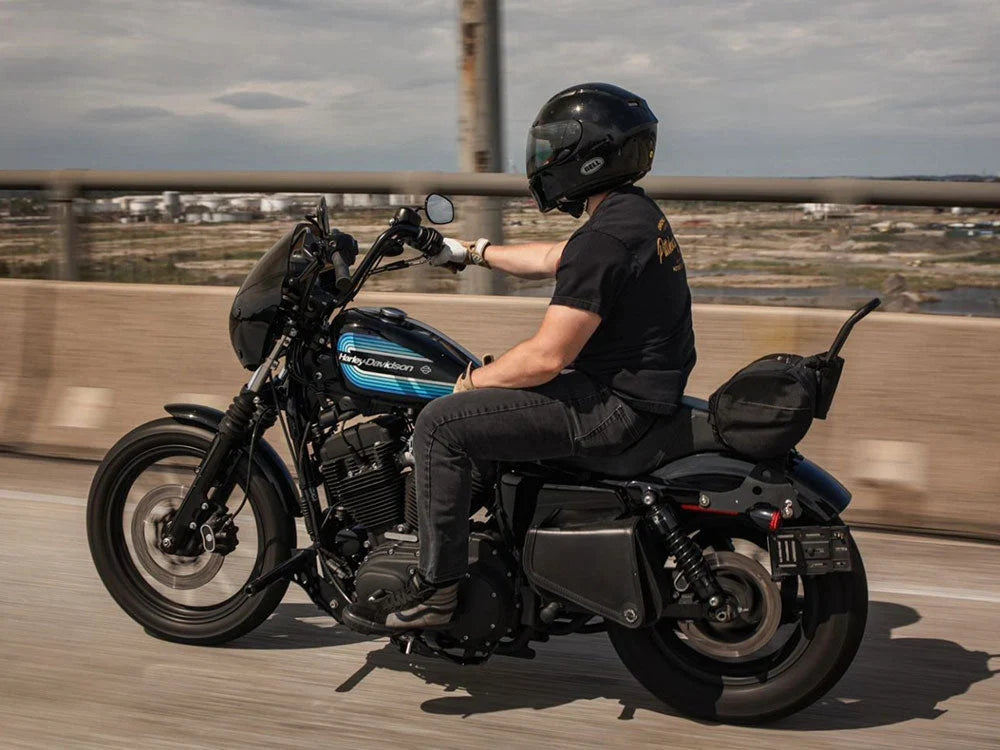
An 883, a Forty-Eight, an old Nightster, and a Sportster S may all wear the Sportster name, but they are not the same kind of motorcycle. This guide traces how Harley-Davidson changed the Sportster across generations, engines, chassis, and model lines - and what those differences mean when identifying, buying, modifying, or fitting luggage to one.
The Harley-Davidson Sportster has always been easy to recognize. Figuring out exactly which Sportster you're looking at is another matter.
An 883, a 1200, a Forty-Eight, an Iron, an original Nightster, and a modern Sportster S can all carry the Sportster name, yet there are substantial differences between them. Harley-Davidson has changed the engine, chassis, suspension, electronics, and riding position over the decades — and, eventually, the entire engine architecture underneath that familiar badge.
That can make a used-bike search surprisingly confusing. It also creates headaches when you're looking for parts, planning a custom build, or trying to work out whether a particular set of luggage will actually fit.
The easiest way into the Sportster family is to look at the major mechanical changes first. Once those are clear, the individual models start to make a lot more sense.
Table of contents
1. Where the Harley-Davidson Sportster Started
Harley-Davidson introduced the Sportster in 1957 as an overhead-valve successor to the K-series motorcycles. It went on to become one of the company's longest-running motorcycle families, although the motorcycle carrying the Sportster name in 2026 has very little mechanically in common with the first XL.
The first long-running chapter of that story was the Ironhead era.

2. Major Sportster generations
| Generation | Years | Engine family | What changed |
|---|---|---|---|
| Ironhead Sportster | 1957–1985 | Ironhead | Original long-running Sportster generation |
| Evolution Sportster | 1986–2022 | Evolution | New aluminum-head engine; the foundation for decades of Sportster models |
| Revolution Max Sportster | 2021–present | Revolution Max | Liquid-cooled, modern architecture; major change in chassis and electronics |
The Evolution and Revolution Max Sportsters overlap in model years — the Sportster S arrived for 2021 while Evolution-powered Sportsters continued through 2022.
From Ironhead to Evolution
The big change came in 1986, when Harley-Davidson replaced the Ironhead with the Evolution Sportster. The new engine appeared in 883cc and 1100cc versions, with the 1200cc Evolution becoming one of the most important engines in the Sportster family as the years went on.
That Evolution platform had a remarkably long run. Harley-Davidson introduced a five-speed transmission and belt drive in 1991, then made another major change in 2004 when the engine was rubber-mounted to the chassis, reducing vibration transmitted through the frame while keeping the basic Evolution architecture intact.
For anyone shopping the used market, that long production run is worth remembering. There are decades' worth of Evolution Sportsters out there, and they don't all have the same equipment even when the displacement badge looks familiar. An 883 from one period and a 1200 from another can have different wheels, brakes, suspension, gearing, controls, and tanks before a previous owner has changed a thing.
883 vs. 1200: The Engine Size Is Only the Beginning
An 883 Sportster uses an 883cc Evolution engine, while a 1200 uses the larger 1,200cc Evolution engine. That part is straightforward — the rest depends on the motorcycle.
Model year, gearing, suspension, wheels, brakes, exhaust, intake, factory tune, and modifications all influence what you end up with. Two Evolution Sportsters can share the same basic engine family and still be built around very different riding priorities.
This comes up constantly with used bikes. A listing that simply says "1200 Sportster" leaves out quite a bit of information. Before comparing parts or deciding what you want to change, find out the exact model and year.

3. How Do You Identify Which Sportster You Have?
If a used-bike listing only says "Sportster," don't start comparing parts yet. Identify the exact model and year first.
The VIN and registration can confirm the motorcycle's identity. The engine configuration, cooling system, transmission, factory badges, and major chassis features can then help distinguish the generation. Previous-owner modifications are another matter and should be documented separately.
Start with:
- Model name
- Model year
- VIN
- Engine family
- Air-cooled or liquid-cooled
- Factory configuration
- Major modifications
This becomes particularly useful with later Sportsters because the name carried over into a completely different mechanical generation. An Evolution 1200 Nightster and a Revolution Max 975T Nightster aren't interchangeable simply because the tank badge says Nightster.
4. Sportster models at a glance
| Model | Model years | Engine | Key distinction |
|---|---|---|---|
| Iron 883 | 2010–2021 | Evolution 883 | Dark Custom styling, stripped-down setup |
| Iron 1200 | 2018–early 2020s | Evolution 1200 | Iron styling with 1200 engine |
| Forty-Eight | 2010–2022 | Evolution 1200 | Low stance, peanut tank, wide front tire |
| Original Nightster | 2007–2012 | Evolution 1200 | Dark factory-custom styling |
| Roadster | 2016–2020 | Evolution 1200 | More road-focused chassis and equipment |
| Nightster | 2022–present | Revolution Max 975T | Modern liquid-cooled architecture |
| Sportster S | 2021–present | Revolution Max 1250T | Performance-oriented modern platform |
Harley-Davidson's model documentation identifies the original Nightster as the XL1200N from 2007 through 2012, the Forty-Eight from 2010 through 2022, and the Roadster through the 2020 model year. The Iron 1200 arrived for the 2018 model year.

5. The Sportster Models That Shaped the Family
There have been plenty of Sportster variants over the years. You don't need a list of every one of them to understand how the family developed — a handful of models tell most of the story.
Iron 883
The Iron 883 became one of the most recognizable Dark Custom Sportsters. Harley-Davidson introduced the stripped-down XL883N around the 2010 model year, and it quickly became a common starting point for owners who wanted to personalize a relatively simple motorcycle.
The 883 Evolution engine is only part of the appeal — the low-key equipment and minimalist bodywork left plenty of room for an owner to take the bike in a different direction. Its stripped-down equipment and Evolution platform give it a distinctly simpler mechanical character than the modern Revolution Max Sportsters.
Choosing luggage for an Iron 883 can be more complicated than the model name suggests. The year, rear suspension, exhaust, turn signals, and whatever the previous owner has done to the bike can all affect the available space.

Iron 1200
The Iron 1200 brought the larger Evolution engine into the Iron formula. Harley-Davidson introduced the XL1200NS for the 2018 model year, combining the Iron's stripped-down appearance with the 1200cc engine.
It's easy to lump the Iron 1200 in with every other 1200 Sportster, but its factory configuration is part of what makes it its own model. The same applies when choosing luggage — a saddlebag listed for a "Sportster 1200" still needs to be checked against the exact year, suspension, exhaust, signals, and mounting setup.

Forty-Eight
The Forty-Eight is probably the quickest Sportster to pick out of a lineup. The low stance helps, as does the peanut tank and wide front tire — those proportions set it apart from the Iron and SuperLow. The model debuted for 2010 and remained in the Evolution Sportster family through 2022.
It also became a popular basis for custom work. Some owners kept the factory proportions almost intact; others went much further with bars, seats, suspension, rear bodywork, and luggage. If you're taking one toward a bagger-style build, the changes work best when considered as a complete setup rather than as a matter of simply hanging bags off the rear.

SuperLow
Harley-Davidson introduced the SuperLow in 2011 as a Sportster designed around an accessible riding position and easy handling. Its low seat and chassis setup gave it a different riding focus from the more stripped-down Iron 883 — a useful reminder that the Evolution family wasn't built around one kind of rider.

Roadster
The Roadster pushed the Sportster in a more road-focused direction. The XL1200CX arrived for 2016 with a more aggressive riding position and chassis equipment than the low-slung custom models. Its 19-inch front and 18-inch rear wheels, inverted fork, and dual front brakes were a clear departure from the traditional low-and-wide Sportster formula. Harley-Davidson's model information lists the Roadster through 2020.

The Original Nightster
The original Nightster is worth separating from the modern bike of the same name. The XL1200N used the Evolution 1200 engine and belongs to the 2007–2012 Sportster generation. Its dark styling, low suspension, and compact rear section gave it a distinct factory-custom appearance. Then Harley-Davidson brought the Nightster name back in 2022 — the name stayed the same, but the motorcycle underneath did not.

6. The Modern Sportster: Nightster, Nightster Special, and Sportster S
The Sportster changed direction again in 2021. The Sportster S introduced the Revolution Max 1250T engine and an entirely different motorcycle underneath the familiar name. The Nightster followed in 2022 with the smaller Revolution Max 975T, and Harley-Davidson added the Nightster Special for 2023.
Modern Nightster
The current Nightster uses the liquid-cooled Revolution Max 975T engine. For 2026, Harley-Davidson lists 91 horsepower, 72 lb-ft of torque, a 481-pound running weight, and a 27-inch laden seat height, plus selectable ride modes and modern rider-safety electronics.
Compared with the old XL1200N, this is a completely different generation of motorcycle. The shared Nightster name is useful for tracing the history, but not much help when determining mechanical or luggage compatibility.
Nightster Special
The Nightster Special uses the same Revolution Max 975T platform but adds a passenger-ready setup, traction control, and a 4-inch TFT display. For 2026, Harley-Davidson lists 91 horsepower, 72 lb-ft of torque, and a 483-pound running weight.
Sportster S
The Sportster S is where the modern Sportster departs most dramatically from the traditional formula. Its Revolution Max 1250T engine produces 121 horsepower and 93 lb-ft of torque for 2026. Harley-Davidson lists a 502-pound running weight, a 28.9-inch laden seat height, performance-tuned front forks, and a high-mounted 2-1-2 exhaust — a performance-oriented machine with modern chassis hardware and electronics, not simply an Evolution Sportster with a larger engine.

7. What Different Sportsters Are Like to Ride
Ride an Iron 883 and then climb onto a Sportster S and the family resemblance starts to feel pretty abstract.
The Iron 883 has the stripped-down equipment and Evolution platform that defined so many traditional Sportsters — compact, relatively simple, and built around a very different mechanical package from the current bikes. The Forty-Eight takes that older formula toward the low-slung cruiser end of the spectrum; its peanut tank, wide front tire, and low stance shape the motorcycle's proportions and riding position. The Roadster takes a different route, with wheel sizes, suspension, brakes, and riding position giving it a more road-focused character.
The original Nightster stayed within the Evolution family but gave that hardware a darker, more compact factory-custom treatment. The modern Nightster changes the equation again — the 975T Revolution Max engine, liquid cooling, electronics, and newer chassis architecture put it much closer to the modern Sportster S than to the old XL1200N in engineering terms. Then there's the Sportster S itself, with its 1250T engine, high-mounted exhaust, modern suspension, and rider-assist systems, occupying the most performance-focused corner of the family.
So when someone says they ride a Sportster, the next question is usually worth asking: which one?
8. Buying a Used Sportster
A used Sportster deserves a little more investigation than an odometer reading and a quick look at the paint. Start by confirming exactly what you're looking at — check the VIN, registration, model year, engine configuration, and service records. Then look at the motorcycle itself, because a heavily modified Sportster can tell a very different story from its original specification.
Check:
- Exact model and model year
- VIN and registration
- Engine family and displacement
- Service records
- Cold-start behavior
- Oil leaks or other fluid leaks
- Tires and wheels
- Brake condition
- Suspension condition
- Belt and pulleys
- Intake and exhaust modifications
- Fuel-management or tuning changes
- Electrical and wiring work
- Crash damage
- Custom bodywork
- Engine conversions or major internal work
Don't automatically treat modifications as a negative — a bike with an aftermarket exhaust, different handlebars, or upgraded suspension may be perfectly well sorted. The concern is work that can't be explained or inspected properly. Unknown wiring, questionable engine work, and undocumented tuning deserve more attention than the fact that somebody changed the seat or put different bars on the bike.
9. Why Sportsters Became Such Good Custom Platforms
Some owners change almost nothing. Others change everything. That's been part of the Sportster's appeal for decades — the motorcycle can stay close to factory form, or an owner can start changing the bars, seat, suspension, wheels, tires, exhaust, intake, lighting, rear bodywork, foot controls, fairing, and luggage.
An Iron 883 can remain a stripped-down city bike. A Forty-Eight can become a long-distance custom. A Roadster can be pushed further toward aggressive street riding. A traditional Sportster can also be rebuilt around saddlebags and touring equipment. That's a fairly broad range for one motorcycle family, and it explains much of the Sportster's longevity as a custom platform.
10. Sportster Luggage: What Actually Matters
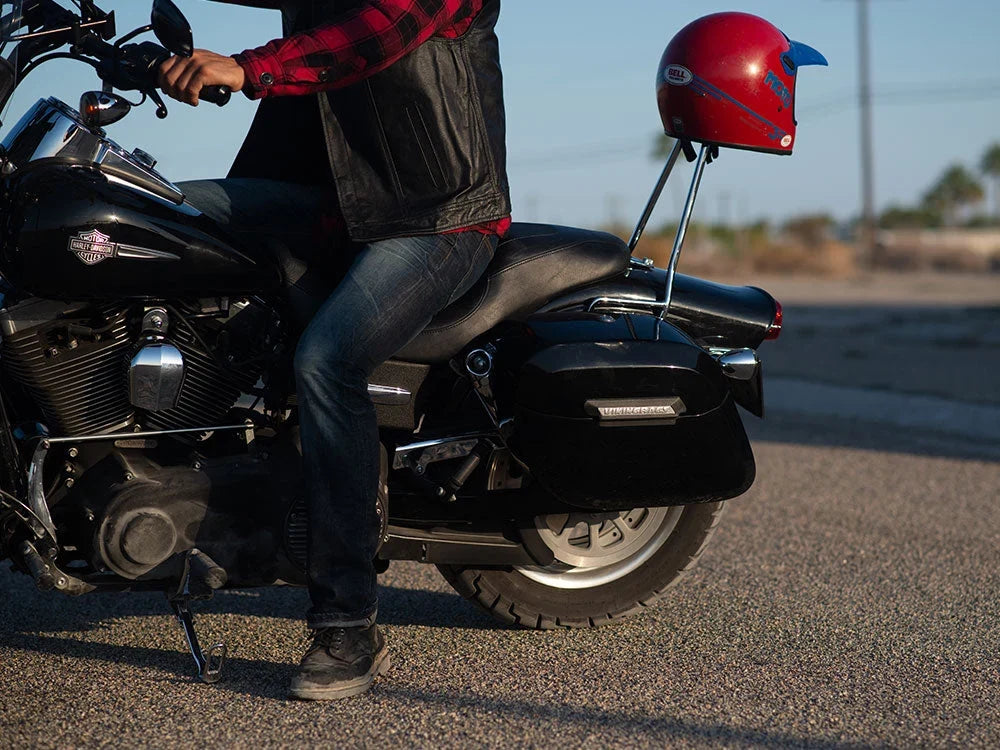
Harley Sportster luggage comes in several forms, from leather saddlebags and throw-over systems to hard bags and quick-disconnect setups. The choice depends on how the motorcycle is being used, but fitment comes before material or style.
Before buying bags, identify whether you're dealing with an older Evolution Sportster, the original Nightster, or one of the modern Revolution Max models. Then look closely at the motorcycle itself: suspension, exhaust routing, rear fenders, turn signals, wheel and tire combinations, passenger equipment, sissy bars, racks, and docking hardware can all change the available mounting space.
Harley-Davidson's own saddlebag documentation shows how specific fitment can be, with model-year differences and exclusions involving rear axle covers, certain turn signals, detachable side plates, side-mounted license plates, and different exhaust configurations. So a product description that simply says "fits Sportster" isn't enough information by itself.
Measurements should come from the motorcycle you're actually working on rather than a generic model description. Clearance should be checked with the suspension in the positions required by the manufacturer or mounting instructions, not judged from one unloaded position on a stand.
For city riding, a smaller bag can make more sense than a large touring system, particularly when preserving the Sportster's compact proportions is part of the goal.
11. Building a Sportster Into a Bagger
A Sportster can be built into a bagger-style motorcycle, but the interesting part is usually the whole combination rather than the saddlebags alone. A build might include saddlebags, a fairing or windshield, rear luggage, a different seat, a sissy bar, touring controls, or suspension changes — and the starting motorcycle makes a difference too.
The Forty-Eight is a good example: its low stance and compact proportions can be pushed a long way from the original factory configuration through a combination of changes. The order of those changes can matter — an exhaust change can affect bag clearance, different rear suspension can change available space, and a new seat or rack can alter where luggage sits behind the rider. A Sportster doesn't have to become a full touring motorcycle to benefit from luggage; the better approach is to build around how the motorcycle is actually going to be ridden.
12. Frequently Asked Questions About Harley-Davidson Sportsters
Is a Sportster 883 the same as a 1200?
No. Both can use the Evolution engine family, but the 883 uses an 883cc engine while the 1200 uses the larger Evolution 1200. Surrounding equipment can differ too, depending on model year and trim.
Is the Harley-Davidson Sportster still made?
Yes, though the current lineup differs sharply from the traditional Evolution models. For 2026, Harley-Davidson's Sportster family includes the Nightster, Nightster Special, and Sportster S, all using Revolution Max engines. Harley-Davidson has also announced plans, under its "Back to the Bricks" strategy, to revive a traditional air-cooled Sportster - reportedly an 883cc model priced around $10,000 - targeted for roughly 2027–2028.
Is the new Nightster the same as the old Nightster?
No. The original Nightster was the XL1200N, an Evolution 1200 Sportster produced from 2007 through 2012. The modern Nightster arrived for 2022 with the liquid-cooled Revolution Max 975T.
Which Sportster models are 1200s?
A number of Evolution Sportsters used the 1200cc engine, including the original Nightster, Forty-Eight, Roadster, Iron 1200, 1200 Custom, and other variants. Exact availability varied by model year and market.
Is a Sportster a good beginner motorcycle?
It depends heavily on which Sportster. An 883 Evolution Sportster and a 121-horsepower Sportster S are very different motorcycles. Rider experience, training, physical fit, and the specific bike's weight, controls, and power delivery all matter.
Are Sportsters good motorcycles for customization?
Yes - they've long been popular custom platforms, particularly the Evolution models. Owners have built them around everything from simple cosmetic changes to suspension, wheels, bodywork, fairings, saddlebags, and touring equipment.
Can you put saddlebags on a Harley Sportster?
Yes, but the correct luggage and mounting system depend on the exact model and year. Exhaust location, turn signals, suspension, fenders, mounting hardware, and previous modifications can all affect fitment.
Can a Sportster be turned into a bagger?
Yes. Sportsters have been built with saddlebags, fairings, windscreens, rear luggage, touring seats, and other equipment. How far the build goes depends on the starting model and combination of modifications.
What should I check before buying a used Sportster?
Confirm the exact model and year first, then check VIN, service history, engine, charging system, brakes, tires, suspension, belt, exhaust and intake modifications, wiring, crash damage, and any engine or chassis work.
Do Sportster saddlebags fit all Sportster models?
No. Fitment isn't universal - Evolution and Revolution Max Sportsters use different mounting arrangements, and even bikes within the Evolution family can have different fitment requirements.
What is the difference between the Sportster S and Nightster?
The current Nightster uses the 975T Revolution Max engine and is lighter and lower. The Sportster S uses the larger 1250T and has more performance-oriented chassis equipment. For 2026, Harley-Davidson lists 91 horsepower for the Nightster and 121 horsepower for the Sportster S.
13. What the Sportster's Future Looks Like
The Sportster story isn't finished. As part of its 2026 "Back to the Bricks" turnaround plan under CEO Artie Starrs, Harley-Davidson confirmed it will revive the Sportster as a traditional, air-cooled, mid-tier model - separate from the current Revolution Max lineup - aimed at riders who want an affordable, customizable "blank canvas" bike. Reporting since the announcement points to an 883cc air-cooled engine, a price point around $10,000, and a target launch window of roughly 2027–2028, alongside a smaller new "Sprint" entry model.
Final specifications, chassis details, equipment, and luggage fitment shouldn't be treated as confirmed until Harley-Davidson publishes them - but the direction is now clear: the name is coming back to its air-cooled roots, not just carrying on through Revolution Max models alone.
14. Final Thoughts
The Harley-Davidson Sportster makes more sense once you stop treating the name as one motorcycle. The Ironhead, Evolution, and Revolution Max generations mark major mechanical changes. Within the Evolution era, models such as the Iron 883, Iron 1200, Forty-Eight, SuperLow, Roadster, and original Nightster took the same broad platform in very different directions. The modern Nightster and Sportster S then moved the name into another engineering era altogether - and a revived, air-cooled Sportster is now on the way.
The same rule applies when you start shopping for luggage. An 883, 1200, Forty-Eight, original Nightster, and modern Sportster S shouldn't be treated as interchangeable simply because they share the Sportster name. Start with the exact model and year, then look at the motorcycle in front of you: its suspension, exhaust, signals, fender, mounting points, and any changes made by previous owners.



Leave a comment
All comments are moderated before being published.
This site is protected by hCaptcha and the hCaptcha Privacy Policy and Terms of Service apply.