
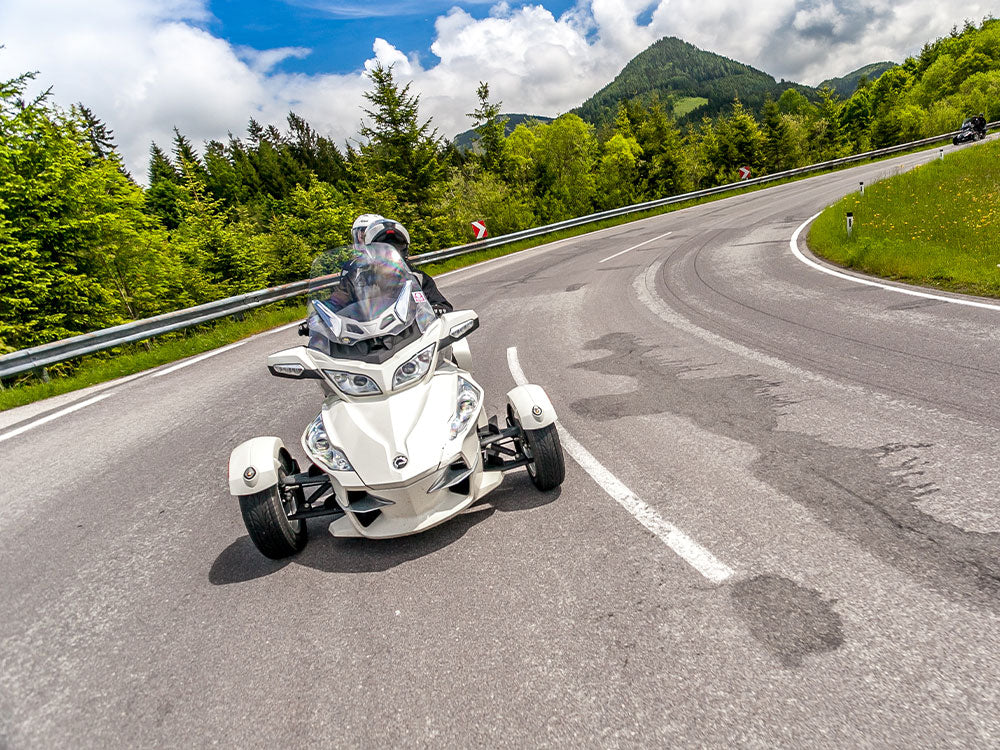
The most common Can-Am Spyder problems are battery and charging faults, front sprocket wear shown by red dust, squealing brakes, ignition key errors, belt vibration, coolant leaks and loose mirrors. Several issues have been safety recalls, including 2015-2019 F3 and RT sprocket wear and 2017-2019 F3 and RT output shaft failure. Check your VIN before buying or riding.
Table of Content
Last updated: October 27, 2026
Can-Am Spyders are motorcycles with a three-wheel configuration, also known as Trikes. The most classic type of trike is the regular trike, with a single wheel towards the front and two wheels in the rear. However, the Can-Am Spyder features an unconventional three-wheel configuration known as the reverse trike, with two front steering wheels and one rear wheel. This wheel configuration is also referred to as a Y-configuration. Having an unconventional design, the Can-Am Spyders are not as common as two-wheelers and are difficult to maintain.
The Can-Am Spyder has a wider front end, resembling the front of a mini-car. They are quite different from two-wheelers as they do not require balancing with your feet when stopped. If you are looking to buy a Can-Am Spyder trike, you should have an idea about how reliable they are and potential issues that may arise. This article discusses the 10 most common Can-Am Spyder problems.
What Are the Most Common Can-Am Spyder Problems?
The most common Can-Am Spyder problems are battery and charging faults, front sprocket wear (red dust), squealing brakes, ignition key errors, belt vibration, coolant leaks, paddle shifter and joystick trouble in wet weather, loose mirrors and a fuel cap that will not seat. Several issues have been safety recalls, including front sprocket wear on 2015-2019 F3 and RT models and a breakable engine output shaft on 2017-2019 F3 and RT models. Check your VIN for open recalls before you buy or ride.
1. How Reliable are Can-Am Spyders?
Can-Am Spyders are not as reliable as standard motorcycles due to their complex designs resembling snowmobiles with an All-Terrain Vehicle (ATV) style chassis. They are ranked the lowest when it comes to the most reliable motorcycle brands.
Reliability varies by model year and by how well a Spyder was maintained, and owner reports are mixed. The clearest evidence is the recall record. Can-Am recalled about 30,400 Spyder F3 and RT models from 2015-2019 for front sprocket wear in 2022, about 8,700 F3 and RT models from 2017-2019 for a breakable engine output shaft in 2024, and 2020-2023 Spyder RT models for a brake light switch fault in 2023. An open recall is a repair to book with a Can-Am dealer, so check any Spyder's VIN before you buy it.
2. 10 Most Common Can-Am Spyder Problems
2.1 Battery and Connections Issues
The Can-Am Spyder’s battery may look simple but often suffers from connection issues. The Can-Am Spyder has a lot of parts that require electricity to operate and riders may also add aftermarket parts like lights, a horn, and a charging option. It is recommended you check the battery connection before the winter or riding seasons. Any issues with the power, steering, and lighting will be indicated by error codes on the dashboard screen. Make sure to charge the battery every once in a while during the winter and replace it after every 4-5 years.
If the battery keeps going flat even after the terminals are tight, the problem may be the charging system rather than the battery. Owners most often trace it to a bad or missing ground, a blown charging fuse, or the stator, which charges the battery while you ride. Check the terminals, ground and fuse first, because those are the cheapest fixes.
2.2 Sprocket Red Dust Issue

On Can-Am Spyder F3 and RT models built from 2015 to 2019, and on some other Spyders, red dust starts to gather on the front sprocket due to rusting and oxidation. Red dust can be an indication of possible mechanical failure. The front sprocket should be changed every 25,000 miles to prevent red dust. This problem arises as the belt moves against the sprocket and a cloud of powdery red dust is generated due to the constant grinding. If you find red dust coating the front sprocket, it should be changed out as soon as possible. The red dust can also be treated using Loctite chemicals used for surface treatments. It is best to replace the sprocket every 25,000 miles.
Red dust, noise and vibration near the front sprocket are the warning signs Can-Am's recall describes. NHTSA recall 22V352 (May 2022) covers about 30,400 Spyder F3 and RT models from 2015-2019, and the recall notice says the front sprocket on affected vehicles needs to be replaced regardless of mileage. Check your VIN with a Can-Am dealer.
2.3 Squeaking Brakes
Most Can-Am Spyder models suffer from squeaking brakes that reduce performance and make an irritating noise. If you are an aggressive rider, it can be dangerous to ride a Can-Am Spyder with squeaking brakes as they can destroy the rotors. Squeaking brakes indicate that they need to be replaced immediately with floating, ventilated rotors, and larger brakes. However, if you are not an aggressive rider, try acquiring brake cleaner to help maintain the condition of the brakes.
2.4 Malfunctioning Ignition System/Key
A malfunctioning ignition system/key is one of the major issues with the Can-Am Spyder RT as it can happen anytime without warning. This problem can occur due to a faulty ignition system or key. If you attempt to switch on the Can-Am Spyder, a bad key error code may appear on the dashboard screen. If this happens, wait for 3-4 min before trying to switch on the motorcycle again. However, the best solution is to reprogram the key function or replace the ignition system, which can be expensive if you do not have a warranty.


2.5 Belt Vibrations
Belt vibrations can negatively affect the Can-Am Spyder’s performance. This happens due to a loose belt drive that causes heavy vibrations while riding. The belt drive also starts to make sounds which may not be possible to adjust if the problem is left unfixed. The only solutions are to replace the belt or adjust its length using a belt tensioner.
2.6 Coolant Leaks

If you have a Can-Am Spyder, keep an eye out for leaking coolant or the smell of an old battery, especially in the Can-Am Spyder F3. Most coolant leaks occur due to cracks in the reservoirs. This also occurs due to low-quality and brittle clamps, sealants, and worn-out pipes. To fix coolant leaks, replace all the tubes, pipes, reservoirs, and housings.
2.7 Paddle Gear Shifter Problem
The Can-Am Spyder F3 series comes with a semi-automatic transmission that allows the riders to quickly shift between gears using a thumb-controlled paddle shifter. This feature continuously shifts between gears when pressed several times. However, it does not function properly while riding in the rain or when still wet after being cleaned. The paddle shifter can become stiff and less responsive.
2.8 Broken Joystick
On rainy days, the Can-Am Spyder’s joystick can malfunction. The joystick helps control the LCD while riding. However, a faulty joystick and other handlebar-mounted controls can be frustrating and distracting to operate while riding.
2.9 Loose Mirrors
Most Can-Am Spyders, especially the Can-Am Spyder F3-T models, are fitted with loose side mirrors as they tend to vibrate and fly off while riding at high speeds. To prevent loose side mirrors from constantly vibrating at high speeds, you can buy side mirror locks or replace them with new ones for a better riding experience.
Can-Am has also listed a safety recall for 2022 and 2023 Spyder F3 and F3-S models because the mirror lenses may dislodge and reduce visibility, so ask a dealer to check your VIN if your mirrors feel loose.
2.10 Fuel Tank Cap Problem
The most common Can-Am Spyder problem is its fuel tank cap not closing properly. You can replace the stock fuel tank cap with a suitable aftermarket fuel tank cap that closes more easily.
A fuel cap that does not seal is a safety issue, not only an annoyance. Early Spyders from 2008-2012 were recalled in two campaigns for fuel vapor leaking from the vent hose and from a fuel cap that did not seal against the filler neck. If you own or are buying a Spyder from those years, run its VIN through a Can-Am dealer to confirm the recall work was done.
3. Can-Am Spyder Recalls to Check Before You Buy or Ride
Can-Am has issued several safety recalls on Spyder models. Check any Spyder's VIN on the Can-Am safety recall page or the NHTSA recall lookup before you buy or ride it. These are the main ones.
Recall |
Models and years |
Problem |
Source |
|---|---|---|---|
NHTSA 22V352 (May 2022) |
Spyder F3 and RT, 2015-2019 (about 30,400 units) |
Front sprocket can wear prematurely and cause loss of drive power; red dust is the warning sign |
|
NHTSA 24V728 (Sept 2024) |
Spyder F3 and RT, 2017-2019 (8,721 units) |
Engine output shaft can fatigue and break, causing loss of drive power; BRP replaces it free below a mileage threshold |
|
NHTSA 23V175 (Mar 2023) |
Spyder RT, all 2020-2021 and certain 2022-2023 |
Brake light switch can leave the brake lights on |
|
BRP Bulletin 2020-5 |
1,407 Spyder RT built Sept 2019 to Feb 2020 |
Weakened brake support could cause loss of braking |
|
Mirror lens recall |
Spyder F3 and F3-S, 2022-2023 |
Mirror lenses may dislodge and reduce visibility |
|
Engine compartment heat |
Spyder RT, 2013 |
Elevated temperature in the engine compartment |
|
Fuel vapor and fuel cap seal (two campaigns) |
Early Spyders, 2008-2012 |
Vapor leaking from the vent hose and from fuel caps that did not seal |
|
Clutch sticking engaged |
Spyder RS SE5 and RT SE5, 2010 |
Clutch can stay engaged |
A recall does not mean a Spyder is a bad buy. It means a known fault has a manufacturer repair. Ask for proof that the recall work was done, because a Spyder with completed recalls is a safer purchase than one with open ones.
4. Can-Am Spyder Problems by Model Generation
The Spyder has had two engine generations, and their weak points differ.
Generation |
Models and years |
Engine |
Problems reported |
|---|---|---|---|
V-twin |
GS, RS and ST, plus RT (2010-2013) |
998cc Rotax V-twin |
Fuel vapor and fuel cap recalls (2008-2012), 2010 clutch recall, 2013 RT engine heat recall, fuel pump pressure loss and throttle position sensor faults |
Inline triple |
RT (2014 on), F3, F3-S, F3-T (2015 on) |
1330cc Rotax ACE |
Front sprocket wear (2015-2019), output shaft fatigue (2017-2019), RT brake light switch (2020-2023), F3 mirror lenses (2022-2023), battery drain when parked, shift hesitation on the semi-automatic gearbox if service is skipped, belt wear |
The two generations share no engine parts, so make sure you are comparing the right bike when you shop for parts or read a repair thread. A Spyder from either generation with documented service and completed recalls is a reasonable buy.
5. More Can-Am Spyder Problems Owners Report
5.1 Parking Brake Will Not Release
Some owners report a parking brake that stays engaged, sometimes because of a failed switch. The regular foot brake still stops the Spyder, but a stuck parking brake leaves you unable to ride away, so have a Can-Am dealer check the switch and cable.
5.2 Reverse Will Not Engage When the Engine Is Warm
Many owners find reverse stops working once the engine is warm. The usual cause is that the reverse button on the handlebar must be pressed while you move the paddle shifter. If reverse still fails, the next things to check are the reverse actuator wiring and its fuse.
5.3 Fuel Pump and Throttle Sensor Faults on V-Twin Models
On the earlier V-twin Spyders, owners report fuel pump pressure loss and throttle position sensor faults that can cause hesitation, limp mode and limited rpm. Fuel pump failures have also been reported on later models, though less often.
5.4 How Much Do Can-Am Spyder Repairs and Maintenance Cost?
Spyders cost more to maintain than most motorcycles because they have three tires, and some work needs Can-Am-trained technicians and special tools. Published dealer price lists have shown about $217 for the 3,000-mile service on an F3 and about $239 on an RT, so confirm current prices with your dealer. Repairs can cost far more: one owner on a Spyder forum reported $1,075 at a dealer to diagnose and replace a failed fuel pump and fuel filter, and shop labor rates quoted in the same thread ran $179 to $225 per hour. Staying on schedule with maintenance is the cheapest way to avoid those bills.
5.5 Buying a Used Can-Am Spyder: What to Check
Before you buy a used Spyder, go through this list:
- Run the VIN for open recalls, especially the 2015-2019 F3 and RT sprocket recall, the 2017-2019 output shaft recall and the 2020-2023 RT brake light recall.
- Look for fine red dust around the front sprocket.
- Test the paddle shifter, reverse, the joystick and the parking brake release.
- Check the drive belt for wear and for vibration on a test ride.
- Look for coolant stains or a battery smell around the reservoirs.
- Check that the mirrors are tight and the fuel cap seals.
- Ask for service records and who did the work.
6. Takeaway
Can-Am Spyders offer a unique riding experience and have an unconventional design that makes them popular among women and older riders. They are easier to handle, balance, and control than two-wheelers. However, due to their unorthodox construction and unique frame, Can-Am Spyders are difficult to maintain and repair, which makes them less reliable. Most Can-Am Spyders are prone to the issues covered in this article. Most Can-Am Spyder issues require replacing certain parts which can be expensive. If you love riding a Can-Am Spyder, you can easily install specially-designed saddlebags for the Can-Am Spyder F3 and the Can-Am Spyder F3-S available at Viking Bags.
7. FAQs
Are Can-Am Spyders reliable?
Can-Am Spyders have mixed reliability. It depends on the model year and on maintenance, and several years carry safety recalls. A Spyder with service records and completed recalls is the safest choice.
What are the most common Can-Am Spyder problems?
Owners most often report battery and charging faults, front sprocket wear shown by red dust, squealing brakes, ignition key errors, belt vibration, coolant leaks and loose mirrors.
Which Can-Am Spyder years have recalls?
Spyder recalls cover fuel vapor leaks on 2008-2012 models, engine heat on the 2013 RT, front sprocket wear on 2015-2019 F3 and RT models, output shaft failure on 2017-2019 F3 and RT models, and brake light switches on 2020-2023 RT models. Check your VIN to see which apply.
How long do Can-Am Spyders last?
A well-maintained Spyder is commonly reported to reach 50,000 to 100,000 miles or more. That figure is an owner-based estimate, not a Can-Am guarantee, and it depends heavily on following the service schedule.
Are Can-Am Spyders expensive to maintain?
Yes, more than most motorcycles. A Spyder has three tires, and some work needs trained technicians and special tools, which raises labor costs. Dealer pricing for the 3,000-mile service has been around $217 to $239, and larger repairs can run into the thousands.
Is the Can-Am Spyder still made in 2026?
Yes. Can-Am's 2026 three-wheel lineup includes the Spyder RT and F3 families, alongside the Canyon and Ryker.
Popular Collections


Leave a comment
All comments are moderated before being published.
This site is protected by hCaptcha and the hCaptcha Privacy Policy and Terms of Service apply.