
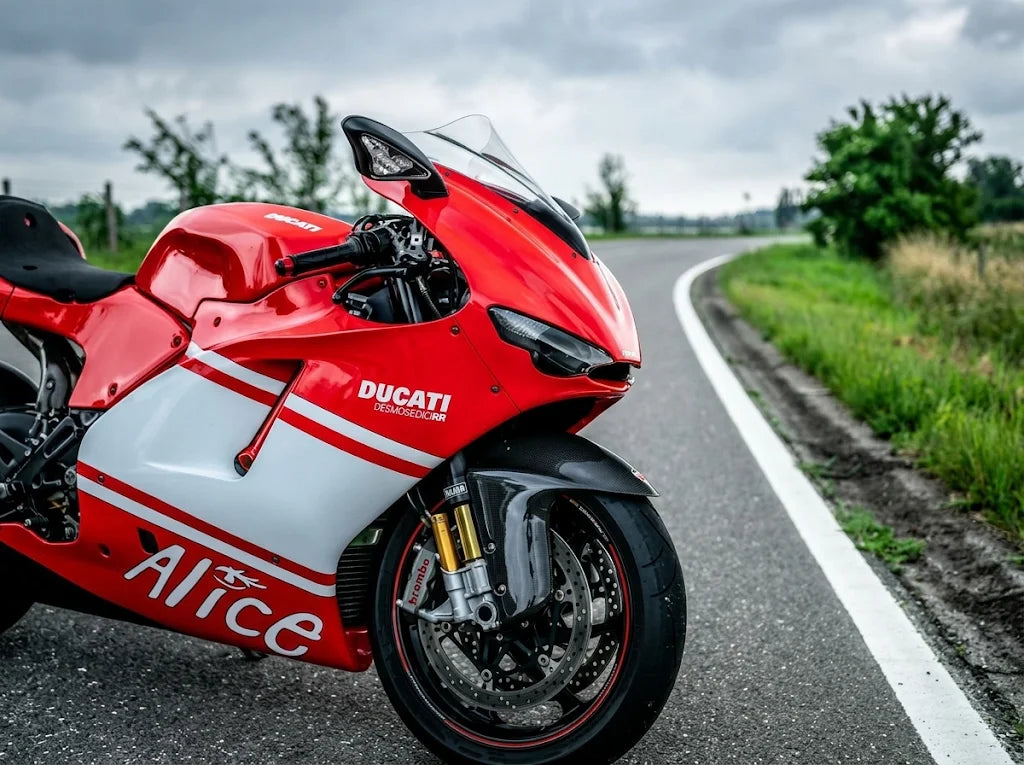
The Ducati Desmosedici RR is a 1,500-unit, 989cc MotoGP replica rated at 200 hp only with its racing exhaust and control unit. In road trim it makes about 181 hp.
Table of contents
Some motorcycles look intimidating while parked. Then you notice the carbon bodywork, the single exhaust outlet in the tail and the lack of any electronic rider aids, and you understand why experienced riders treat the Ducati Desmosedici RR with respect.
It’s also one of the most misquoted bikes in the sport. Headlines say “200 hp, street-legal MotoGP bike” and stop there. The details are more interesting, and they matter if you’re comparing it with a modern superbike or thinking about buying one.
Quick answer: The Desmosedici RR is a limited-production (1,500 units), 989cc MotoGP-derived road bike built in 2007–2008. Ducati’s 200 hp figure applies to the configuration with the supplied racing exhaust and dedicated control unit. In road-homologated trim, Ducati’s owner’s manual lists about 181 hp. It feels demanding because it has no ABS or traction control, a racing riding position, a sensitive throttle, a short wheelbase and an unusual 16-inch rear tire. A modern Panigale V4 R makes more power in U.S. road trim (208.4 hp) and adds electronic aids, but it is still no beginner bike.

1. The Desmosedici RR vs the 2026 Panigale V4 R at a glance
| Ducati Desmosedici RR | 2026 Panigale V4 R (U.S.) | |
|---|---|---|
| Purpose | Road replica of Ducati’s GP6 MotoGP bike | WorldSBK-homologation road superbike |
| Engine | 989cc 90° V4, desmodromic | 998cc Desmosedici Stradale R V4 |
| Road-trim power | About 181 hp (133 kW) | 208.4 hp |
| Race-configuration power | 200 hp (147.1 kW) with racing exhaust and dedicated ECU | 235.3 hp with racing exhaust; 239 hp with Ducati Corse oil (closed-course only) |
| Wheelbase | 1,430 mm | 1,477 mm |
| Tires | 120/70 ZR17 front, 200/55 ZR16 rear | 120/70 ZR17 front, 200/60 ZR17 rear |
| Rider aids | No ABS, no traction control | Cornering ABS, traction, wheelie, slide and engine-brake control, up/down quickshifter |
| Suspension | Öhlins fork and shock | Öhlins NPX25/30 fork, TTX36 shock, SD20 steering damper (mechanical, not semi-active) |
These are manufacturer specifications, not independent measurements. Ducati quotes the RR’s output in metric horsepower (200 hp = 147.1 kW, roughly 197 hp in imperial terms), and the two bikes use different measurement conventions, so treat the comparison as approximate.
2. What is the Ducati Desmosedici RR?
Ducati unveiled the Desmosedici RR in 2006 as a road-going version of its GP6 MotoGP machine. Production ran in 2007 and 2008, limited to 1,500 bikes. It brought a 90° desmodromic V4, forged magnesium Marchesini wheels, radial Brembo monobloc front calipers, Öhlins suspension and carbon-fiber bodywork to paying customers. The tail houses a 4-2-1 exhaust that exits through a single vertical outlet.
It is a road-homologated motorcycle, not a literal MotoGP prototype with lights. “MotoGP bike with a license plate” describes its character, but road approval meant compromises. For the broader story of how Ducati reached this point, see our history of Ducati motorcycles. This article stays focused on what the RR means for riders and owners today.


2.1 Does the Desmosedici RR really make 200 horsepower?
As a manufacturer claim in race-kit configuration, yes. Ducati specified 200 hp at 13,800 rpm and 116 Nm of torque with the supplied 102 dB racing exhaust (no catalytic converter) and its dedicated control unit. In road-homologated trim, the owner’s manual lists roughly 181 hp at 13,750 rpm and 104 Nm.
That gap is why you should be careful with “200 hp” in a listing. A bike advertised with a race ECU and exhaust does not automatically make 200 hp today. Output depends on the configuration, the measuring method and the engine’s condition, and it should be confirmed with documentation and a proper dyno test. Also check whether the racing exhaust is allowed on your roads, because it was not the road-approved system.
2.2 Is the Desmosedici RR street legal?
It was sold as a road-homologated motorcycle with a catalytic exhaust. Whether an individual bike is legal and usable on the road depends on its configuration, especially the exhaust, and on local noise and emissions rules. If you’re buying one, confirm the exact setup and paperwork before assuming anything.

2.3 How does it compare with a 2026 Panigale V4 R?
On paper, the newer bike is more powerful. In U.S. trim the V4 R makes a claimed 208.4 hp, more than the RR’s 200 hp race-kit figure. Ducati also quotes up to 239 hp with the full racing exhaust and Ducati Corse oil, but that is a closed-course setup, not a road-legal one.
The bigger difference is how the performance is delivered. The V4 R has cornering ABS, traction control, wheelie control, slide control, engine-brake management and a bidirectional quickshifter. Those systems can reduce rider workload, but they don’t change the physics of grip or make a race-derived bike suitable for a beginner.
One detail people often mix up: the V4 R uses mechanical Öhlins suspension, while the Panigale V4 S is the model with semi-active suspension. If you want the wider horsepower picture, our guide to the most powerful motorcycles of 2026 ranks the current field. Here the question isn’t who wins a power contest. It’s why a bigger number doesn’t always mean a scarier bike.
2.4 Why does the Desmosedici RR feel so intimidating?
Several factors combine, and horsepower is only one of them.
- No electronic safety net. Period road tests describe it without ABS or traction control, so the rider’s right hand does the work.
- Sensitive throttle response. Reviewers noted a noticeable step in power delivery between closed and open throttle, which rewards smooth hands.
- Short wheelbase and racing geometry. At 1,430 mm, it is shorter than the V4 R’s 1,477 mm and tuned for sharp turn-in.
- A focused riding position. It was designed for track-style riding, not comfort.
- Heat and age. The underseat exhaust runs hot, and every surviving bike is now almost twenty years old.
None of this makes it unsafe by definition. It means the bike asks for precision, preparation and respect, and the cost of a mistake is higher than on a bike with modern aids.
2.5 Does the 16-inch rear wheel make it dangerous?
Not by itself. Turn-in feel depends on wheel and tire profile, geometry, suspension setup and weight distribution together, so blaming one number is misleading. What the 16-inch rear does create is a tire-sourcing and compatibility question.
The RR runs a 120/70 ZR17 front and a 200/55 ZR16 rear. Bridgestone developed a dedicated tire for it because a standard MotoGP size wasn’t road-legal. Modern superbikes, including the Panigale V4 R, use a 17-inch rear (200/60 ZR17 on the V4 R). You cannot assume a current 17-inch sport tire fits an original RR wheel. Some owners fit aftermarket 17-inch wheels, but that’s a decision for a Ducati specialist and the tire maker, not something to improvise.
3. Tire age and condition matter more than the headline number
An old tire can look fine and still be compromised. Michelin recommends a professional inspection once a tire has five years of use, repeated annually, and replacement ten years after the manufacture date even if the tread looks good. Damage or reduced grip means replacing it sooner. The manufacture date is in the DOT code on the sidewall.
That’s especially relevant on a collectible that may have sat for long periods. Cool pavement, damp patches and loose gravel are all reasons to ride more conservatively, and none of them is a mechanical fault. A high-output bike needs fresh, correctly sized, correctly inflated tires on a surface you trust. If a tire’s age, condition or suitability is uncertain, replace it before you ride.

4. What to check on a rare race replica
A low-mileage bike can still have age-related problems. Before regular use, or before buying, have a specialist inspect:
- Tires and wheels: manufacture dates, sizes, pressures, condition and an approved fitment.
- Brakes and suspension: fluid condition, seals, fork and shock service history, and damper setup.
- Final drive and fasteners: chain, sprockets, wheel hardware and all safety-critical fasteners, to the correct specification.
- Cooling, fueling and electronics: leaks, wiring, fuel-system age, and which ECU and exhaust are installed.
- Documents: service records, title, insurance and local noise and emissions requirements.
Parts for a limited-run carbon-bodied bike can be costly and hard to find. Prices vary widely with the part, market and condition, so get quotes rather than rely on rough figures from forums.
5. Is the Desmosedici RR the world’s most dangerous motorcycle?
No credible ranking proves that label. “Widowmaker” is a nickname that has attached itself to many bikes for different reasons. It’s more useful to name specific risk factors. For the RR, those are high power for its era, no standard electronic aids, a focused riding position, aging components and tire sourcing. They don’t mean every RR is unsafe or every owner reckless. A modern superbike can be just as hazardous in untrained hands, and an ordinary bike on bald tires can be dangerous too. For the wider history of the nickname, see our guide to the most dangerous motorcycles ever produced.
6. Could you live with one on the road?
For occasional rides, yes. As a daily bike, it’s a stretch. The RR is a single-seater with a racing riding position, almost no storage, specialist servicing needs and rare, expensive parts.
If you simply want to carry a phone, wallet and a small bottle on a normal road ride, a lightweight rider-worn bag is more realistic than bolting luggage to the bike, especially with the exhaust exiting through the tail. Our motorcycle backpack collection includes rider-carried options, and the 12L Explorer backpack comes with a chest harness and adjustable shoulder, waist and chest straps. On a track-focused machine, carrying less is usually better, and track days may have their own rules about bags. Riders with other sportbikes can browse our street and sportbike luggage guide, and Ducati owners can see the Ducati luggage range.
7. What the RR teaches about superbike progress
Put the RR next to a Panigale V4 R and the lesson isn’t that modern bikes are easy. It’s that performance is now delivered differently. Brakes, chassis development and electronics help a skilled rider, but they can’t create grip on gravel or repair an aged tire. A rider who relies on a dashboard full of assistance has misunderstood the bargain.
That’s why the old 200-hp Ducati still leaves such a strong impression. Its reputation doesn’t come from a dramatic nickname. It comes from asking for preparation, precision and mechanical sympathy every time it leaves the garage.
8. Frequently asked questions
How much horsepower does the Ducati Desmosedici RR make?
Ducati quotes 200 hp (147.1 kW) at 13,800 rpm with the supplied racing exhaust and dedicated control unit. In road-homologated trim, the owner’s manual lists about 181 hp (133 kW) at 13,750 rpm.
How many Desmosedici RRs were built?
Ducati built 1,500 examples, in 2007 and 2008.
What engine does the Desmosedici RR have?
It has a 989cc, liquid-cooled, 90° V4 with desmodromic valve actuation, derived from Ducati’s GP6 MotoGP engine.
Does the Desmosedici RR have traction control?
No. Period road tests describe it without ABS or traction control. Check any individual bike for later modifications.
What tire size does the Desmosedici RR use?
The front is 120/70 ZR17 and the rear is 200/55 ZR16, originally a dedicated Bridgestone design. Confirm any replacement with a Ducati specialist and the tire manufacturer.
Is the 2026 Panigale V4 R more powerful than the Desmosedici RR?
On Ducati’s U.S. road figures, yes: 208.4 hp against roughly 181 hp for the RR in road trim, or 200 hp in race-kit form. The V4 R’s 239 hp is a closed-course setup, so the comparison isn’t like for like.
Should a new rider buy a Desmosedici RR?
No. It combines extreme performance, rare parts and no electronic aids, so it suits advanced riders with specialist support and a realistic maintenance budget.
9. Final verdict
The Ducati Desmosedici RR deserves its reputation as a spectacular, uncompromising motorcycle. Its 200-hp figure is real as a race-kit claim, its link to MotoGP is extraordinary, and the way it rides is a world apart from a current Panigale. The practical lesson is simpler: horsepower alone doesn’t decide how intimidating a bike feels. Tires, condition and rider skill matter just as much.
Specifications are manufacturer-published figures as of November 2026 and are not independent test results.




Leave a comment
All comments are moderated before being published.
This site is protected by hCaptcha and the hCaptcha Privacy Policy and Terms of Service apply.