Automatic motorcycles are becoming a much bigger part of the 2026 motorcycle market. This guide explains how today’s automatic and automated transmissions work, including Honda DCT, Yamaha Y-AMT, BMW ASA, KTM AMT, and Kawasaki’s system, while clarifying why E-Clutch and quickshifters are not the same thing. It also looks at the automatic motorcycles available in 2026, how they ride, and which type may suit commuting, touring, adventure riding, or everyday use.
Yes, automatic motorcycles exist. And in 2026, there are more factory-built options than there were just a few years ago.
Honda has its Dual-Clutch Transmission (DCT), Yamaha has Y-AMT, BMW has ASA, KTM has AMT, and Kawasaki uses an automated manual transmission on its Ninja 7 Hybrid and Z7 Hybrid. There are also regional models from manufacturers such as CFMOTO and QJMotor.
The confusing part is the word automatic.
A Honda DCT is not the same transmission as Yamaha Y-AMT. BMW ASA works differently again, while Honda E-Clutch automates clutch operation without automatically selecting every gear for the rider. Quickshifters are another thing entirely.
So if you're looking for an automatic motorcycle, the useful question is not simply whether a bike has a clutch lever.
It's what the transmission actually automates, what the rider still controls, and which motorcycles use that system in 2026.
Table of contents

1. What Counts as an Automatic Motorcycle?
On a conventional motorcycle, the rider operates the clutch and selects the gears.
An automatic or automated system takes some or all of that work away. The exact mechanism depends on the motorcycle.
For this article, an automatic motorcycle means a factory-built motorcycle that can select its own gears in a normal automatic operating mode without the rider operating a conventional clutch lever.
That definition includes DCT and automated manual systems that can shift automatically. It does not mean every motorcycle that happens to be clutchless.
Here is the distinction that makes the rest of the subject easier to understand:
System |
Automatic clutch? |
Automatic gear changes? |
Manual shifting possible? |
What the rider mainly controls |
Honda DCT |
Yes |
Yes |
Yes |
Throttle, braking and optional gear selection |
Yamaha Y-AMT |
Yes |
Yes in AT mode |
Yes |
Throttle, braking and optional manual shifts |
BMW ASA |
Yes |
Yes in D mode |
Yes |
Throttle, braking and optional manual shifts |
KTM AMT |
Yes |
Yes in automatic mode |
Yes |
Throttle, braking and optional manual shifts |
Kawasaki automated manual |
Yes |
Yes in automatic mode |
Yes |
Throttle, braking and optional button shifts |
Honda E-Clutch |
Yes |
No |
Yes |
Throttle, braking and gear selection |
Quickshifter |
No automatic gear selection |
No |
Yes |
Clutch/shift controls and gear selection |
CVT |
System-controlled |
Continuously variable |
Usually no |
Throttle and braking |
Electric direct drive |
No conventional clutch |
No conventional gear changes |
No |
Throttle and braking |
The important line is automatic gear changes.
A motorcycle can operate without a clutch lever and still require the rider to select every gear. That is why E-Clutch, quickshifters and some semi-automatic motorcycles should not automatically be described as fully automatic.
2. How Do Automatic Motorcycle Transmissions Work?
2.1. Honda DCT
Honda's Dual-Clutch Transmission is one of the clearest examples of a true automatic motorcycle transmission.
Instead of one clutch handling every gear, DCT uses two clutch packs. One manages one group of gears while the other manages the remaining gears. The system can select gears automatically, but the rider can also request shifts manually using the motorcycle's controls.
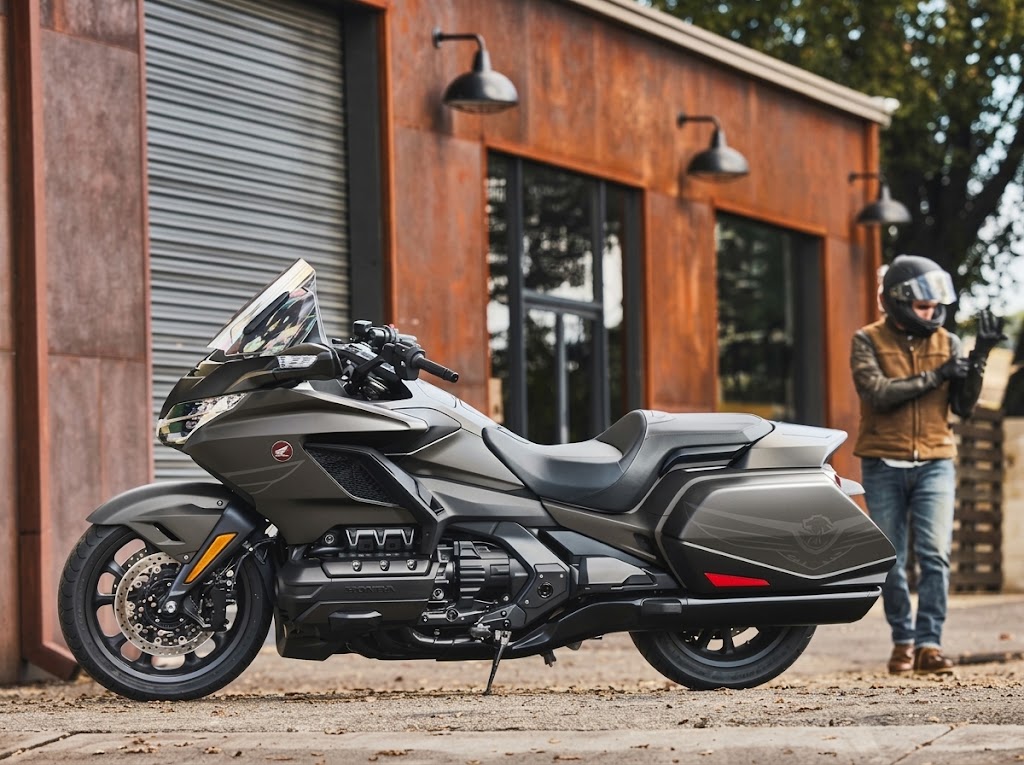
Honda's 2026 DCT lineup includes motorcycles such as the Gold Wing, Africa Twin, NC750X, NT1100 and Rebel 1100. The Gold Wing uses a seven-speed automatic DCT, while the other DCT motorcycles in Honda's current lineup use six-speed systems.
The Africa Twin is a useful example because Honda allows the rider to leave it in fully automatic mode or use paddle shifters for manual gear selection.
So a DCT motorcycle is still a conventional geared motorcycle underneath. The difference is that the motorcycle itself manages clutch engagement and gear changes.

2.2. Yamaha Y-AMT
Yamaha takes a different approach with Y-AMT, or Yamaha Automated Manual Transmission.
The basic gearbox remains a conventional sequential motorcycle transmission, but the motorcycle uses electronic and electromechanical control to operate the clutch and change gears.
Yamaha's system can run in automatic mode or manual mode. In manual operation, the rider changes gears using handlebar controls rather than a conventional foot-operated shift lever and clutch lever.
Yamaha expanded Y-AMT into additional 2026 models, including the MT-07, MT-09, TRACER 7 and TRACER 7 GT, while the TRACER 9 range also has Y-AMT versions in European markets.
That makes Y-AMT particularly interesting for riders who still want to choose their gears but would rather remove clutch operation from the equation.

2.3. BMW ASA
BMW's Automated Shift Assistant, or ASA, follows the automated-manual approach as well.
BMW uses two electromechanical actuators to automate clutch operation and gear changes in a conventional six-speed gearbox.
In automatic D mode, the motorcycle selects the gears. In manual M mode, the rider can choose the shift points while the system continues to handle clutch operation.
BMW offers ASA on its R 1300 platform, including the R 1300 GS, R 1300 GS Adventure, R 1300 R, R 1300 RS and R 1300 RT, although exact equipment and option availability varies by market and configuration.
The system does not replace the motorcycle's conventional gearbox with something resembling a scooter transmission. It automates the work normally done by the rider.

2.4. KTM AMT
KTM has taken the automated-manual concept into the adventure category with the 1390 Super Adventure S EVO.
Its AMT system can operate automatically or allow manual gear selection. The motorcycle is still using a six-speed gearbox; the difference is who operates the clutch and controls the shifts.
The 2026 1390 Super Adventure S EVO is a production motorcycle rather than a prototype or future concept. KTM is also actively promoting its AMT technology in 2026.
That is worth pointing out because older articles about KTM AMT may describe it as something that was still “coming.” That is no longer an accurate description of the current production bike.

2.5. Kawasaki's Automated Manual Transmission
Kawasaki's Ninja 7 Hybrid and Z7 Hybrid are another interesting case.
Both motorcycles combine a 451cc parallel-twin engine with an electric traction motor and a six-speed electronically controlled automated manual transmission.
The transmission can operate automatically or manually. In automatic operation, the motorcycle controls both the gear changes and hydraulic clutch operation. In manual operation, the rider uses buttons on the handlebar rather than a conventional shift pedal.
Kawasaki's 2026 update also added an automatic transmission mode to Sport Mode.
These motorcycles are therefore different from a conventional electric motorcycle and different from Honda DCT, but they still meet the practical definition of an automatic motorcycle because the transmission can select its own gears.


2.6. What About Honda E-Clutch?
This is where a lot of automatic-motorcycle lists get the terminology wrong.
Honda E-Clutch is not the same thing as Honda DCT.
Honda E-Clutch automates clutch operation, but the motorcycle still has a conventional manual gearbox and the rider still selects the gears.
Honda's 2026 Rebel 300 E-Clutch is a good example. Honda lists it with a six-speed manual transmission with E-Clutch. The system allows the rider to shift without using the clutch lever, but the rider still changes gears with the foot-operated shifter.
Honda also offers E-Clutch on the 2026 Transalp. Again, it is an automated clutch system rather than a DCT-style automatic transmission.
That makes E-Clutch useful for a different type of rider. Someone who enjoys choosing gears but dislikes repeated clutch operation gets a very different benefit from someone who wants the motorcycle to select gears automatically.
The cost difference is also not as simple as adding a fixed “automatic premium.” E-Clutch and DCT are often fitted to different motorcycles, engine sizes and equipment levels, so comparing sticker prices without controlling for the motorcycle itself can be misleading.
The maintenance implications are different as well. E-Clutch retains a conventional manual gearbox and clutch assembly, with additional electronic hardware controlling the clutch. DCT uses a substantially different transmission architecture with two clutch packs and its own control hardware.
That does not make one system inherently unreliable. It means they are different mechanical systems with different service requirements.
Resale is harder to generalize. There is not enough model-independent evidence to claim that either E-Clutch or DCT consistently adds or subtracts a particular amount from used value. The motorcycle, model year, condition, mileage and local demand can have a much larger effect.
The rider profiles are easier to separate:
E-Clutch is for the rider who still wants to choose gears but does not always want to operate the clutch. DCT is for the rider who wants the motorcycle to be capable of choosing the gears as well.
With E-Clutch, you still shift.
With DCT, the motorcycle can shift for you.


2.6. What About a Quickshifter?
A quickshifter is not automatically an automatic transmission.
A quickshifter lets the rider make gear changes without manually operating the clutch lever. Depending on the system, it can assist with upshifts, downshifts or both.
But the rider is still deciding when to change gears.
Think of it this way:
Manual transmission: you operate the clutch and select the gear.
Quickshifter: you still select the gear, but the system helps with the shift.
E-Clutch: the system manages clutch operation, but you still select the gear.
DCT/AMT/ASA/Y-AMT in automatic mode: the motorcycle can select the gear for you.
That is a much more useful distinction than simply calling all of them “clutchless.”
2.7. What About CVT Motorcycles?
A continuously variable transmission (CVT) is another legitimate form of automatic transmission.
Instead of using fixed gears such as first, second, third and fourth, a CVT continuously varies the transmission ratio.
CVTs are extremely common on scooters and maxi-scooters, which is why they sometimes dominate searches for automatic bikes.
They are less common on the conventional full-size motorcycles that most riders picture when they search for an “automatic motorcycle.”
For this article, DCT and automated manual motorcycles are the main focus because they retain the traditional motorcycle format of a geared drivetrain.
2.8. What About Electric Motorcycles?
Electric motorcycles add another wrinkle.
Many electric motorcycles use a direct-drive or single-speed arrangement. There may be no conventional clutch or multi-speed gearbox for the rider to operate.
From the rider's point of view, that can feel automatic because there is no shifting.
Technically, though, it is better to describe a direct-drive electric motorcycle separately from a motorcycle equipped with an automated multi-speed transmission.
A DCT motorcycle automatically changes between mechanical gears.
A direct-drive electric motorcycle may simply have no conventional gears to change.
Those are different solutions to the same rider problem.
3. Which Motorcycle Brands Make Automatic Motorcycles in 2026?
The 2026 market is considerably broader than the old “Honda DCT” answer suggests.
The main factory systems currently worth knowing are:
Manufacturer |
System |
2026 examples |
Availability |
Honda |
DCT |
Gold Wing, Africa Twin, NC750X, NT1100, Rebel 1100 |
Current; exact models vary by market |
Yamaha |
Y-AMT |
MT-07, MT-09, TRACER 7, TRACER 7 GT, TRACER 9 family |
Primarily market-specific; strong European presence |
BMW Motorrad |
ASA |
R 1300 GS, GS Adventure, R 1300 R, R 1300 RS, R 1300 RT |
Market/configuration dependent |
Kawasaki |
Automated manual |
Ninja 7 Hybrid, Z7 Hybrid |
Market-specific |
KTM |
AMT |
1390 Super Adventure S EVO |
Current 2026 production |
CFMOTO |
AMT |
450CL-C AMT |
Regional; China-market example |
QJMotor |
AMT |
SRV 250 A, SRV 400 A and related variants |
Regional; Japan-market examples |
The table is intentionally not labeled “every automatic motorcycle in the world.”
That would be difficult to defend because manufacturers sell different models in different countries, and regional manufacturers can add models that never reach North America or Europe.
The useful question for a buyer is always:
Is this model actually sold in the market where I intend to buy it?
4. 2026 Automatic Motorcycle Models You Can Buy
4.1. Honda DCT motorcycles
among the major motorcycle manufacturers.
Its 2026 U.S. DCT lineup includes:
Gold Wing Automatic DCT
Gold Wing Tour Automatic DCT
Gold Wing Tour Airbag Automatic DCT
Africa Twin DCT
Africa Twin Adventure Sports ES DCT
NC750X DCT
NT1100 DCT
Rebel 1100 DCT
Rebel 1100 DCT SE
Rebel 1100T DCT
Honda's current DCT material confirms the Gold Wing's seven-speed automatic DCT and the six-speed DCT systems used on models such as the Africa Twin, NC750X and Rebel 1100.
The variety is important. Honda does not treat automatic transmission as something that belongs to only one type of motorcycle.
You can find it on a luxury tourer, adventure bike, sport tourer, practical middleweight and cruiser.
4.2. Yamaha Y-AMT motorcycles
Yamaha's 2026 Y-AMT range is particularly significant because the technology has moved beyond a single model.
Verified European-market examples include:
MT-07 Y-AMT
MT-09 Y-AMT
TRACER 7 Y-AMT
TRACER 7 GT Y-AMT
TRACER 9 Y-AMT
TRACER 9 GT Y-AMT
TRACER 9 GT+ Y-AMT
Yamaha's European 2026 pricing and model material confirms Y-AMT versions across the TRACER range, while Yamaha's 2026 materials also show MT-07 and MT-09 Y-AMT models.
Exact availability depends on country. A Y-AMT model appearing in a European Yamaha lineup does not mean the same configuration is offered in the United States or every other market.
4.3. BMW ASA motorcycles
BMW's 2026 ASA-equipped R 1300 family includes:
R 1300 GS
R 1300 GS Adventure
R 1300 R
R 1300 RS
R 1300 RT
The system can operate automatically or manually, but the clutch operation remains automated. BMW describes ASA as two electromechanical actuators controlling clutching and shifting in the conventional six-speed gearbox.
For a rider who wants a large touring or adventure motorcycle without manually operating the clutch, ASA is a different proposition from simply fitting a quickshifter.
4.4. Kawasaki Ninja 7 Hybrid and Z7 Hybrid
Kawasaki's two strong-hybrid motorcycles deserve their own category because the transmission is part of a larger hybrid powertrain.
The:
Ninja 7 Hybrid
Z7 Hybrid
use a six-speed automated manual transmission.
Kawasaki allows full automatic operation as well as manual button shifting. The motorcycles can also use their electric motor and combustion engine in different combinations depending on riding mode.
This is not an electric motorcycle disguised as a gasoline motorcycle. It is a strong hybrid with an internal-combustion engine, electric traction motor and automated six-speed transmission.
4.5. KTM 1390 Super Adventure S EVO
KTM's 2026 1390 Super Adventure S EVO brings AMT to a high-performance adventure platform.
The motorcycle retains a six-speed gearbox but automates clutch and shifting when the rider selects automatic operation. Manual control remains available.
The 2026 model is already in production and being actively promoted by KTM, so it belongs in the current-model section rather than an “upcoming technology” section.
4.6. CFMOTO 450CL-C AMT
CFMOTO demonstrates why automatic-motorcycle research cannot be limited to the biggest Japanese and European manufacturers.
The 450CL-C AMT is a 449cc parallel-twin motorcycle with an automated manual transmission. CFMOTO's market-specific information describes automatic modes and manual paddle control.
It is an important current regional example, but it should not be presented as universally available.
4.7. QJMotor AMT models
QJMotor also has automated motorcycles in selected markets.
Its Japanese lineup includes AMT versions of models such as the SRV 250 A and SRV 400 A, with market-specific model names and configurations.
These motorcycles are useful evidence that automated motorcycle transmissions are spreading into smaller and more affordable platforms, but availability is regional.
5. What Are Automatic Motorcycles Like to Ride?
Removing the clutch lever does not make every automatic motorcycle feel the same.
A DCT Gold Wing still feels like a Gold Wing.
An R 1300 GS with ASA still feels like a large boxer-powered adventure motorcycle.
An MT-07 Y-AMT still has the basic character and chassis of an MT-07.
What changes is your relationship with the transmission.
Published testing of DCT, Y-AMT and ASA also shows that the systems do not all behave identically. Shift timing, low-speed clutch behavior, engine braking and automatic-mode programming can change the character of the ride.
5.1. In city traffic
This is where the benefit is easiest to understand.
Stop, move, shift, slow down, stop again. On a conventional motorcycle, your left hand and left foot repeat those actions throughout the ride.
An automatic system can take much of that work away.
Honda specifically points to low-speed maneuvering and reduced rider workload as advantages of DCT.
DCT testing has generally found the system smooth and easy to use in traffic, particularly on touring-oriented motorcycles. At the same time, the exact feel varies by model and transmission programming.
Y-AMT can also work well in traffic, but its behavior is different. Published testing of the MT-07 and MT-09 Y-AMT describes smooth clutch engagement from a stop followed by quick automated shifts. Testers have differed on how natural the automatic shift timing feels, with some preferring it and others wanting different shift points.
That is useful information for a buyer. “Automatic” does not tell you exactly how the motorcycle will behave when traffic is crawling or when you accelerate away from a stop.
5.2. On the highway
Once you're cruising, the difference can become less dramatic.
You may spend long stretches in one gear on a conventional motorcycle anyway.
The advantage of an automatic system becomes more noticeable when traffic speed changes, when you need a quick burst of acceleration, or when the road requires frequent gear changes.
DCT systems are generally designed to make those changes without requiring the rider to manage the clutch. But automatic programming can still influence how the motorcycle feels. A transmission that holds a high gear longer may feel relaxed to one rider and slow to respond to another.
Manual override can address that when the rider wants a lower gear sooner.
Y-AMT gives the rider a similar option. In automatic mode, the system decides when to shift. In manual mode, the rider can select the gear from the handlebar controls.
5.3. On winding roads
This depends heavily on the transmission's programming and the rider's preferences.
Published Y-AMT testing has produced mixed results. Some testers found the automatic shift timing natural on faster roads, while others reported unwanted upshifts during corners or shifts that did not arrive when expected.
Honda DCT testing shows a similar tradeoff on some models. Automatic mode can work extremely well for relaxed riding, but a rider who wants a specific lower gear for engine braking or corner exit may prefer to request that gear manually.
That is one reason manual override is useful on systems such as DCT, Y-AMT, ASA and AMT.
You can let the motorcycle manage the routine shifts and still intervene when you want more control.
BMW ASA is somewhat different in feel because it remains closely tied to a conventional six-speed gearbox. Published testing of the R 1300 GS has found the gear changes familiar, while the absence of a manually operated clutch changes the way the rider handles very slow-speed situations.
5.4. On hills
Automatic systems can remove the need to coordinate clutch engagement with throttle input when starting or changing speed on an incline.
That can be useful, but the motorcycle's weight still matters.
A 500-pound-plus adventure motorcycle does not become a lightweight bike because its transmission is automatic.
You still have to balance it, brake it, steer it and manage its momentum.
5.5. During low-speed maneuvering
This is one of the more interesting areas.
Slow-speed riding requires careful throttle and balance control regardless of transmission type.
An automated clutch removes one variable from the rider's workload, but it does not remove the need to control the motorcycle smoothly.
Honda DCT testing has generally found good low-speed behavior, particularly on the Gold Wing, although testing of other DCT-equipped motorcycles has shown that the system does not always reproduce the precise clutch feel of a manually controlled motorcycle.
BMW ASA presents another approach. Because the system controls the clutch electronically, the rider cannot manually slip the clutch in the same way as on a conventional motorcycle. That can take some adjustment during very slow maneuvers.
Y-AMT testing generally reports smooth clutch engagement from a stop, but it also requires the rider to adapt to an automated clutch rather than relying on a physical clutch lever.
So there is no universal “automatic motorcycle feel.”
DCT, Y-AMT and ASA all remove clutch operation, but they do not produce identical throttle response, shift timing, engine braking or low-speed behavior.
6. Are Automatic Motorcycles Good for Beginners?
They can be.
But automatic does not automatically mean beginner-friendly.
An automatic motorcycle removes some of the coordination involved in operating a conventional clutch and gearbox. That can make the first few rides less complicated for someone who is struggling with clutch control.
It does not remove the fundamentals of riding.
A beginner still needs to learn:
throttle control
braking
steering
body position
low-speed balance
cornering
hazard awareness
proper motorcycle control
And the motorcycle itself matters.
A 286cc Rebel 300 E-Clutch, for example, is a very different proposition from a 1,833cc Gold Wing DCT or a large BMW R 1300 GS with ASA.
Even Honda's Rebel 300 E-Clutch is not actually an automatic motorcycle in the full sense. Honda lists it as a six-speed manual with E-Clutch.
So if your goal is specifically no clutch operation and no manual gear selection, look for a motorcycle with a true automatic mode rather than simply searching for “clutchless.”
If you are simply trying to make learning easier, E-Clutch may be relevant too—but it is a different solution.
7. Automatic Motorcycles for Commuting, Touring and Adventure Riding
The type of riding you do can matter more than the word “automatic” on the specification sheet.
7.1. Commuting
For stop-and-go riding, an automatic transmission can reduce repetitive clutch and shifting work.
The Honda NC750X DCT is a good example because its design already emphasizes practical road use and integrated storage. Yamaha's MT-07 and MT-09 Y-AMT models bring the same basic transmission idea into lighter naked-bike platforms.
7.2. Touring
Touring is another obvious use case.
Honda offers DCT on the Gold Wing and NT1100. BMW offers ASA on the R 1300 RT, and Yamaha's Y-AMT is available on several TRACER models in Europe.
Over a long day, removing repeated clutch operation and routine gear changes can change how much attention the rider spends on the drivetrain.
That does not necessarily make the motorcycle better for every touring rider. Some people enjoy being directly involved with every shift.
7.3. Adventure riding
Automatic and automated transmissions have become much more interesting in the adventure category.
Honda offers DCT on the Africa Twin. BMW offers ASA on the R 1300 GS and GS Adventure. KTM has AMT on the 1390 Super Adventure S EVO.
Here the question goes beyond convenience.
At very low speeds, an automated clutch changes how the rider interacts with the drivetrain. That can be useful when maneuvering a large motorcycle, although it does not eliminate the physical demands of an adventure bike.
7.4. Cruising
The Rebel 1100 DCT shows that automatic technology is not limited to touring and adventure motorcycles.
It gives riders a cruiser-style motorcycle with Honda's six-speed DCT, allowing automatic or rider-selected shifting.
That makes it one of the clearest answers to the question, “Are there automatic cruiser motorcycles?”
Yes.
7.5. Sport and naked motorcycles
Yamaha's MT-07 and MT-09 Y-AMT models show that automated transmissions are moving into lighter street motorcycles.
Kawasaki's Ninja 7 Hybrid takes the idea in another direction by combining automated shifting with a hybrid powertrain.
These bikes also demonstrate why it is too simplistic to describe an automatic motorcycle as something designed only for riders who want maximum convenience.
The technology is being used in motorcycles built around very different riding experiences.
8. What About Harley-Davidson, Ducati, Suzuki, Indian and Other Brands?
This is where search results can become misleading.
Searching for “automatic Harley” does not mean Harley-Davidson currently sells one.
For 2026, Harley-Davidson's official motorcycle lineup covers cruiser, touring, sport and adventure models, but its current lineup does not list a factory motorcycle using an automatic transmission comparable to Honda DCT, Yamaha Y-AMT, BMW ASA or KTM AMT.
The same approach should be used with other manufacturers.
Manufacturer |
Current factory automatic verified in the 2026 material reviewed? |
Important distinction |
Harley-Davidson |
No |
Current lineup remains primarily conventional manual motorcycles |
Ducati |
No |
Do not confuse rider-assistance systems or prototypes with a current automatic model |
Suzuki |
No full automatic verified |
Suzuki does have automatic-clutch/minibike examples such as the DR-Z50, which is not a full-size automatic motorcycle |
Indian Motorcycle |
No |
Current lineup reviewed does not show a factory automatic motorcycle |
Triumph |
No current factory automatic verified |
Clutchless technology should not automatically be classified as automatic |
Royal Enfield |
No current factory automatic verified |
Current conventional lineup does not establish a full automatic model |
Victory |
No current model |
The brand is discontinued, so historical motorcycles are not 2026 options |
Suzuki's 2026 DR-Z50 is a good example of why the terminology matters. It has an automatic clutch, but still uses a three-speed manual foot-shift transmission.
So it is relevant to searches for automatic-clutch motorcycles, but it is not the kind of full-size automatic motorcycle most adult shoppers mean when they search for an automatic bike.
9. Can You Convert a Manual Motorcycle to Automatic?
A manual motorcycle can be extensively modified, but converting one into a reliable automatic motorcycle is not a simple matter of removing the clutch lever.
The factory systems discussed above integrate several components:
clutch actuation
gear selection
engine speed
throttle position
sensors
electronic control
transmission hardware
rider controls
ECU logic
The motorcycle has to know when to engage the clutch, when to change gears and how to coordinate those actions with engine speed and throttle input.
That is why factory automatic motorcycles are designed around the system from the beginning.
A custom conversion may be technically possible in specialist situations, but it involves considerably more engineering than fitting a quickshifter or an aftermarket clutch-assist device.
9.1. What does a conversion cost?
There is no reliable universal conversion price.
The cost depends on the motorcycle, transmission design, available components, fabrication required and how much of the control system has to be developed or adapted.
That makes a conversion difficult to compare with the price premium of a factory automatic motorcycle. A factory system benefits from manufacturer-developed hardware, calibration and service procedures. A custom build has to account for those problems individually.
For a rider who simply wants automatic shifting, buying a factory-built automatic or automated motorcycle is generally the more straightforward route.
9.2. What about maintenance and reliability?
A conversion adds another layer of non-standard hardware to a motorcycle that was not originally designed around that system.
That does not mean a specialist conversion cannot work. It means reliability cannot be assumed simply because the motorcycle can be made to move without a clutch lever.
A factory DCT, Y-AMT, ASA or AMT system has manufacturer-developed components and control logic designed around the motorcycle's engine and gearbox.
A custom conversion may require specialist knowledge later if something fails or needs recalibration.
9.3. Does an automatic conversion increase resale value?
There is no general evidence that it does.
A heavily modified motorcycle may appeal strongly to a particular buyer, especially if the conversion solves a specific riding requirement. But it can also narrow the pool of potential buyers because the next owner has to understand and trust the custom system.
A factory automatic motorcycle has a recognizable transmission, manufacturer documentation and an established used-bike market.
9.4. Who is a conversion actually for?
A conversion makes the most sense when the owner has a strong reason to keep a particular motorcycle and is prepared for a specialist engineering project.
For someone who simply wants to stop using a conventional clutch, a factory-built automatic or automated motorcycle is the more straightforward route.
For someone who mainly wants clutch-free starts and shifts while retaining manual gear selection, E-Clutch addresses a much narrower problem without attempting to turn the motorcycle into a fully automatic machine.
There is also a big difference between automating the clutch and automating the entire transmission.
An E-Clutch system solves the first problem.
DCT, Y-AMT, ASA and AMT systems can solve both.
10. Automatic vs. Manual Motorcycle: What Actually Changes?
For a full comparison of the two approaches, see the dedicated automatic vs. manual motorcycle comparison.
For this article, the basic distinction is enough:
Feature |
Manual motorcycle |
Automatic/automated motorcycle |
Clutch lever |
Usually yes |
Usually no |
Rider selects gears |
Yes |
Depends on mode/system |
Motorcycle selects gears |
No |
Yes in automatic mode |
Manual override |
Normal operation |
Common on DCT, Y-AMT, ASA and AMT |
Clutch control |
Rider |
System on automatic systems |
Gearbox |
Conventional geared transmission |
Often still a conventional geared transmission |
Rider workload |
More drivetrain coordination |
Less drivetrain coordination |
Model selection |
Much broader |
More limited |
An automatic motorcycle is not necessarily a different kind of motorcycle.
In many cases, it is a familiar motorcycle with a different way of managing the drivetrain.
11. Frequently Asked Questions
Do automatic motorcycles actually exist?
Yes. Factory-built automatic and automated motorcycles are currently available from manufacturers including Honda, Yamaha, BMW, Kawasaki and KTM, with additional regional models from manufacturers such as CFMOTO and QJMotor. Availability depends on the market.
Are automatic motorcycles fully automatic?
Some are.
Honda DCT, Yamaha Y-AMT, BMW ASA, KTM AMT and Kawasaki's automated transmission can operate in an automatic mode where the motorcycle handles gear changes.
Other systems, such as Honda E-Clutch, automate only clutch operation while the rider continues selecting gears.
What is the difference between DCT and AMT?
DCT uses two clutch packs to manage different groups of gears.
An automated manual transmission generally starts with a conventional sequential gearbox and uses electronic or electromechanical actuators to operate the clutch and gear selector.
Both can provide automatic shifting, but the mechanical designs are different.
Is Honda E-Clutch an automatic transmission?
No—not in the same sense as Honda DCT.
Honda E-Clutch automates clutch operation, while the rider still selects the gears.
Honda's 2026 Rebel 300 E-Clutch is officially listed with a six-speed manual transmission with E-Clutch.
Can you manually shift an automatic motorcycle?
Often, yes.
Honda DCT, Yamaha Y-AMT, BMW ASA, KTM AMT and Kawasaki's automated transmission all provide some form of manual control.
The controls vary. Some use paddle shifters, while others use handlebar buttons or retain a conventional foot lever.
Is Yamaha Y-AMT automatic?
Yes, when operating in its automatic mode.
Y-AMT can automatically select gears, but it can also be used in manual mode. Yamaha's 2026 lineup includes Y-AMT versions of several motorcycles, with availability varying by market.
Is BMW ASA automatic?
Yes, in its automatic D mode.
BMW's ASA automates clutch operation and gear changes in a conventional six-speed gearbox. Manual shifting remains available in M mode.
Are automatic motorcycles good for beginners?
They can reduce the coordination required to operate a clutch and gearbox, but the transmission does not determine whether a motorcycle is appropriate for a beginner.
Weight, seat height, engine performance, braking, ergonomics, training and low-speed control still matter.
An automatic Gold Wing and a small beginner-oriented motorcycle are not interchangeable simply because both can shift automatically.
Can an automatic motorcycle still have gears?
Absolutely.
Honda DCT, Yamaha Y-AMT, BMW ASA, KTM AMT and Kawasaki's automated transmission all use multiple gears.
The difference is that the motorcycle can operate those gears automatically.
Does a quickshifter make a motorcycle automatic?
No.
A quickshifter assists gear changes, but the rider still chooses when to shift.
It should not be confused with an automatic transmission that selects gears itself.
Are electric motorcycles automatic?
Many electric motorcycles do not require gear changes because they use a direct-drive or single-speed arrangement.
They can therefore be operated without a clutch or conventional shifting, but they are mechanically different from a multi-speed automatic motorcycle such as a DCT or AMT bike.
Why aren't all motorcycles automatic?
Because automatic transmission changes the riding experience, adds complexity and hardware, and does not solve the same problem for every rider.
Some riders want the convenience of automated shifting. Others prefer controlling the clutch and choosing every gear themselves.
The motorcycle market therefore supports both approaches.
12. Sourcing and Methodology
Model and transmission information in this article was compiled from current manufacturer specifications, model-year materials and technology documentation, supplemented by published motorcycle road tests and reviews where rider experience is discussed. Market-specific availability was treated separately because a 2026 model offered in one country may not be offered in another. The model and specification review was conducted against information available as of September 25, 2026.
13. Final Takeaway
Automatic motorcycles are real, but there is no single design called “an automatic motorcycle.”
DCT uses two clutches. AMT automates a conventional-style gearbox. Yamaha Y-AMT and BMW ASA put automated shifting into very different motorcycles. Honda E-Clutch removes much of the clutch work without automatically selecting the gears. CVTs take an entirely different approach, while many electric motorcycles simply eliminate conventional shifting altogether.
For a 2026 buyer, the useful question is therefore not just automatic or manual?
It's what does the transmission automate, what does the rider still control, and which motorcycle uses that system in the market where you actually intend to buy?



Leave a comment
All comments are moderated before being published.
This site is protected by hCaptcha and the hCaptcha Privacy Policy and Terms of Service apply.