Table of contents
Saddlebags are older than the motorcycle, the car and even the combustion engine. Old doesn’t mean obsolete, though. More time in the field has meant more time to adapt, and today’s saddlebags are very different from the simple throw-over pouches that started it all.
Each generation of luggage fixed a problem the previous one created. Understanding that progression is the easiest way to choose luggage that matches how you ride.
Motorcycle saddlebags have evolved through four main designs:
- Throw-over bags: simple paired bags that drape over the seat or mount to the sides.
- Roll-top bags: compressible, weather-resistant bags with a rolled closure.
- Modular dry-bag systems: independent bags on a mounting harness, so you replace only what fails.
- Harness-and-holster systems: the bag and the protection are separate parts, so a fall’s force spreads across the holster instead of the mounts.
The right fit depends on trip length (measured in liters), terrain, and whether you want luggage made for your specific bike.
1. Key takeaways of Motorcycle Saddlebag Designs
- A roll-top closure compresses your load. It does not make the bag airtight.
- Higher denier numbers (like 1,000D or 1,680D) mean thicker fabric yarns, which generally means better abrasion resistance. Coating and construction matter too.
- Many riders treat roughly 40 liters as a comfortable starting point for multi-day adventure trips.
- Heat clearance and a complete mounting kit matter as much as the bag itself.
2. Why saddlebag design keeps changing
Every saddlebag has to handle five problems: weight, heat, water, impact and fit. A design that solves one often makes another worse. Heavy-duty armor protects against falls but adds weight. Open zippers allow quick access but let dust in. A bag that fits one frame well may rub the exhaust or block a turn signal on another, which is why the choice between universal and bike-specific saddlebags matters before you look at any other feature.
That tension drove the whole motorcycle saddlebag designs evolution below.


Stage 1: Throw-over saddlebags
The original design is simple: two bags joined by a strap or panel, draped over the seat or rear fender. They’re affordable, easy to understand and still popular for commuting and short trips.
Strengths: low cost, quick setup, familiar shape.
Trade-offs: limited water protection, shifting on rough roads, and modest capacity unless the bags are oversized.
For a daily commute or an overnight run, this style still works. It struggles when the ride gets longer, wetter or rougher.

Stage 2: Roll-top and “beaver-tail” designs
The next step compressed the load and sealed the opening. A roll-top closes by folding the top edge over several times and clipping it, which squeezes out empty space. A rear “beaver tail” panel lets you lash an extra dry bag on top.
Here’s the detail that surprises many riders: a rubberized roll-top is rarely fully waterproof on its own. The fabric is stitched, and many designs have openings at the base for fender straps. Those stitches and openings can let water in. The roll-top’s real job is compression. For heavy rain, pack gear in inner dry bags, or read our guide to waterproof saddlebags for all-weather riding to see what to look for in sealed construction.
Mounting matters at this stage too. Look for:
- A heat shield between the bag and the exhaust side.
- Hose clamps or straps included in the kit, so installation doesn’t begin with a trip to the hardware store.
- Clear instructions for where the bag should sit relative to the exhaust.

Stage 3: Modular dry-bag systems
As adventure riding got more demanding, riders wanted luggage that could survive abuse and be repaired in pieces. Modular systems mount individual armored dry bags to a harness, available in shapes made for popular bikes or as a universal design. If you’re sorting out which setup suits trail riding specifically, our adventure and dual-sport saddlebag guide covers it in more depth.
Why riders like it:
- Replace only the damaged part. If one bag gets scraped, melted near a campfire or left too close to the exhaust, you swap that bag, not the whole kit.
- Removable liners. Like a camera bag, an inner liner lets you organize and lift out your gear.
- Tougher panels. Abrasion-resistant patches on the outside and 1,000-denier fabric add durability.
The trade-offs: some mounting hardware can sit exposed in a slide, and a full system costs more up front.

Stage 4: Harness-and-holster systems
The newest idea separates the protection from the bag. The harness has a centerpiece and two holsters. The bags slide into the holsters, and the holsters take the knocks.
The design improves several things:
- Crash behavior. In a drop, force spreads along the whole perimeter of the holster. In a bag-with-armor design, the same force concentrates on the mounting points.
- Replacement cost. The bags are protected by the holsters, so they’re cheaper to replace.
- Adjustability. Narrow and wide settings fit different bikes without a separate product for each model.
- Expandability. An expandable tail section, extra tail bags that double as day packs, and webbing or MOLLE-style panels add capacity as trips get longer.
- Quick access. Outer pockets hold a water bottle or tool roll.

3. Comparing the four designs
| Design | Suited to | Water protection | Crash resilience | Repair approach |
|---|---|---|---|---|
| Throw-over | Commuting, short trips | Basic | Low | Replace the bag |
| Roll-top | Weekend trips, dual-sport | Good with dry-bag liners | Moderate | Replace the bag |
| Modular dry-bag | Multi-day adventure | High | Good | Replace individual bags |
| Harness-and-holster | Long, rough-terrain trips | High | High | Replace bags or holsters separately |
No single design wins every ride. A weekend highway trip rarely needs a holster system, and a cross-continent off-road trip usually outgrows a throw-over. If you’re also weighing rigid cases against these soft designs, our hard vs. soft saddlebag comparison lays out the trade-offs.
4. Materials decoded: what denier and coatings tell you
Denier (D) measures the thickness of the yarn used in the fabric. A 1,680D nylon uses thicker yarns than a 500D one, and thicker yarns generally resist abrasion better. Denier isn’t the whole story, because weave and coating also affect strength, weight and weather resistance.
Other materials you’ll see:
- PVC- or TPU-coated fabrics: waterproof coatings, common on soft panniers.
- Leather: classic look, strong and repairable, popular on cruisers.
- Hard shells: rigid inner or outer shells that hold their shape and add security.
5. How many liters do you need?
Capacity is measured in liters (L) and usually refers to the total across both bags. Use these ranges as a starting point:
| Trip type | Typical capacity |
|---|---|
| Daily commute or day ride | 10–20 L |
| Overnight trip | 20–30 L |
| Weekend trip | 30–40 L |
| Multi-day touring or camping | 40 L and up, often plus a tail bag |
Pack heavy items low and close to the bike’s center, and keep both sides about equal in weight so handling stays predictable. For longer journeys, the long-distance touring saddlebag guide goes deeper on capacity and packing, and the saddlebag buying guide walks through a fitment checklist.
6. Where Viking Bags fits in this evolution
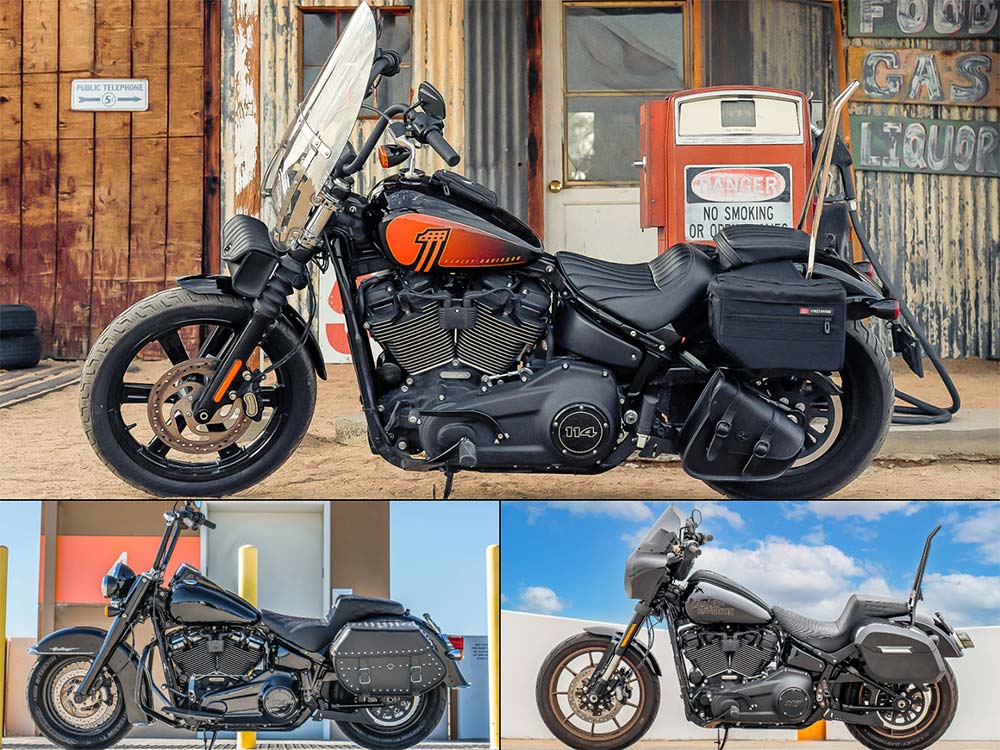
Viking Bags approaches luggage from the touring and cruiser side of the timeline. Rather than forcing one universal design onto every bike, the range centers on bike-specific fitment: you choose your motorcycle’s make, model and year, and the product page confirms what fits. The range includes:
- Leather and hard saddlebags with internal shells that hold their shape. Many are key-lockable.
- Roll-top leather styles for riders who want the compressible shape with a classic look.
- Soft waterproof panniers, including TPU panniers for the BMW R 1300 GS, for adventure riders.
- Mounting hardware included, plus quick-mount and quick-disconnect options for removing the bags when you park. Our comparison of quick-release and permanent-mount saddlebags explains which suits your routine.
Riders reviewing Viking Bags on Trustpilot, with a 4.8 average across more than 6,000 reviews, often mention sturdy construction, strong webbing and helpful support.
One practical tip: confirm your exact model and year before ordering, and contact support if anything is unclear. That single step prevents most fitment surprises. When you’re ready to compare, you can browse Viking Bags’ motorcycle saddlebags by make and model.
7. Common mistakes when choosing luggage
- Ignoring exhaust heat. Synthetic fabrics can melt. Leave clearance and use a heat shield.
- Overpacking one side. Uneven loads change how the bike turns.
- Assuming roll-top means waterproof. Add inner dry bags for rain.
- Skipping the fit check. Confirm compatibility with your turn signals, passenger pegs and exhaust.
- Buying more capacity than you carry. Empty volume invites shifting and clutter.
8. Frequently asked questions
What is the difference between saddlebags and panniers?
Both mount on the sides of the bike. “Saddlebags” is more common for cruisers and for bags that drape over or attach near the rear seat. “Panniers” usually means luggage that mounts to a rack or frame, common on touring and adventure bikes. The terms overlap, so check how the product mounts.
Are roll-top saddlebags waterproof?
Not always. A roll-top compresses contents and keeps out most spray, but stitching and strap openings can let water in. For heavy rain, pack gear inside inner dry bags or choose a bag with welded, sealed seams.
How many liters of luggage do I need for a motorcycle trip?
Roughly 10–20 liters covers a commute, 20–30 liters an overnight trip, and 30–40 liters a weekend. Multi-day adventure trips often need 40 liters or more, sometimes with a tail bag added.
What does denier mean on motorcycle luggage?
Denier measures yarn thickness. Higher numbers, such as 1,000D or 1,680D, generally mean tougher, more abrasion-resistant fabric. Coating, weave and seam construction also affect durability and waterproofing.
Do saddlebags affect motorcycle handling?
They can, mostly through weight and balance. Keep loads low, close to the frame and even from side to side. Heavily loaded or poorly mounted bags can make a bike feel unsettled.
How do I stop saddlebags from touching the exhaust?
Use the heat shield or support brackets that come with the bag, check clearance with the bags fully loaded, and re-check after the first ride. If your exhaust is close to the mount, choose a bike-specific design.
Are bike-specific saddlebags worth it?
Often, yes. They’re built around your bike’s frame, turn signals and exhaust, so installation is more straightforward and the bags look cleaner. Universal bags offer flexibility and a lower price, but may need extra brackets.
9. Final thoughts
Saddlebag design is a history of riders solving real problems: carrying more, staying dry, surviving drops and replacing only what breaks. Whether you want a classic leather set, a roll-top for the weekend or a waterproof soft pannier for the trail, the right choice starts with your trip, your terrain and your bike. Match those three, confirm the fit, and the luggage fades into the background so the ride stays the point.



Leave a comment
All comments are moderated before being published.
This site is protected by hCaptcha and the hCaptcha Privacy Policy and Terms of Service apply.