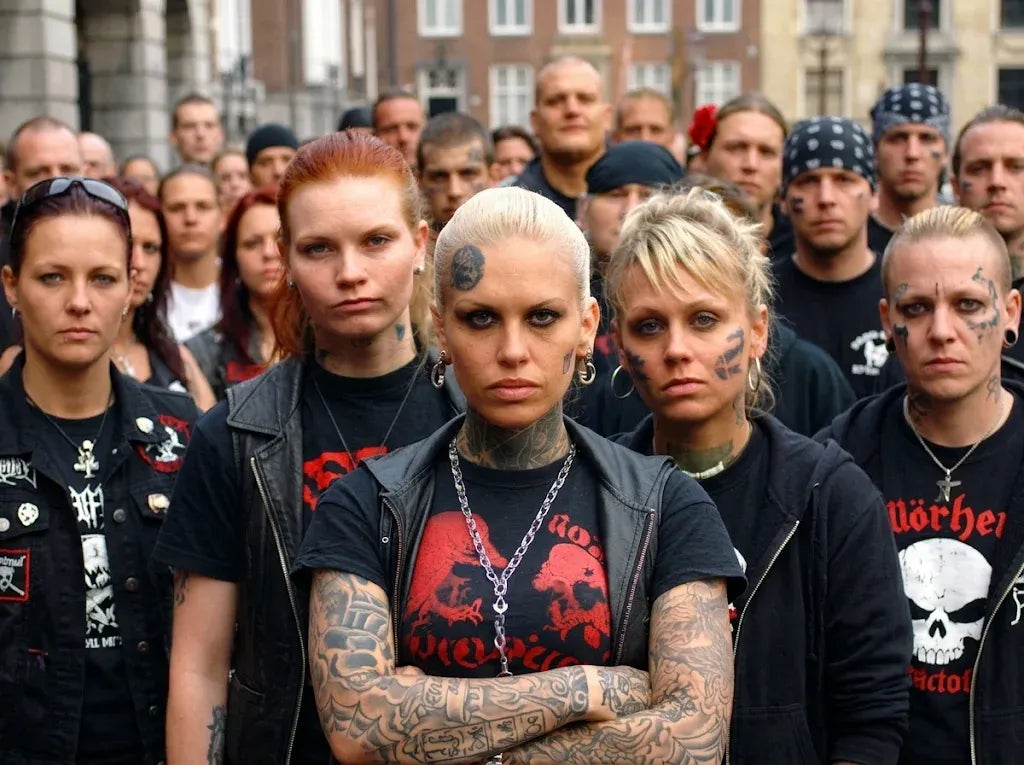
Which motorcycle clubs are the most dangerous in the world? We ranked 15 outlaw clubs using court rulings, police statements, and news reporting, from Vagos and the Night Wolves to the Hells Angels and the Bandidos at number one. Learn what each club is known for, which are banned, how the 1% label began, and how riders can stay out of trouble. Updated November 2026.
Table of contents
Quick answer: The Bandidos and the Hells Angels are generally considered the most dangerous motorcycle clubs in the world. Both pair a presence in dozens of countries with a long record of deadly feuds, major prosecutions, and government crackdowns. Close behind are the Mongols, Outlaws, Pagans, Sons of Silence, and, outside the US, Satudarah and the Night Wolves. Almost every rider on the road is law-abiding. This list covers only the small slice of outlaw clubs that police and courts have repeatedly linked to serious violence.
Most motorcycle clubs want the open road, a few good rides, and a barbecue at the end of it. A much smaller group wants territory. These clubs have fought wars on casino floors, in airports, in car parks, and across entire provinces. Some are banned in several countries. One has ridden beside a head of state. Another once tried to hold a government to account over its own logo.
Below, we rank the 15 most dangerous motorcycle clubs in the world, explain how we ranked them, and show what separates a feared club from a merely famous one. Every case is drawn from court rulings, police statements, and reputable news reporting. Where a club disputes the charge, we say so.

1. How We Ranked These Clubs
No government publishes an official “most dangerous” list, so this ranking is an editorial judgment. We weighed five things:
- Documented violence: deadly clashes, shootings, bombings, and murders tied to members or chapters.
- Legal action: racketeering cases, court bans, sanctions, and classification by agencies such as the US Department of Justice.
- International reach: how many countries the club operates in, and how far its feuds travel.
- Public-safety impact: harm to bystanders, new laws passed in response, and events cancelled out of fear.
- Staying power: whether the club survived arrests, bans, and rival wars.
One caveat before we start. Clubs and their members commonly deny being criminal enterprises, and individual members are innocent until proven otherwise. The incidents below involve specific people and chapters, not every rider who wears a patch. If the “1%” label is new to you, our guide to what the 1%er label really means and how outlaw clubs work is a good place to start.
2. The 15 Most Dangerous Motorcycle Clubs in the World
15. Vagos
Founded: 1965, San Bernardino, California · Nickname: the Green Nation · Patch: Loki, the Norse trickster god, on a motorcycle
The Vagos spent decades in the shadow of bigger names. That changed in September 2011 at the Nugget Casino in Sparks, Nevada, when a confrontation with Hells Angels erupted into gunfire on the gaming floor. Jeffrey Pettigrew, president of the Hells Angels’ San Jose chapter, was killed, and the city declared a state of emergency. The shooting put the Vagos on the federal radar, and prosecutors later built a racketeering case against the club’s leadership. The club denies being a criminal enterprise. Today it has chapters across the western US, in Mexico, and overseas.
14. Night Wolves
Founded: 1989, Moscow · Leader: Alexander Zaldostanov, “The Surgeon” · Members: estimated at 5,000 or more, with around 45 chapters
The Night Wolves began as a Soviet-era rock-and-bikes scene and became the first officially recognized biker club in the USSR. Under Vladimir Putin the club turned political. Putin has ridden beside Zaldostanov, the Kremlin has backed the club’s mass shows, and members supported pro-Russian forces in Crimea and eastern Ukraine in 2014. The US sanctioned the club and its leader in December 2014, Canada followed in 2015, and the EU added them in July 2022. Zaldostanov has said the sanctions mean nothing to him. The Night Wolves are not mainly a street-crime club. They rank here because they have the backing of a state.

13. Mongols
Founded: 1969, Montebello, California · Patch: a pony-tailed rider with a sword, inspired by Genghis Khan
The Mongols formed after Hispanic bikers in Southern California were turned away by the Hells Angels, and the rivalry has defined them since. In April 2002 the two clubs collided inside Harrah’s casino at the Laughlin River Run in Nevada. Three men died, two Hells Angels and one Mongol. The ATF has described the Mongols as among the most violent outlaw clubs in the country, and an undercover agent, Billy Queen, spent more than two years inside the club before the mass arrests of Operation Black Rain. The government then tried something unprecedented: seizing the club’s trademarked logo. A jury sided with prosecutors in 2019, but a judge later blocked the seizure on free-speech grounds. For the full rivalry, see how police track outlaw club rallies after Laughlin.
12. Comancheros
Founded: 1960s, Sydney, Australia · Founder: William “Jock” Ross, Scottish-born
The Comancheros took their name from a John Wayne western. A split in the early 1980s created a rival, the Australian Bandidos, and the two sides armed up. On September 2, 1984, Father’s Day in Australia, they met at the Viking Tavern in Milperra, a Sydney suburb. Seven people died, including 14-year-old Leanne Walters, who belonged to neither club. The Milperra massacre permanently changed how Australia saw bikers. The violence resurfaced in March 2009 when a brawl between Comancheros and Hells Angels at Sydney Airport left a man dead. That incident helped push through some of the toughest anti-bikie laws in the world.
11. Outlaws
Founded: 1935, McCook, Illinois (by club history) · Motto: God forgives, Outlaws don’t · Rival: Hells Angels (“ADIOS,” Angels Die in Outlaw States)
Often described as the oldest outlaw club still riding, the Outlaws helped create the “1%er” identity. The story goes that after the 1947 Hollister rally, the American Motorcycle Association said 99% of riders were law-abiding, and outlaw clubs claimed the other 1%. Historians debate whether the AMA ever said it, but the diamond patch stuck. The club’s most notorious figure was International President Harry “Taco” Bowman, who landed on the FBI’s Ten Most Wanted list in 1998 and was captured in 1999. He was later sentenced to life in prison after being accused of ordering attacks and bombings against rivals. The Outlaws remain one of the four clubs US law enforcement calls the “big four.”
10. Satudarah
Founded: 1990, Moordrecht, Netherlands · Name means: “one blood” · Status: banned in the Netherlands, Germany, and Norway
Satudarah was founded mostly by Moluccan immigrants and opened its doors to every background, which helped it grow to 44 chapters in the Netherlands alone. Dutch police came to consider it more violent than the local Hells Angels. After a tense 2011 standoff on the A2 motorway near Amsterdam, events were cancelled across the country. Germany banned the club in 2015. A Dutch court banned it in 2018, and the ban was upheld on appeal and at the Supreme Court. In October 2024, Norway’s Supreme Court banned the Norwegian chapters as a criminal association, observing that the motorcycle interest appeared secondary. In Denmark, the local chapter dissolved itself in 2023 and relaunched under a new name.
9. Warlocks
Founded: 1967 · Two clubs, one name: Florida (phoenix patch) and Philadelphia (harpy patch)
Two unrelated clubs took the Warlocks name in the same year, and each says the other copied it. The Florida club has fought long feuds with the Outlaws. The Philadelphia club built a reputation as one of the hardest on the East Coast, and one of its enforcers, Robert “Mudman” Simon, was convicted of murdering a New Jersey police officer in 1995, shortly after being released on parole. Police have also linked the Pennsylvania club to methamphetamine trafficking.
8. Rock Machine
Founded: 1986, Montreal · Founder: Salvatore Cazzetta · Defining event: the Quebec Biker War
Rock Machine was founded after Cazzetta turned down an invitation to join the Hells Angels. By 1994 the Angels, led by Maurice “Mom” Boucher, wanted total control of Montreal’s drug trade, and Rock Machine stood in the way. The Quebec Biker War that followed lasted years and cost well over 100 lives. Clubhouses were firebombed, and car bombs went off in city streets. In August 1995 a bomb killed an 11-year-old boy, Daniel Desrochers, who was playing nearby. The outrage led to Canada’s first anti-gang law. In 2000, crime reporter Michel Auger was shot six times outside his newspaper and survived. Boucher was later imprisoned for life, and Rock Machine patched over to the Bandidos before the name was revived.
7. Pagans
Founded: 1959, Prince George’s County, Maryland · Founder: Lou Dobkin, a biochemist · Patch: Surtur, the Norse fire giant
The Pagans are unusual: no international chapters and no overseas empire, yet US law enforcement still counts them among the big four. Police have long tied the club to methamphetamine and other drugs on the East Coast. In February 2002, dozens of Pagans stormed a Hells Angels motorcycle and tattoo expo in Plainview, New York, armed with knives, clubs, and guns. One Pagan was killed, several people were wounded, and police arrested more than 70 members in a single day.
6. Gypsy Jokers
Founded: 1956, San Francisco · Strongholds: Oregon, Washington, plus chapters in Germany, Norway, and Australia
The Gypsy Jokers grew a network of support clubs across the Pacific Northwest. In 2015, prosecutors say members took a former member, Robert Huggins, from a Portland house after he allegedly stole from the club, and beat him fatally on a remote property in Southwest Washington. In 2022, chapter president Mark Dencklau and another member were sentenced to life in federal prison. In Australia, the club has been linked to a 2001 car bombing in Perth that killed a retired detective and his friend. Our profile of the Gypsy Joker Motorcycle Club goes deeper.
5. Satan’s Choice
Founded: 1965, Ontario, Canada · Founder: Bernie Guindon
By the 1970s Satan’s Choice was the biggest outlaw club in Canada. Then, on December 29, 2000, about 68 Ontario bikers from the club and several smaller ones swapped their colors for the Hells Angels death head in a single ceremony, and the biggest club in Canada disappeared overnight. It did not stay gone. The name was revived, and on May 8, 2026, the Alberta RCMP issued a public warning that Satan’s Choice is expanding across Canada and into Alberta, which could raise tensions with the Hells Angels. It is one of the few clubs on this list whose story is still being written.
4. Sons of Silence
Founded: 1966, Niwot, Colorado · Reach: the Midwest, plus chapters in Germany
The club’s one rule was that you never talk, and for decades that held. Then ATF agent Blake Boteler spent roughly two years undercover, earned his full patch at the 1998 Sturgis rally, and was even elected enforcer of his chapter. The 1999 raids that followed turned up 27 machine guns, silencers, sawed-off shotguns, grenades, homemade bombs, and more than 25 pounds of methamphetamine. The club survived, and members have continued to face drug and weapons cases in the years since.
3. Iron Order
Founded: 2004, Jeffersonville, Indiana · What makes it different: many members are police, military, or prison staff
The Iron Order says it is not an outlaw club at all. It ranks this high because it ended up at war with outlaw clubs anyway. In January 2016 at the Colorado Motorcycle Expo in Denver, a fight between Iron Order and Mongols members turned into a shooting that wounded several people and killed a Mongols member. The man who fired first, a state prison officer, said he acted in self-defense. Each club blamed the other. In fairness, the Iron Order is on this list for conflict, not for a pattern of organized crime like the clubs above it.
2. Hells Angels
Founded: 1948, Fontana, California · Founder: Otto Friedli · Patch: the winged “death head”
The most recognized biker brand on Earth. The club’s global reputation was cemented in December 1969 at Altamont Speedway, where a Hells Angel killed a concertgoer, Meredith Hunter, during a Rolling Stones show; a jury accepted a self-defense claim. Under leaders like Sonny Barger the club spread to dozens of countries, and its members have been tied to violence on nearly every continent by police and media accounts. A Dutch court banned the club in 2019, and German authorities have banned several chapters. The Angels also grow by absorption. When a rival can’t be beaten, it is often invited to wear the death head instead, as Satan’s Choice was. For a look at the club today, see Are Hells Angels still active?
1. Bandidos
Founded: 1966, San Leon, Texas · Founder: Donald Chambers, a former US Marine · Colors: red and gold · Motto: “We are the people our parents warned us about”
The Bandidos top this list because their violence has repeatedly crossed borders and boundaries. They fought the Hells Angels in Scandinavia in the mid-1990s in the Great Nordic Biker War, with anti-tank rockets fired at clubhouses and members shot at a Copenhagen airport. On May 17, 2015, a biker meeting at a Twin Peaks restaurant in Waco, Texas, turned into a gunfight between Bandidos and Cossacks. Nine people died, around 20 were wounded, and 177 were arrested, yet the charges were ultimately dropped or dismissed and the question of who fired which shots was never settled in court. The darkest chapter came in April 2006 near Shedden, Ontario, where eight Bandidos were found dead in abandoned vehicles. They were killed by fellow members in an internal purge, and six men were convicted. The Australian Bandidos behind the Milperra massacre also took their name from these Texans.
3. Ranking at a Glance
Rank |
Club |
Founded |
Home base |
Defining moment |
|---|---|---|---|---|
15 |
Vagos |
1965 |
California |
Nugget Casino shooting, 2011 |
14 |
Night Wolves |
1989 |
Russia |
Sanctioned by US, Canada, EU |
13 |
Mongols |
1969 |
California |
Laughlin River Run, 2002 |
12 |
Comancheros |
1960s |
Australia |
Milperra massacre, 1984 |
11 |
Outlaws |
1935 |
Illinois |
FBI Ten Most Wanted leader, 1998 |
10 |
Satudarah |
1990 |
Netherlands |
Banned in three countries |
9 |
Warlocks |
1967 |
Florida / Pennsylvania |
Two clubs, one name |
8 |
Rock Machine |
1986 |
Quebec |
Quebec Biker War |
7 |
Pagans |
1959 |
Maryland |
Plainview expo clash, 2002 |
6 |
Gypsy Jokers |
1956 |
California / Pacific NW |
2015 Washington murder case |
5 |
Satan’s Choice |
1965 |
Ontario |
Patch-over to Hells Angels, 2000 |
4 |
Sons of Silence |
1966 |
Colorado |
ATF undercover case, 1999 |
3 |
Iron Order |
2004 |
Indiana |
Denver shooting, 2016 |
2 |
Hells Angels |
1948 |
California |
Altamont, 1969 |
1 |
Bandidos |
1966 |
Texas |
Waco 2015, Shedden 2006 |

4. Where Reasonable People Disagree
No ranking like this is final. If you rank purely by size, the Hells Angels usually come first and the Bandidos second. If you rank by the ATF’s own language, the Mongols are often named the most violent in the US. Canadian researchers and police have long argued that the country’s biker wars were among the worst in the world. And if you rank by political power instead of street violence, the Night Wolves would climb. We placed the Bandidos first because they combine reach, repeated multi-country wars, mass-casualty incidents, and internal killings. We placed the Hells Angels second because of their scale and global brand. Reasonable readers can order the middle differently.
5. Frequently Asked Questions
What is the most dangerous motorcycle club in the world?
There is no official answer, but the Bandidos and the Hells Angels are the most commonly named. Both operate internationally and have been tied to deadly feuds and large prosecutions. In the US, the Mongols are frequently described by federal agencies as among the most violent.
What is the largest motorcycle club in the world?
The Hells Angels are generally cited as the largest outlaw club by membership and chapters, with the Bandidos usually second. Counts vary by source because clubs don’t publish rosters.
What does “1%er” mean?
It is a patch worn by clubs that identify as living outside the law, a play on the often-quoted line that 99% of riders are law-abiding. US agencies treat the biggest 1%er clubs as outlaw motorcycle gangs, a label the clubs reject. See our full guide to one percenters, patches, and club rules.
Which motorcycle clubs are banned?
Satudarah is banned in the Netherlands, Germany, and Norway. The Hells Angels were banned in the Netherlands in 2019 and have had chapters banned in Germany. Rules differ by country, so a club banned in one place may operate legally in another.
Which club is the oldest outlaw motorcycle club?
The Outlaws trace their origin to 1935 in McCook, Illinois, and are often described as the oldest outlaw club still operating. Origin dates come from club histories and are difficult to verify independently.
Are all motorcycle clubs dangerous?
No. The overwhelming majority of motorcycle clubs are social, charity, veteran, or riding groups. Outlaw clubs are a very small minority, which is why the 1% label exists.
Is the Iron Order an outlaw club?
By its own account, no. Many of its members are police, military, and corrections staff. It appears here because of the 2016 Denver shooting and its friction with outlaw clubs.
How can riders stay safe around outlaw clubs?
Don’t wear club-style patches you haven’t earned, don’t pick fights over turf, and leave early if tension builds.
6. If You Ride: How to Stay Out of Trouble
Most riders will never have a problem. These habits make that nearly certain:
- Don’t wear lookalike patches or colors. In club territory, a three-piece patch layout can be read as a challenge. Our guide to motorcycle patches to avoid explains what to skip.
- Respect the unwritten rules. Don’t touch someone’s bike, don’t stare, and don’t crowd a group at a gas station.
- Know that big rallies draw heavy policing. Events like Sturgis and Laughlin are watched closely, and police can detain anyone near a fight. Read how police track outlaw club runs.
- Leave early if tension builds. Every incident above began as a bump, a shove, or a spilled drink.
- Don’t treat the culture as a costume. Real clubs take colors seriously, and so do the police watching them. If you came here from the TV show, our breakdown of whether Sons of Anarchy is based on the Hells Angels separates fiction from fact.
Want the American picture in more detail? Our guide to the top 35 motorcycle clubs in America and their patches covers the regional and law-abiding clubs too.



Leave a comment
All comments are moderated before being published.
This site is protected by hCaptcha and the hCaptcha Privacy Policy and Terms of Service apply.