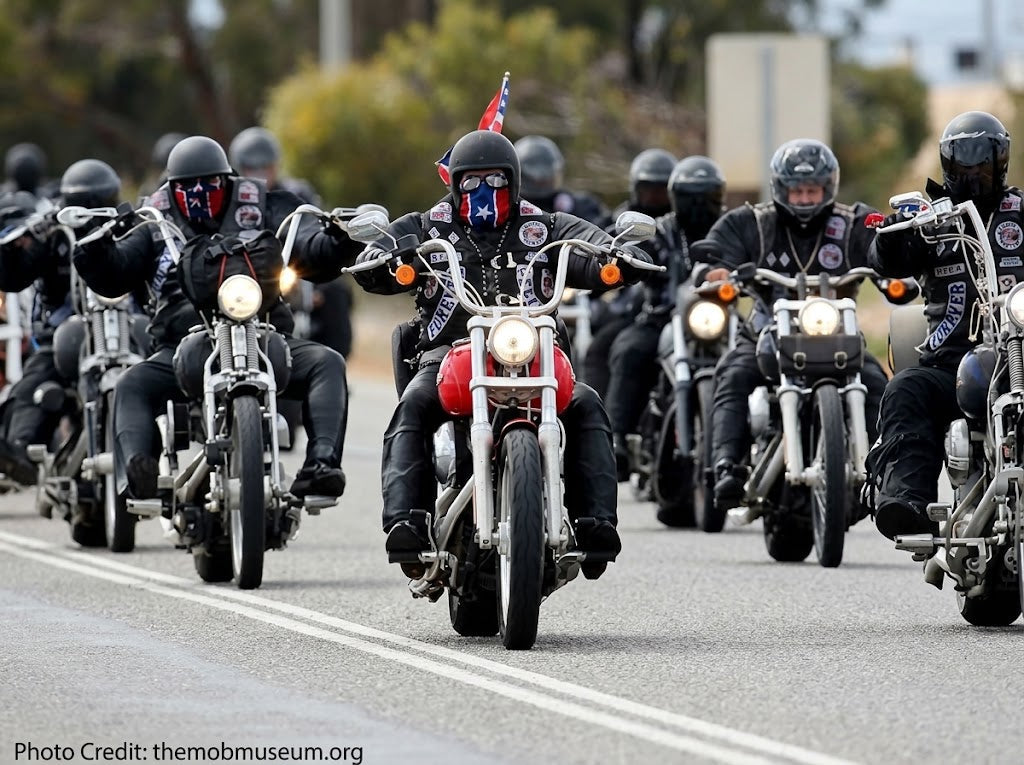
Outlaw motorcycle clubs are tightly organized, patch-wearing clubs whose members call themselves one percenters. This guide explains what the 1% label really means, how prospects earn a patch, what patches are said to signal, and how the Hells Angels and Mongols fit into the picture. It’s for readers who want a clear, balanced answer: you get the club’s view, law enforcement’s view and the court record, all in one place. You’ll also learn how outlaw clubs differ from everyday riding clubs, so you can tell the two apart.
Table of contents
1. Inside Outlaw Motorcycle Clubs: One Percenters, Patches and Club Rules
Outlaw motorcycle clubs are tightly organized, patch-wearing clubs whose members call themselves one percenters. Law enforcement calls them outlaw motorcycle gangs and says many members use the club as cover for criminal activity. The clubs call themselves brotherhoods and say they are misunderstood.
This guide explains what the 1% label means, how someone joins, what the patches are said to signal, how police track big gatherings, and where the Hells Angels and Mongols fit. Where a claim comes from police, prosecutors, courts or former members, we say so.
2. What Is an Outlaw Motorcycle Club?
An outlaw motorcycle club is a club whose members reject mainstream rules and wear that status on their backs. The US Department of Justice defines outlaw motorcycle gangs as organizations whose members use their motorcycle clubs as conduits for criminal enterprises. Members reject that label.
Where “1%” comes from. The story most often told starts in 1947 in Hollister, California. A three-day rally ended in fights, drunkenness and street racing, and dozens of people were arrested. According to the familiar version, the American Motorcycle Association said 99% of riders were law-abiding, which left the final 1% as outlaws. The AMA has disputed that it made the statement, so treat it as a widely repeated origin story rather than a documented quote. What is clear is that clubs adopted the label as a badge, and many wear a 1% diamond patch.
The first outlaw clubs grew out of Second World War combat veterans who wanted to ride and socialize together. The first Hells Angels chapter followed in 1948, and the trademarked death-head logo came soon after. Rival clubs appeared, and some later joined forces.
Club or gang? Members say they are motorcycle clubs, not gangs, and many find the word offensive. Police and prosecutors say that in some clubs members commit drug, weapons, extortion and violent crimes. Not every member of an outlaw club is accused of a crime, and many motorcycle clubs are not outlaw clubs at all.

2.1. The Biggest Outlaw Motorcycle Clubs
The names that carry the most weight are the Hells Angels, Pagans, Outlaws, Mongols and Bandidos. The Hells Angels are the largest, with chapters across the United States and in dozens of countries. Counts of chapters and members vary by source and year, so treat any single figure as a snapshot. The Mongols are smaller, with membership estimates of a few hundred. They formed in 1969 in Montebello, California, and, like the first outlaw clubs, many early members were servicemen, in this case Vietnam veterans. Their logo is a Mongol warrior in sunglasses on a chopper.
Support clubs. Law enforcement officials say big clubs work with smaller support clubs in a clear pecking order. A gang specialist who advises police said that in Hells Angels territory such as Minneapolis–St. Paul, local clubs answer to the Angels and tip them off when a rival moves in. He also said support clubs can be used to carry out illegal activity, which keeps a direct trail away from the main club. These are the specialist’s claims, and clubs reject the picture.
3. How You Join: Prospects, Votes and Patches
Nobody walks into a club like the Hells Angels and gets the patch. You start as a prospect, and you cannot wear the full club logo.
The prospect period. A former member interviewed on the subject described a period of about 12 to 16 months. Prospects watch the bikes outside bars, guard the clubhouse, stock the bar, clean up and do whatever full members ask. The length varies by club and chapter, so it is not a fixed rule.
The prospect period. A former member interviewed on the subject described a period of about 12 to 16 months. Prospects watch the bikes outside bars, guard the clubhouse, stock the bar, clean up and do whatever full members ask. The length varies by club and chapter, so it is not a fixed rule.
The cost. One former Maryland chapter president called becoming a full patch member the best day of his life. He was later arrested on drug and gun charges after a clubhouse raid, served time and lost almost everything he owned. He said he would do it again.
What patches are said to signal. Law enforcement officers and former members interpret patches, and the meanings can vary by club and by chapter. A patch alone is not proof that someone committed a crime.
The 1% diamond marks a member who sees himself as living outside the law.
The three-piece patch (a top rocker, the club emblem and a bottom rocker naming the territory) is the usual outlaw layout. But many law-abiding clubs wear a three-piece patch too, so it does not prove a club is outlaw.
Special-meaning patches. A police officer who tracks the Hells Angels said a patch worn by one member signaled that he had assaulted a law enforcement officer, and that a “filthy few” patch is given to members who have killed for the club. A former Mongol described the club’s skull-and-crossbones patch as meaning the wearer “took care of business” for the club.
Many members also wear tattoos of allegiance and say they do not care what society thinks.
Church is the weekly club meeting, where members talk business. Women and prospects wait outside.


3.1. Do Outlaw Clubs Recruit From the Military?
Law enforcement says they do. A federal ATF report on outlaw motorcycle groups and the military, covered by NBC News, said outlaw clubs and support clubs actively recruit service members, and that documented members had included active-duty personnel, reservists, National Guard members and federal employees and contractors. The report stressed that only a small share of military personnel are involved, and that Department of Defense rules do not specifically prohibit membership in an outlaw club. The FBI’s National Gang Intelligence Center made similar points in earlier reports.

4. The Hells Angels USA Run in Carlton, Minnesota (2009)
The Hells Angels hold an annual national gathering called the USA Run. The 2009 run in Carlton, Minnesota, a small town near Duluth, took place from July 29 to August 2 and shows how police respond to one.
The preparation. Law enforcement in northern Minnesota spent weeks planning. Police planned for up to 1,000 Hells Angels and followers. A gang specialist who advised police estimated 350 to 400 full-patch members would be in one small area, and news reports during the run put the crowd at about 500 members. Agencies from across the region joined the Carlton County sheriff, including the St. Louis County sheriff, Duluth and Cloquet police, the State Patrol and federal agencies. The Hells Angels told local officials the event would be civil and family-like.
What surveillance found. The Hennepin County Sheriff’s gang strike force watched the Minnesota clubhouse during an East Coast Officers meeting. They saw the vice president standing lookout on the street, a job police said is usually left to prospects. Officers pulled over a car for an illegal U-turn and found a ball-peen hammer in the door. They photographed the out-of-state members, warned them and let them go. More than 50 delegates came and went, but police learned nothing about what was said inside.
The rival threat. Police feared a clash with the Outlaws, a rival club based in neighboring Wisconsin. The Angels claim Minnesota, and the Outlaws claim Wisconsin. Police used aerial surveillance, including a federal helicopter, and stopped a group of Angels heading toward the state line on Interstate 35. The group was searched and released. Local reporting during the run said the Outlaws never entered Minnesota, and the event passed without a major incident.
The numbers and the pushback. Police reported more than a thousand traffic stops over the five days. Citation counts differ between reports, but local coverage said only a small share went to Hells Angels members. The sheriff said the plan worked. Some residents and the owner of the bar the Angels used as headquarters called the response harassment and alleged profiling, and police said the Angels spent money at local businesses, including at least 200 rooms booked at the casino resort. Both sides are part of the record.
Why police prepared so heavily. Earlier USA Runs left a mixed record. Police in Missoula, Montana, received reports of rapes in 2008 that were not prosecuted for lack of witnesses. At an earlier run in Eureka Springs, Arkansas, six Hells Angels were arrested after four Bandidos were stabbed and beaten.
5. Mongols vs Hells Angels
The two clubs have been at odds for decades. In California the conflict turned deadly before a fragile truce was reached, with the Hells Angels holding Northern California and the Mongols growing in the south.
The Laughlin brawl (2002). The truce broke at the Laughlin River Run in Nevada. Around 2 a.m., about 40 Mongols were drinking in a casino bar when a group of Hells Angels walked in. More than 100 bikers fought with knives, hammers, wrenches, bats and guns while staff and players ran for cover. Two Hells Angels and one Mongol died, and over a dozen people were hurt.
The federal case against the Mongols. From 2005, ATF agents ran an undercover investigation called Operation Black Rain, in which four agents became full-patch members. The government charged 79 Mongols, and 77 of them eventually pleaded guilty. Prosecutors also tried something new: seizing the club’s trademarked patch. In 2008, a judge barred members, relatives and associates from wearing or selling the logo. A jury later ordered forfeiture of the patch in 2019. But in February 2020, Judge Carter denied the forfeiture, holding it would violate the First and Eighth Amendments. The Mongols kept their patch. Members and their lawyers argued throughout that the club is a brotherhood and that crimes were committed by rogue members.
The Oregon expansion. The Mongols chartered their first Oregon chapters in a state with five existing one percenter clubs. A former Mongol who helped the club expand east said the Hells Angels “greenlighted” him after he chartered a chapter in their New York territory. In this world, that means a price on his head.
Police in Eugene and Portland responded with visibility. Detectives visited the Free Souls clubhouse during church. The Free Souls, founded in 1969, are the oldest and largest club in Oregon. Officers pulled over prospects on minor violations to identify them. At a Mongol party in Portland, about 30 to 40 Mongols and about 100 members of Oregon clubs were in town and nothing happened. Police noticed the Gypsy Jokers and the Mongols standing together for the first time they had seen, and said it did not necessarily mean an alliance.
6. The Florence Run: Brotherhood Behind Bars
Every year, riders gather in Florence, Arizona, for a run that salutes members in prison. The run began in the early 1970s as a tradition of the Dirty Dozen, an Arizona club that merged with the Hells Angels in 1997, and it is held each February. Riders drive past the prisons and into town while police set up barricades. A documentary-era police estimate expected about 1,500 Hells Angels and affiliates, but turnout varies by year. By police accounts, the Florence run has historically gone more smoothly than the USA Run.
7. Two Sides of the Same Story
The Hells Angels’ own motto sums up how members feel: “When we do right, no one remembers. When we do wrong, no one forgets.”
The clubs’ view: misunderstood, unfairly targeted, a brotherhood of riders who live their lives their way.
Law enforcement’s view: many chapters use the club as cover for drug trafficking, weapons offenses and violence.
The record: the clubs survive because they adapt, and courts, juries and police have repeatedly tested what they can and can’t do.
8. What Has Changed Since: Bans, Court Rulings and Waco
Court bans abroad. A Dutch court banned the Bandidos in 2017 and the Hells Angels in 2019, calling the Angels a danger to public order.
Waco, 2015. A shootout at a Texas restaurant between the Bandidos and the Cossacks and their allies left nine bikers dead. It remains the best-known recent example of a club rivalry spilling into public.
The Mongols’ patch. The 2020 ruling above means the government has not been able to take the patch from the club.

9. Outlaw Clubs vs. Everyday Riders
This is the part that gets lost. Most motorcycle clubs are not outlaw clubs. Plenty of law-abiding clubs wear patches and use a club structure, and some outlaw clubs are also known for charity toy runs. To see how big the wider club world is, read our guide to the top 35 motorcycle clubs in America and their biker patches. Curious how pop culture compares with the real thing? Our breakdown of whether Sons of Anarchy is based on the Hells Angels separates TV fiction from fact. And for a side of club life that rarely gets told, read about women and “old ladies” in the Hells Angels motorcycle club.
The Hells Angels are famously associated with Harley-Davidson motorcycles, though bike choice varies across the wider riding community. Riders who want more storage can explore Harley-Davidson saddlebags or browse the full range of motorcycle saddlebags.
10. FAQs
What does 1% mean in motorcycle clubs?
It refers to the claim that 99% of motorcyclists are law-abiding, which leaves the last 1% as outlaws. The story is tied to the 1947 Hollister rally, though the AMA has disputed that it made the statement. Clubs adopted the figure as a badge, often as a 1% diamond patch.
Are outlaw motorcycle clubs the same as motorcycle gangs?
Terminology differs. Members call their groups clubs. Police and prosecutors use “outlaw motorcycle gang” for groups whose members use the club for criminal enterprises.
How long does it take to become a Hells Angel?
There is no fixed rule. A former member described a prospect period of around 12 to 16 months, but it varies by club and chapter, and full members must vote.
What is the Hells Angels USA Run?
It is an annual national gathering hosted by a different chapter. It draws members from across the country and often a heavy law enforcement response, as in Carlton, Minnesota, in 2009.
Which outlaw motorcycle clubs have had documented conflicts with the Hells Angels?
The Bandidos, the Outlaws and the Mongols have each had reported conflicts with the Hells Angels, including the 2002 Laughlin brawl with the Mongols.



Leave a comment
All comments are moderated before being published.
This site is protected by hCaptcha and the hCaptcha Privacy Policy and Terms of Service apply.