
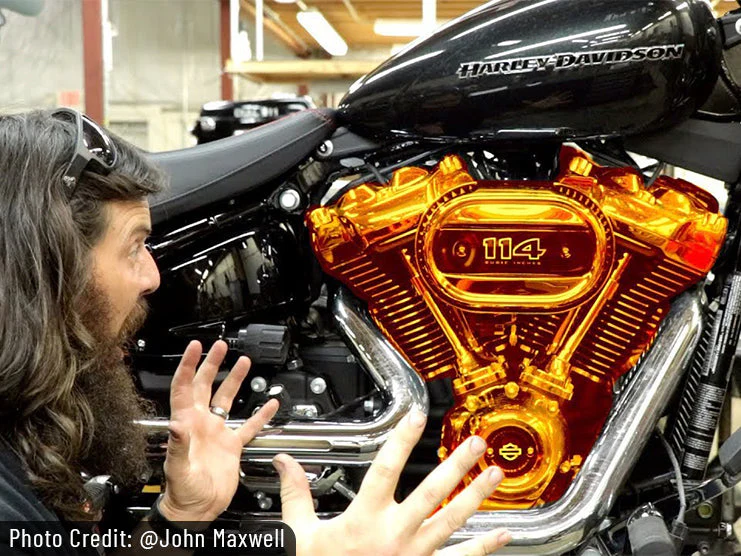
The most common Milwaukee 8 problems are oil sumping and oil transfer from the transmission to the primary case on 2017–2019 Harley-Davidson models, plus rear-cylinder heat, cold starts and lean running on some bikes. Harley redesigned the oil pump for 2020, so newer bikes carry less risk, and a 2017–2019 bike with the updated pump and service records can still be a sound buy.
Table of Content
Last updated: October 23, 2026
Harley Davidson is a popular American motorcycle brand that has been producing reliable, high-quality motorcycles since 1903. Harley Davidson keeps updating their engines to improve their performance and power output, introducing new engines every two decades. Most Harley Davidson touring and heavy-duty motorcycles have moved on from Twin-Cam engines and are now powered by Milwaukee-Eight engines. The Milwaukee-Eight engine is considered to be a more powerful and improved version of the Twin Cam engine. However, Milwaukee-Eight (M8) engines have a long history of suffering from mechanical issues, including oil leakage, power loss, engine failure, and cold-start issues. This article discusses the most common problems with Milwaukee-Eight engines.
1. Milwaukee 8 Problems at a Glance
The most common Milwaukee 8 problems are oil sumping and oil transfer from the transmission to the primary case on 2017–2019 bikes, plus rear-cylinder heat, cold-start trouble and lean running on some bikes. Owners generally report the engine as reliable, and Harley-Davidson redesigned the oil pump for 2020.
Problem |
Years most affected |
What you notice |
Fix |
|---|---|---|---|
Oil sumping |
2017–2019 |
Oil in the air cleaner, oil on the right side of the engine, power loss, extra heat |
Updated 2020-style oil pump |
Oil transfer (transmission to primary) |
2017–2019 |
Low transmission oil, high primary oil level |
Breather vent kit from a dealer |
Low gear oil |
Varies |
Hard shifting, grinding noise |
Check the level and find the leak |
Cold starting |
Varies |
Slow or no start below about 50°F |
Check the battery and the oil grade |
Lean mixture |
Varies |
Erratic throttle, weak low-rpm power |
Fuel tuning or BoosterPlug |
Rear-cylinder heat |
Varies, worse in traffic |
Heat on the right side, idle changes at a stop |
Keep moving, idle management system, oil cooler fan |
2. Milwaukee-Eight Engine

The Milwaukee-Eight (M8) is Harley-Davidson's big-twin engine for Touring, Softail, Trike and CVO models. The name comes from Harley's Milwaukee headquarters and the eight valves, four per cylinder. It replaced the Twin Cam in 2017. Compared with the Twin Cam 103 it replaced, the Milwaukee-Eight 107 added roughly 11% more torque and 11% quicker acceleration, according to Jalopnik. For that older engine's own weak points, see our Twin Cam 103 article.
Introduced in 2017, the Milwaukee-Eight is a heavy-duty engine that powers heavyweight Harley lineups, including the Harley Grand American Touring and Harley trikes. Since 2017 the Milwaukee-Eight family has grown to include 107, 114, 117 and 121 cubic-inch versions.
The standard Milwaukee-Eight 107 engine has an oil-cooled system that powers many well-known Harley Glides, including the Street Glide, the Electra Glide, the Road Glide, and the Harley Road King. Liquid- and air-cooled Milwaukee-Eight 107 engines has powered many heavyweight touring bikes, including the Harley Road Glide Ultra, the Harley Tri Glide Ultra, and the Harley Ultra Limited. Meanwhile, Harley's 2026 CVO™ models use the larger Milwaukee-Eight 121, with a High Output version on the CVO ST models.
The Milwaukee-Eight engines are popular among Harley Davidson fans and riders. These engines have a high-power output, ensuring smooth torque delivery and acceleration. However, many motorcycle enthusiasts have reported several issues with their Milwaukee-Eight engines.
3. Oil Sumping
One of the most frequently reported problems with the Milwaukee-Eight engine is oil sumping. If you own a 2017–2019 Harley Davidson model fitted with a Milwaukee 8 engine, you are most likely to face the oil sumping issue.
The Milwaukee-Eight engine is lubricated with oil to reduce friction and heat when the parts rub against each other. If the motorcycle is not running for a long time, the oil will go back into the tank. However, oil sumping occurs when oil accumulates in the crankcase instead of going back into the tank. Oil sumping occurs due to a faulty oil pump. If you see clouds of smoke coming out of the exhaust pipes when you start your motorcycle, this is a sign of oil sumping. Over time, the oil continues to build up in the crankcase, which causes the engine’s performance to worsen.
There are several indications your Milwaukee-Eight engine is suffering from oil sumping, including:
- If too much oil accumulates in the crankcase, it might start to leak from the engine’s right side. Always check your motorcycle’s engine for any oil leakage after you finish a ride, especially after a long tour.
- Having the right quantity of oil will ensure your engine and crankshaft perform correctly. However, oil sumping could cause the engine’s performance and power to deteriorate. The Milwaukee-Eight engine will not be able to produce an adequate power output and prevent acceleration.
- If there is too much oil in your Milwaukee-Eight crankcase, it can also cause the air filter to choke due to having a large amount of carbon and debris. This can result in unbalanced air and fuel mixture and cause more fuel to burn. A clogged air filter negatively affects fuel economy and engine performance.
- Oil sumping can cause your engine to overheat. High temperatures can cause the internal engine parts to become worn out quicker and cause the Milwaukee-Eight engine to fail.
3.1 How to Resolve the Milwaukee-Eight Engine’s Oil-Sumping Problem?
The only way to resolve the Milwaukee-Eight engine’s oil sumping problem is to install a new oil pump, which can cost between $300-$700, including labor costs. Also, if you plan to buy a Harley Davidson motorcycle powered by the Milwaukee-Eight engine, make sure to buy a 2020 or newer model.
3.2 Which Milwaukee-Eight Years Have the Oil Sumping Problem?
Oil sumping is a 2017–2019 problem, not a problem on every Milwaukee-Eight. Harley-Davidson acknowledged it in a 2017 service bulletin, which said sumping can occur during long periods at high rpm or under heavy load. The bulletin covered Touring, CVO, Trike, Police and Softail models. Harley revised the oil pump for the 2020 model year, and reports of sumping dropped sharply on 2020 and 2021 bikes.
Short rides can hide the problem. After a short ride the extra oil drains back at the next start-up, so sumping tends to show after long or hard high-speed riding. Owners also report that no oil warning light comes on when it starts, so look for the signs yourself.
If you are buying a used 2017–2019 bike, check these four things:
- Ask whether the oil pump has been replaced with the 2020-style pump, and ask to see the service record.
- Look inside the air cleaner and along the right side of the engine for oil.
- Ask whether the transmission-to-primary oil transfer (see section 3.2) was addressed with the breather vent kit.
- Ask a Harley-Davidson dealer whether your VIN qualifies for any pump replacement credit. A 2020 service bulletin describes a credit procedure for pump replacement on 2017–2019 bikes, and coverage can change.
The 114 has its own list of issues. See our Milwaukee-Eight 114 engine problems and solutions guide.
3.3 Is Oil Consumption Normal on a Milwaukee-Eight?
Some oil use is normal. Harley-Davidson's own diagnostic tip for the Milwaukee-Eight lists 1 quart per 1,500 miles (1 liter per 2,400 km) as acceptable consumption. The same tip starts by asking how the oil level was checked and filled, so follow the procedure in your owner's manual before deciding the bike is using too much. If it uses more than that, ask a technician to check for leaks and sumping.
4. Gear Oil/Transmission Fluid Problems
To ensure smooth gear shifts and transmission operation, the gears are lubricated with oil to reduce friction between parts. However, if the gear oil level drops, this could cause the gearbox and the engine to become damaged. The lack of gear oil will be even worse on the gearbox and engine while riding at high speeds.
There are several indications your Milwaukee-Eight engine is suffering from gear oil issues including:
- If your Milwaukee 8 engine has low gear oil or transmission fluid levels, it becomes difficult to shift between gears, putting more pressure on the transmission and engine.
- If the gear oil level is low, this will result in more friction between the metallic parts, causing them to grind against each other and produce an unpleasant noise.
- The metallic parts constantly grind against each other due to a lack of gear oil level causing an increase in friction and heat. Not refilling the gear oil will result in the engine suffering permanent damage.
Also Read: 10 Signs Your Motorcycle Needs an Oil Change
4.1 How to Resolve the Milwaukee-Eight Engine’s Gear Oil Problem?
This issue can be resolved by regularly checking the gear oil level and following a strict maintenance schedule. If you see any indication of low gear oil level, get your motorcycle checked by a professional mechanic to find the oil leak and replace the damaged parts.
4.2 Oil Transfer From the Transmission to the Primary Case
Not every drop in gear oil level is a leak. On some 2017–2019 bikes, transmission oil moved into the primary case, leaving the transmission low and the primary overfull. Pressure builds in the transmission case and pushes oil along the main transmission shaft into the primary. The transmission breather was meant to relieve that pressure but did not do it well enough on affected bikes, so Harley-Davidson offered a breather vent kit. If your transmission level keeps dropping while the primary level climbs, this is the likely cause, and a dealer can tell you whether the kit applies to your bike.
5. Cold-Start Problems
While the cold-start issue is not as severe as the oil sumping and low gear oil level, it can be frustrating if the Milwaukee-Eight engine refuses to start in cold temperatures below 10°C (50°F).
Checking the battery is the first thing you should do to determine why the motorcycle is not starting in the cold. If the battery is fine, the issue may be because of the engine oil.
5.1 How to Resolve the Milwaukee-Eight Engine’s Cold-Start Problems?
Check if the battery is working correctly or not. If the battery provides nominal voltage, then the cold start issue may be due to the engine oil. Using engine oil that is incompatible with your motorcycle’s engine or too viscous can result in cold-start problems. You should check the motorcycle owner’s manual or consult a mechanic if you are unsure what type of engine oil to use.


6. Fuel Injection and Lean Mixture Problems
Lean mixture occurs when there is more air in the fuel-air mixture during combustion. This problem can be due to a faulty fuel injection system delivering less fuel to the engine.
The Milwaukee-Eight’s fuel injection and lean mixture problems can cause erratic throttle response, poor idle power, loss in power output, slow acceleration, and low-range power.
6.1 How to Resolve the Milwaukee-Eight Engine’s Fuel Injection and Lean Mixture Problems?
The Milwaukee-Eight engine’s fuel injection and lean mixture problems can be modified with a BoosterPlug upgrade to ensure a proper mixture of air and fuel. The BoosterPlug is easy to install and ensures better engine life, combustion, and fuel economy. After installing this upgrade, you will notice a significant difference in power output, acceleration, throttle response, and fuel efficiency.
7. Pros and Cons of Milwaukee-Eight Engines
Heat is one of the most common Milwaukee-Eight complaints, and it is mostly about the rear cylinder, which gets less airflow than the front one. Riders notice it most in slow traffic.
The Milwaukee-Eight runs cooler than the engines before it. Harley added oil cooling around the cylinder heads on the 107, and liquid-cooled cylinder heads with radiators ("Twin-Cooling") on the larger touring engines. AMSOIL measured a rear-cylinder peak a little above 420°F (216°C) on a 2019 Street Bob with the 107, against 550°F (288°C) on a 2012 bike, though the two tests were not identical.
Idle temperature management. Many Milwaukee-Eight bikes have an Engine Idle Temperature Management System (EITMS). When the engine is hot and the bike sits at idle, it shuts off the rear-cylinder fuel injector so that cylinder acts as an air pump and cools down. You may notice the idle sound and rhythm change, which can feel like a misfire or a stall. The rear cylinder fires again when you roll the throttle or move off, and Harley's service information says releasing the clutch lever into the engagement zone also switches it off. The same information says riders can enable or disable the system.
What helps: keep the bike moving so air passes over the cylinder fins, avoid long idling in hot weather, and consider Harley's oil cooler fan accessory, which switches on automatically as oil temperature rises and is made for idling and slow-speed riding.
When heat is a warning sign: heat together with oil in the air cleaner, oil on the right side of the engine, ticking lifters or power loss points to oil sumping (see section 2). A bike that really stalls or misfires, rather than just changing its idle in traffic, should be checked by a technician.
8. Milwaukee-Eight Overheating and Rear Cylinder Heat
Milwaukee 8 Engines Pros |
Milwaukee 8 Engines Cons |
|---|---|
Better overall performance |
Oil sumping |
Smooth riding experience |
Oil leakage |
Four valves per cylinder |
Overheating |
Produces more horsepower and torque |
Cold-start problems |
good acceleration |
Produces vibrations |
Less noise |
Produces irritating noises |
Less heat |
Faulty fuel pump design |
Single cam design |
Faulty oil filters |
Soul-satisfying exhaust note |
Can only be installed on a limited number of models |
Comes with an assist & slipper clutch |
Gear oil issues |
Rubber-mounted |
Engine stalling |
Single internal counterbalancer |
Improper air and fuel mixture |
Reduced vibrations |
Clogged air filter |
Better fuel economy |
Carbon deposits and engine sludge |
More exhaust and intake flow |
Engine produces clouds of smoke |
Meet Euro 4 emissions |
Engine misfires |
9. FAQs
What are the most common Milwaukee-Eight problems?
Oil sumping and oil moving from the transmission to the primary case on 2017–2019 bikes, plus rear-cylinder heat in traffic, cold-start trouble and lean running on some bikes.
Is the Milwaukee-Eight engine reliable?
Owner reports are mostly positive. One 2020 owner on a Harley forum reported 224,000 trouble-free miles over five years, and the main reliability problem has been the oil system on 2017–2019 engines.
Which Milwaukee-Eight years should I avoid?
Be careful with 2017–2019 bikes because of the oil pump and the transmission-to-primary oil transfer. Harley revised the pump for 2020. A 2017–2019 bike with the updated pump and a documented service record is a lower risk than one with the original pump.
How long does a Milwaukee-Eight last?
Harley-Davidson does not publish a lifespan figure, but owners report well over 100,000 miles with regular maintenance. Read more in our guide on how long motorcycle engines last.
Is oil consumption normal on a Milwaukee-Eight?
Some is. Harley-Davidson's diagnostic tip lists 1 quart per 1,500 miles as acceptable.
Does the Milwaukee-Eight 114 have more problems than the 107?
Some owners report extra issues on the 114, including radiator blockage, harmonic balancer vibration and rattling noises. See our Milwaukee-Eight 114 problems and solutions guide.
10. Takeaway
The Milwaukee-Eight engine is a powerful and torquey engine that powers Harley touring bikes and CVO™ models. It has a good reputation among motorcycle enthusiasts, particularly Harley Davidson fans. However, the early version of this engine suffered several problems, including oil sumping, power loss, gear oil problems, cold-starting issues, and a lean mixture that were difficult to fix for several years in its production. If your Milwaukee-Eight engine is suffering from such problems, you can try any of the solutions covered in this article. If the problem persists, you should immediately get the motorcycle checked by a mechanic to avoid engine failure.
A well-maintained engine and motorcycle lasts longer, performs better, and requires a lot of care, time, and money to ensure it lasts you a couple of years. Viking Bags offer several aftermarket parts that improve your motorcycle’s aesthetic appeal and safety. The luggage options available at Viking Bags include saddlebags and sissy bar bags. Other aftermarket parts include sissy bars, crash bars, fairings, Seats, and handlebars.
Popular Collections


Leave a comment
All comments are moderated before being published.
This site is protected by hCaptcha and the hCaptcha Privacy Policy and Terms of Service apply.