Table of Content
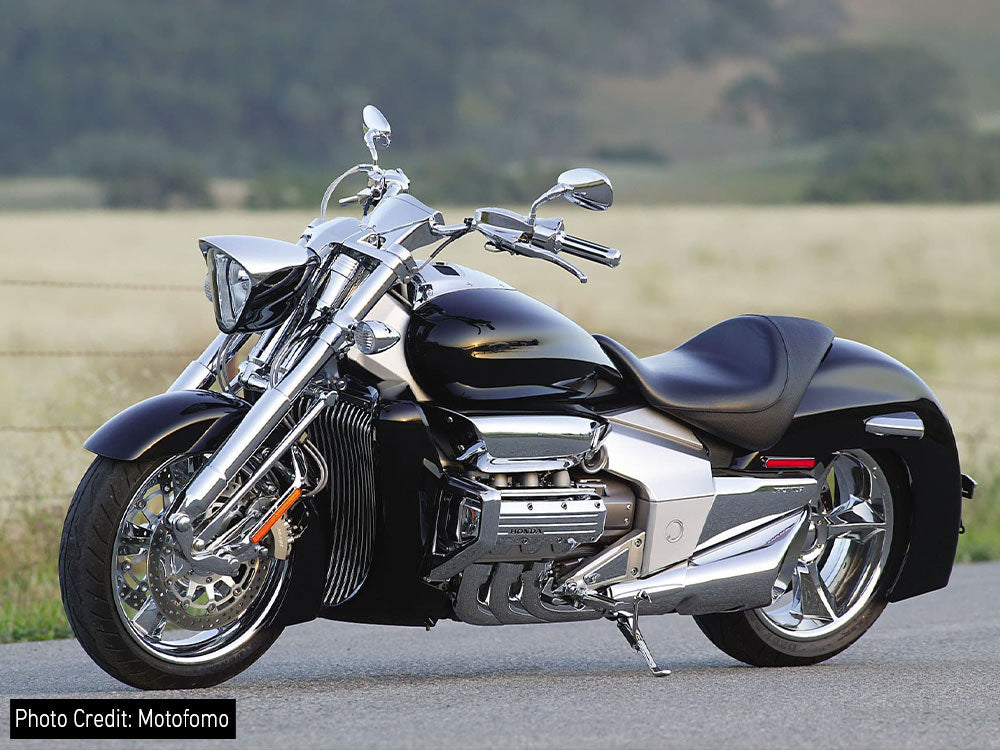
There is no motorcycle in the world that creates such awe, confusion, and intense discussion. We are talking about none other than the Honda Rune. This massive cruiser, which was produced for only one model year in 2004, is one of the boldest and most costly experiments ever undertaken by a bike maker.
The Honda Valkyrie Rune has one of the strangest chapters in the history of motorbikes. It was a concept bike sent straight to production, which increased costs. Honda showed the guts to mass-produce a bike that was merely a concept. It was Honda’s designers' imagination that was put into execution.
The Honda Rune is not only the story of an insane bike, but of a corporate desire. It is also regarded as a financial loss of $225 million. It was a long-term bet on status that has remained fascinating to riders and collectors ever since.
This article explores:
The entire story behind the Honda Rune.
The philosophy behind its creation.
The technical wonders that characterized it.
The naked fiscal truth.
The legacy that has earned it a place in the Hall of Fame.
1. Honda Rune - Genesis of a Dream: Honda Spirit of the Phoenix
One should first consider the strategic thrust of Honda into the U.S. cruiser bike market in the 1990s to see the audacity of the Rune. This was the start of Honda’s ‘Spirit of the Phoenix’ project. It was a focused effort by Honda to produce bikes that would appeal to the U.S. bikers and bike culture. It was not about copying, but rather a redefined American cruiser in Honda’s manner. It also redefined quality and innovation.
The 1997 Honda Valkyrie was the flagship of the project. The Valkyrie, in contrast to its V-Twin rivals, was a power cruiser. It was fitted with a strong 1,520 cc flat-six engine from the Gold Wing touring. This engine gave it a turbine-like power. It was different from the old-fashioned potato-potato rumble of Harley and its imitations.
The Valkyrie was a success, and it showed that Honda could compete in the heavyweight cruiser market. It can have a unique stance in the segment.
The Honda Rune used only the Valkyrie's base. Designers at Honda began dreaming bigger, especially in the U.S. market.
What would happen if they took the limits of style and engineering to the very next level of a production bike?
What would the bike be like?
Why not build a bike so radical, so complete in its vision that the owner would never have to go to a custom shop?
This dream became the Honda Rune.
2. Honda Rune: Emerging from the T-Series Concepts
The immediate predecessor of the Honda Rune is a series of concept bikes. Honda rolled out these concepts to test people’s response. Honda also displayed several T-series concept bikes at high-profile motorcycle shows. This was done from 1998 to 2003. Each concept bike took a radical approach to the future of cruiser bike design.
The most crucial one was the T2 concept by Honda. Its design idea was referred to as the new/retro. This concept bike combined the low-slung, chopped lines of 1940s and 1950s roadsters. It also carried hi-tech features and the mechanical look of the six-cylinder engine. The reaction from the public and the media was electric. Honda was overwhelmed by this. The brand decided to send this spaceship-like machine into production lines.
As per Ray Blank, the Executive Vice President of Honda America at that time:
“(The goal was to) set the bar higher than ever... while also exploding old limitations on what an original equipment manufacturer could mass produce".
Must Read: The Remarkable History of Honda
3. Honda Rune: The Art of Obsession
The 2004 Honda Rune (NRX 1800) was an example of a glorious art of obsession. Each element was designed or built to convey a powerful blend of art and tech.
3.1 Honda Rune’s Powerplant
The Rune featured a heavily revised variant of the 1832 cc Flat-Six engine of the Gold Wing.
In the case of the Rune, the engineers installed six separate throttle bodies.
Not to forget, there were only two on the Honda Gold Wing.
The motor was made more aggressive.
The engine could deliver 118 horsepower and 123 lb-ft of torque.
The noise was termed as a jet-like hum.
It was distinct from the usual V-Twin cruisers’ sounds of the time.
3.2 Honda Rune’s Radical Suspension Design
One of the most recognized and most expensive parts of the Rune was the suspension system.
3.2.1 Front
The old-fashioned telescopic fork was replaced with a complex, full-chrome trailing-link system.
This ensured a radically raked, chopper-esque look on the bike.
Still, it maintained a predictable geometry.
3.2.2 Rear
The Honda Rune was based on the race-dominating Honda RC211V MotoGP bike.
It featured the one-sided swing-arm (Pro-Arm) and Pro-Link rear shock.
This ensured the huge rear wheel looked like a work of art.
It ensured a clean look of the bike to a great level.
Must Read: 10 Best Honda Motorcycles Ever Made
3.3 Honda Rune’s Dimensions
The outcome was a bike of massive dimensions:
Wheelbase: 68.9 inches.
Dry Weight: 749-811 kbs / 360-368 kg.
Wet Weight: Around 888 lbs / 403 kg.
Fuel Tank Size: 6.1 gallons.
4. Honda Rune: Honda’s $225 Million Gamble/Mistake
The most prominent event in Honda Rune's history is its fiscal collapse. What was believed to be a Honda’s image-maker turned out to be a huge mistake. The stats or numbers share a horrific picture of what happened with Rune.
4.1 Massive Cost to Build Honda Rune
The Rune was made with its own parts. This includes the chrome trailing-link fork and other immense bodywork. These parts were highly costly to machine and make. The inside news from Honda suggests that the brand spent more than $100,000 to build each Honda Rune unit.
4.2 Huge Loss Per Honda Rune Unit
At an M.S.R.P. of $27,000, Honda was losing around $73,000 and more per unit. A price tag of $27K may not seem massively big in 2026, but in 2004, it was quite an over-the-top price.
4.3 Loss Incurred in Whole Production
The total loss to Honda due to Honda Rune is massive. It is more than one can estimate. When the cost of the entire limited production run of the Honda Rune is added to the huge cost that went into:
Research.
Marketing.
Branding.
Development.
Buying special tools and machines.
The Honda Rune was made a low-volume model with a limited run. Still, the overall loss for the project was reported to be about $225 million.
The market's reaction was expected. Even Honda’s most loyal fans were stunned at the cost. Most, according to Hagerty valuation analyst James Hewitt, waited until the depreciation was hit on the used Honda Runes.
Honda was left with Rune’s inventory for years. The brand is said to have sold its new old Honda Runes up to 2008 and 2009.
5. Honda Rune Legacy: From Commercial Flop to a Cult Classic
The same elements that killed the Rune in the showrooms became its treasure. These elements solidified its position as a modern classic and as a collector's treasure.
5.1 Honda Rune’s Cult Following
What made the Honda Rune earn a cult following was:
The sheer rarity.
The unquestioned visual impact it made.
The story behind it is Honda’s biggest gamble.
One of the very first owners of the Honda Rune, Tommy Mack, shared his story about the bike. He was one of those who pre-ordered the bike before it was even manufactured. He recalled accidents caused when people started staring at the Rune while not focusing on the road. He also said that celebrities were offering to pay double the price to skip the pre-order wait.
5.2 The Investment Curve
As Hawitt notes, when there is a cult following and people wait for prices to go down, they don’t usually drop that far. The Rune’s value has been on the rise after it dropped to a low point in 20212. Today, a well-preserved, low-mileage Rune model can be sold in the $20,000 to $25,000 range. Some sellers have also been charging even higher prices than would have been unthinkable in 2004.
5.3 A Lasting Statement
In the end, the role of the Honda Rune was beyond the sales stats. It was a statement of something very different. It shows that Honda was capable of designing and producing anything it fancied, even the most complex and expensive ones.
It was an ultimate halo product by Honda that made people crave it. At least it was to those who were Honda’s cult followers. In that manner, the $225 million gamble was not about a bike; it was the brand’s creative freedom and commitment.
6. Summary
The Honda Valkyrie Rune is a controversial icon. Was it the face of a bike art that was irrelevant, ridiculous, as some described it to be? Or was it a vision of a masterpiece? The reality, like any legend, is in the beholder of the eye.
To the Honda accountants, it was indeed a tragedy. It was an expensive nightmare. It may be a lack of seriousness on Honda’s part. However, to bike collectors, the Rune became a treasure. It is a lasting monument to a time when one of the most practical bike makers in the world threw caution to the wind and mountains of cash in the bin. The brand decided to create a dream instead of another product.
7. 2005 Honda NRX 1800 Rune Specs
| 2004-2005 Honda Rune Specs | |
|---|---|
| General Info | |
| Maker | Honda Powersports |
| Model | Valkyrie Rune |
| Model Code | NRX 1800 |
| Motorcycle Type | Performance/Muscle Cruiser |
| Model Year | 2005 |
| Category | Heavyweight Cruiser Bike |
| Introduced In | 2004 |
| Base MSRP | $24,499 to $25,499 (2004 Model) |
| Engine | |
|---|---|
| Displacement | 1832 cc / 111.8 cu-in |
| Type | Four-Stroke, Horizontally-Opposing, Flat-Six-Cylinder Engine |
| No. of Cylinders | Six |
| Cooling System | Liquid-Cooled |
| Valve Train | SOHC, 2 Valves-Per-Cylinder |
| Fuel Delivery System | Programmed Fuel Injection |
| Starter | Electric |
| Stroke | 71 mm |
| Bore | 74 mm |
| Compression Ratio | 9.8:1 |
| Performance | |
|---|---|
| Horsepower | 118 hp / 86 kW at 5500 rpm |
| Torque | 167 Nm / 120.9 lb-ft at 4000 rpm |
| Top Speed | 123 mph/ 198 km/h |
| Fuel Economy | 37.4 mpg |
| Standing Quarter Mile | 12.1 secs @ 105.4 mph |
| Transmission | |
|---|---|
| Final Drive | Shaft Drive |
| Gearbox | Five-Speed |
| Clutch | Hydraulic Wet, Multi-Plate Clutch with Coil Springs |
| Chassis | |
|---|---|
| Frame | Lightweight Aluminum Twin-Spar Frame |
| Suspensions | |
|---|---|
| Front | Non-Adjustable; Trailing Bottom Link Fork |
| Wheel Travel | 100 mm / 3.9 in |
| Rear | Non-Adjustable; Pro-Link Single Shock |
| Wheel Travel | 100 mm / 3.9 in |
| Brakes | |
|---|---|
| Front Brake | 330 mm Dual Full-Floating Discs with 3-Piston Calipers |
| Rear Brake | 336 mm Single Disc with 2-Piston Caliper |
| Tires | |
|---|---|
| Front Tire Dimension | 150/60 R18 |
| Rear Tire Dimension | 180/55 R17 |
| Wheels | |
|---|---|
| Front | 18-inch |
| Rear | 17-inch |
| Dimensions | |
|---|---|
| Seat Height | 27.2 in / 691 mm |
| Wheelbase | 68.9 in / 1,750 mm |
| Dry Weight | 811 lbs / 367 kg |
| Wet Weigh | 888 lbs / 403 kg |
| Fuel Tank Capacity | 6.1 US gals / 23.5 L |




Leave a comment
All comments are moderated before being published.
This site is protected by hCaptcha and the hCaptcha Privacy Policy and Terms of Service apply.