
Table of Content
Driving through a red light can be dangerous and unlawful. However, what is the case when you are on a motorcycle? Do the motorcycle red light laws in the US differ, or are they the same for both four and two-wheelers? Let’s find out the motorcycle red light traffic laws and the dead red laws in different U.S. states. Let’s talk about the major facts concerning the traffic light laws in the US.
1. What Is a Dead Red Law?
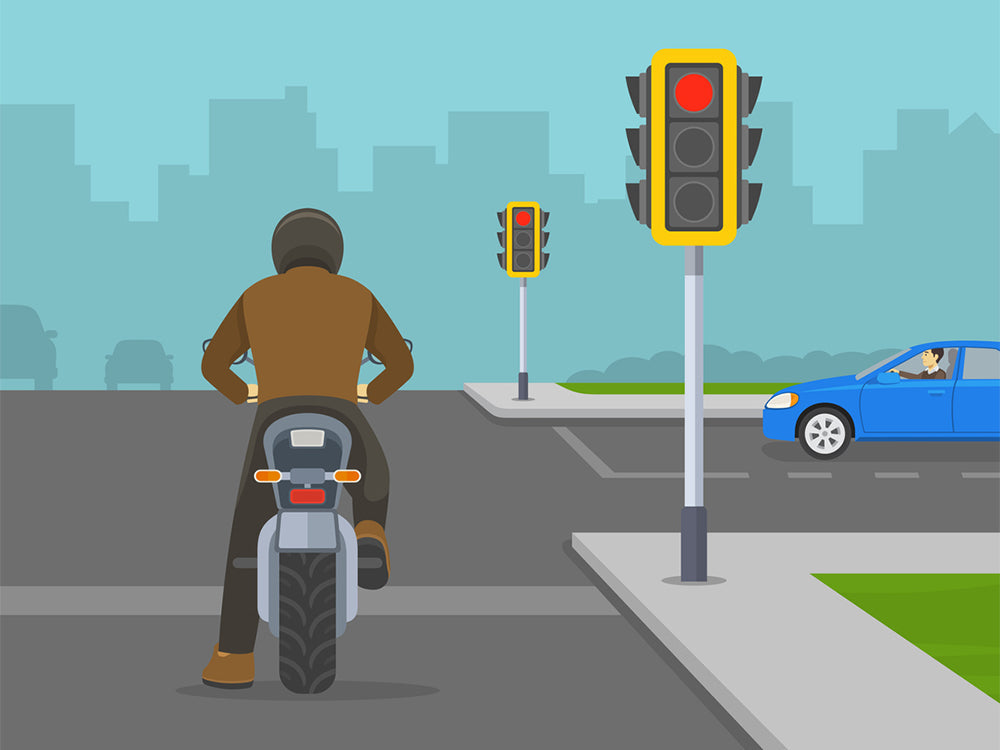
A dead red law is one that comes to the rescue of riders whose bikes failed to send a signal or trigger the traffic light sensor. In most cases, the traffic lights sense vehicles by buried sensors beneath the road. Such sensors sense the weight of a vehicle and then turn on the green light. Bikes are a lot lighter than cars, and hence, the sensors do not detect them sometimes.
Riders get stuck at the red light if the light doesn’t change. They will have to wait for minutes or even longer. Dead Red Law comes in at this point. Such a rule enables riders to proceed through a red light without being involved in an accident if the light signal does not notice the motorbike.
1.1 Why Dead Red Laws Exist?
Dead red laws exist simply for safety and convenience. A rider who is stuck at a red light is at risk. They are out in the open. Other vehicles may fail to notice them. A rider may make a risky decision if he or she waits too long.
Dead red laws provide a legal means of movement to riders when stuck. However, these laws are quite strict. A rider does not have the right to blast through any red light at the traffic signal. Instead, riders must:
Come to a complete stop first.
Wait (Wait period varies by state).
Ensure there is no traffic and it is safe to do so.
First, provide a way for other oncoming vehicles to pass.
Riders must be very cautious while riding through the dead red.
These rules are aimed at maintaining riders' safety while also complying with the law.
2. Which US States Allow Dead Red Laws?

By 2025, 21 states will have a dead red law for motorcycles. These states include:
Wisconsin.
Colorado.
Washington.
Virginia.
Utah.
Tennessee.
South Carolina.
North Carolina.
Pennsylvania.
Oklahoma.
Ohio.
Nevada.
Missouri.
Minnesota.
Kentucky.
Kansas.
Indiana.
Illinois.
Idaho.
Arkansas.
Every state has its own dead red rules, regulations, and waiting periods. We are going to examine some of the major US states and their laws.
3. Motorcycle Dead Red Light Laws in Different US States
3.1 California Motorcycle Red Light Law
California does not possess a dead red law for bikers. In this state, riders must stop at the red light. The legislation covers vehicles in the same way. One has to wait until the light turns green, even though the sensor does not detect your motorbike.
This is contrary to most other states in the US. Riders in California are supposed to be aware of this and plan their route accordingly.
3.2 Colorado Motorcycle Red Light Laws
Colorado allows riders to pass a red light, though it is limited under certain conditions. Once a rider stops, he or she has to wait for a reasonable period of time. Provided that the light does not change. Then, riders can continue with due caution. They should also give way to the traffic.
Another motorcycle law that was approved in Colorado was lane filtering in 2024. This enables riders to move between stopped traffic at traffic signals.
3.3 Florida Motorcycle Red Light Law
The state of Florida does not have a motorbike dead red law. Similar to California, Florida makes it mandatory for all drivers and riders to stop at red lights. Riding through the red light in Florida may cost you a fine of up to $262 and three points on your license.
A right turn on a red light is the only exception riders are allowed. It should only be made in case of a complete stop when it is safe.
3.4 Illinois Motorcycle Red Light Laws
Illinois was one of the first US states to approve a dead red law for bike riders. According to the dead red rule in Illinois, a rider has to wait 120 seconds (2 minutes), and only then he/she may continue riding through the dead red light. In case the light does not change to green after this time and the intersection is clear, the rider can proceed with extreme caution.
The dead red light law in Illinois is quite strict compared to certain other states. But it provides riders with a clear standard to follow.
3.5 Kansas Motorcycle Red Light Law
Kansas has a dead red light law in place. The particular rule says that the rider has to come to a complete stop. In case of failure of the light to detect the motorbike and the light does not change, then the rider is allowed to move. Nevertheless, they have to give way to the traffic and ride cautiously.
3.6 Missouri Motorcycle Red Light Laws
Must Read: Kansas Motorcycle Laws and Licensing
A rider in Missouri is allowed to move through the intersection in case of a dead red light when:
The motorbike comes to a complete halt.
The rider has stopped at the red light for a reasonable period.
The traffic signal is either faulty or has not detected the bike.
There is no traffic moving towards the intersection.
Waiting for a reasonable period gives riders time to assess the traffic situation.
3.7 Ohio Motorcycle Red Light Law
The red light law in Ohio permits riders to pass a dead red light in case the signal is faulty or fails to detect the motorcycle. However, a rider must stop first. Then, when the traffic light does not change even after a reasonable delay, they are safe to ride through the red light. They have to give way to all traffic and practice caution.
3.8 Pennsylvania Red Light Motorcycle Laws
The state of Pennsylvania calls it the “Ride on Red” law. It allows riders to go through a red light in case the signal does not turn green. The law is applicable to all kinds of vehicles and not only motorcycles. The rider has to stop first. Then, in case the light appears to be faulty, they may go on with caution. The law does not provide the amount of time to wait before riding through a dead red light.
3.9 Texas Motorcycle Red Light Law
The state of Texas does not have a dead red law for motorbikes. Nevertheless, the state is considering approving one. In the meantime, riders are required to obey all the traffic laws and to stop at the red traffic light like other drivers. Violation of the red light is a Class C offence, which can lead to a fine of $200 in Texas.
3.10 Wisconsin Motorcycle Red Light Laws
One of the most evident dead red laws is in Wisconsin. The red light will require a rider to wait 45 seconds. Throughout this time, they have to ensure that they check all the directions for oncoming traffic. When there are no other vehicles and the traffic light is not turning green, they can continue to ride through the red light with care. They are required to give way to all traffic and pedestrians.
3.11 Motorcycle Dead Red Light Laws in Other States
Arizona: Arizona does not have a specific dead red light law, but it permits lane filtering.
Alabama: Alabama is not a dead red state. Riders have to stop at the red lights just like any other vehicle.
Minnesota: Minnesota is one of the most liberal states, as it allows riders to pass through a red light provided it has been red for a reasonable time. This will allow riders to have freedom of judgment.
South Carolina: South Carolina is one of the most restrictive, with riders having to wait 120 seconds (2 minutes) before continuing.
Tennessee: Riders are allowed to ride through a dead red light in case they feel that the traffic light sensor does not detect their motorbike.
Utah: Riders have to stop for 90 seconds if it is a dead red light. Only then can they go through the red light.
4. What You Need to Know About Riding Through a Dead Red Light

Despite the dead red light laws in place, there is a high risk to riders. Here are the key points that you must consider if you have to ride through a dead red light:
Stop First: You should always come to a complete stop before even considering going through a red light. Don’t just slow down. Sotp completely.
Yield the Right of Way: Other vehicles from a different direction will pass first if they have a green light. You will have to allow them to pass first.
Check Traffic: Check the traffic coming from all directions. Scan the road traffic, including motorbikes, cars, trucks, or even pedestrians. Ensure that the path is clear and then proceed.
Go Slowly: Only proceed with caution. It is not required to hurry across the intersection. Allow time to respond where necessary.
Know Your State Laws: Riding through a dead red light is not allowed in every US state. Some states are very strict. Know the rules where you ride.
Prove the Traffic Light Is Faulty: In case of a ticket, you will be required to prove that the signal has been broken or faulty, or it has not noticed you. This can be hard to do. Some states impose this burden of proof on the rider.
5. Recent Changes and Updates to the Motorcycle Red Light Laws
The regulations regarding motorcycle traffic laws are evolving. Some states are considering new dead red laws. Others are revising their existing rules. For example:
In 2025, California increased the red light camera program, but it has yet to implement the dead red law on motorbikes.
In 2024 and 2025, Colorado and Minnesota became the states with lane filtering laws that benefit riders but do not directly solve the dead red light cases.
In 2017, Ohio revised its laws to allow motorcycles to ride through red lights under some conditions.
6. Motorcycle Safety Riding Tips At Red Lights
In addition to the motorcycle red light laws, the following are some of the safe practices to follow:
Stay More Visible: Even in the daytime, if you are a bike rider, you must be more visible. This can be done through using daytime running lights (DRLs), installing reflectors, and wearing vibrant-colored riding gear.
Place Your Bike Correctly: You should try to place your bike safely and in a way that the sensor detects it. In-pavement sensors are often loops, buried beneath the road. Ride on these sensors so they get activated.
Report Faulty Traffic Lights: In the event that you encounter a traffic signal light that is not able to read your bike, report it to the relevant authority. They may be in a position to fix or modify the sensor.
Ride With Caution: Although a law may permit you to pass a red light, you have to be more careful. You will likely not be expected by other drivers. So, watch out.
Never Assume: Be careful. Do not assume that because the cross traffic has a red light, the intersection is safe. Check twice, then check again.





Leave a comment
All comments are moderated before being published.
This site is protected by hCaptcha and the hCaptcha Privacy Policy and Terms of Service apply.