Table of Content
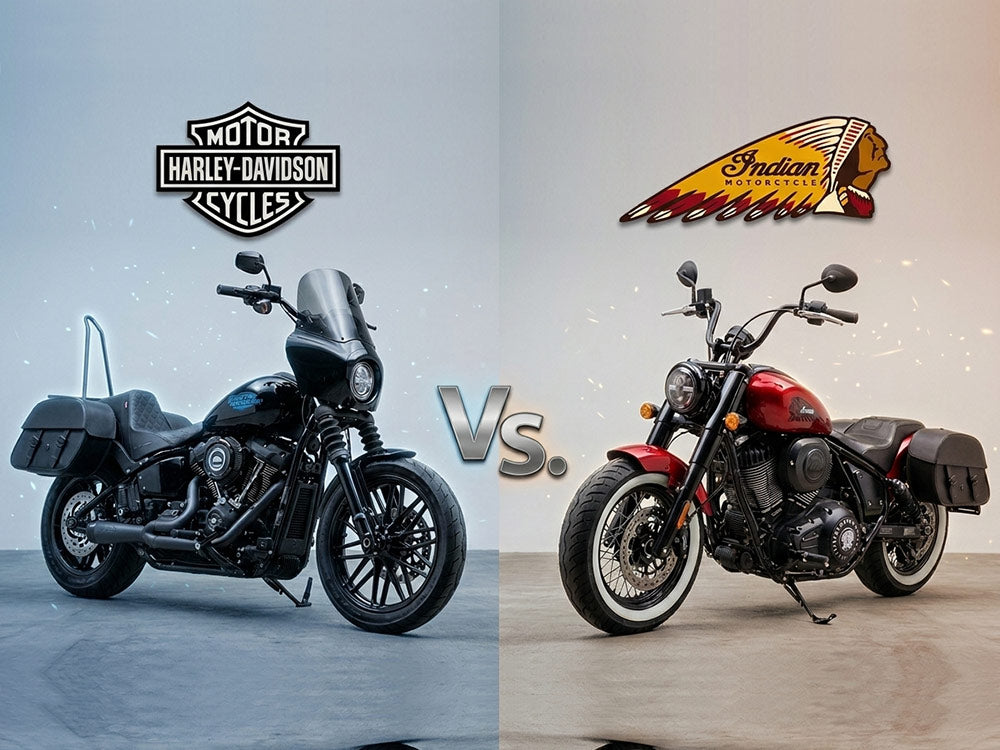
Walk into any Harley-Davidson or Indian dealership in 2026, and the bikes look better than ever. New engines, striking colors, upgraded tech, both brands are making a strong case on the showroom floor. But behind the gloss and the chrome, the actual sales numbers paint a sobering picture for both American cruiser giants. Units are down. Revenues are under pressure. And the battle for market dominance has entered a phase that is less about who builds the flashiest bikes and more about who can hold their ground when the market contracts.
This article takes a clear-eyed, data-first look at how Harley-Davidson and Indian Motorcycle are actually performing in the marketplace, who is losing sales faster, who is gaining market share, what is driving the decline, and what each brand is doing about it. And for riders on either brand who want to maximize their investment, Viking Bags, the best motorcycle luggage bags and aftermarket parts manufacturer for both Harley-Davidson and Indian models, offers model-specific storage and accessories that protect and enhance bikes from both brands.
Here is what the numbers actually say about who is winning the American cruiser market in 2026.
1. The Broader Market: Why American Cruiser Sales Are Falling
To understand how Harley and Indian are performing relative to each other, it helps to first understand the environment in which both brands operate. The US and global heavyweight motorcycle markets have been under significant pressure since 2022, and 2024–2025 proved to be the most difficult stretch in over a decade for premium large-displacement bikes.
1.1 Key Market Forces Squeezing Both Brands
1.1.1 Interest Rates and Affordability
Motorcycles, particularly the premium models that dominate Harley and Indian's lineups, are almost always financed purchases. When borrowing costs rise, monthly payments on a motorcycle priced between $25,000 and $45,000 become a meaningful barrier to entry. The period from 2023 through 2025 saw sustained elevated rates, and both brands confirmed in earnings calls and public statements that this was the primary driver of weaker dealer traffic and lower retail sales.
1.1.2 Post-Pandemic Normalization
Both Harley and Indian saw genuine sales spikes in 2021 and early 2022 as pandemic-era stimulus money and a desire for outdoor activities drove a brief boom. That boom ended, and the market has been normalizing, in some cases overcorrecting, ever since. The 2021 highs were not a new baseline; they were an anomaly.
1.1.3 Tariff Impact
US trade policy changes in 2024 and 2025 introduced new tariffs that affected manufacturers' costs for imported components, steel, and aluminum. For Harley-Davidson, these tariffs cost approximately $67 million in 2025 alone. Indian's parent company, Polaris, also cited tariff-related cost pressure in its financial reports throughout this period.
1.1.4 Rising Competition from Non-American Brands
Royal Enfield, Triumph, and other premium mid-size brands have been aggressively entering the cruiser space at lower price points, attracting younger and budget-conscious buyers who might otherwise have considered a Scout or Sportster. This competition is a structural headwind that neither American brand can simply discount away.
1.1.5 Aging Buyer Demographic
Both brands' core buyers have been getting older for over a decade. Harley's challenge of attracting younger riders, riders under 35, is particularly well-documented. The industry as a whole struggles to convert younger adults into big-displacement cruiser buyers, especially at the price points where Harley and Indian make most of their margin.
With this context established, here is how each brand is actually performing.
2. Harley-Davidson Sales: Three Years of Decline and a Brand in Reset Mode

Harley-Davidson's sales data for 2023, 2024, and 2025 tells the story of a brand in its most sustained downturn in over a century of business. The Motor Company has recorded three consecutive years of declining global retail sales, a streak not seen in Harley's modern history.
2.1 The Annual Sales Trend
Year |
Global Units Sold |
Year-on-Year Change |
Key Event |
2022 |
178,400 |
- |
Post-pandemic peak |
2023 |
162,800 |
-8.7% |
First major fall |
2024 |
151,200 |
-7.1% |
Second consecutive drop |
2025 |
132,535 |
-12.3% |
Lowest in over a decade |
2026 Guidance |
130,000–135,000 |
Flat to -2% |
"Reset year", new CEO |
The 2025 numbers, confirmed in Harley-Davidson's full-year earnings release on February 10, 2026, were the most alarming in the three-year sequence. Harley-Davidson sold 132,535 motorcycles globally in 2025, a drop of 12 percent from 2024. The HDMC (Harley-Davidson Motor Company) segment posted a full-year operating loss of $29 million, a stark reversal from $278 million in operating income in 2024. Total HDMC revenue fell 14 percent to approximately $4.47 billion for the full year.
2.2 The Regional Breakdown: Where Harley Lost the Most Ground
North America (Full Year 2025)
Down 13 percent for the year, though Q4 2025 showed a 5 percent increase versus Q4 2024. This late-year recovery, driven by excitement around the new 2026 Touring models, was the first genuine positive data point in North America for Harley in over two years.
Europe, the Middle East, and Africa (EMEA)
Down 11 percent for the full year. Q4 2025 was particularly painful in EMEA, with a 24 percent year-on-year drop. This region has been one of Harley's most consistent trouble spots as European emission standards tighten and competition from European brands grows stronger on their home turf.
Asia-Pacific
Down 15 percent for 2025. Weakness in China, once seen as a key growth market for Harley, and softness in Japan drove the regional decline. H1 2025 saw a 26 percent APAC fall before a partial recovery in Q4.
Latin America
The only consistently bright spot. Latin America rose 10 percent in Q4 2025, with both Brazil and Mexico showing positive results. Full-year Latin American performance was the least negative among regions.
2.3 Six Reasons Behind Harley's Decline

Beyond the macro market forces, several Harley-specific factors compounded the pain:
2.3.1 Interest Rates and Financing Costs
Harley's product mix is heavily weighted toward high-ticket Touring and CVO models that almost always require financing. With rates elevated throughout 2024 and 2025, consumer confidence fell, and dealer foot traffic dropped significantly. Harley's leadership cited this as the primary cause in every quarterly earnings call.
2.3.2 Tariff Pressure
New tariffs under the US trade policy cost Harley approximately $67 million in 2025. For 2026, Harley has guided for tariff costs of $75 million to $105 million, meaning this headwind is getting worse, not better.
2.3.3 CEO Upheaval and Boardroom Conflict
Major shareholder H Partners launched a public campaign in 2025 to remove CEO Jochen Zeitz and two board members, accusing the company of cultural drift and poor dealer economics. Zeitz announced his retirement, and Artie Starrs, formerly CEO of Topgolf International, was named President and CEO, effective October 1, 2025. The leadership transition created uncertainty at a time when the business needed clarity and decisive action.
2.3.4 Dealer Inventory Overhang
For much of 2024 and early 2025, Harley dealers were sitting on excess unsold inventory, which suppressed new wholesale orders and forced discounting. The situation improved toward year-end: global dealer inventory was down 17 percent by the end of 2025, suggesting the worst of the overhang is being worked through.
2.3.5 E-Commerce Misstep
New CEO Artie Starrs acknowledged in early 2026 that Harley's prior e-commerce approach "created customer confusion and drove excessive discounting, placing unnecessary pressure on dealer economics." The company has reversed this strategy and is now using digital channels to drive dealership visits rather than compete with them.
2.3.6 Aging Buyer Base

Harley's core buyer profile skews older and wealthier, a demographic that is loyalty-driven but not growing. Efforts to attract younger riders through the Revolution Max platform (Nightster, Sportster S, Pan America) had mixed results. The Pan America, which showed early promise in the adventure touring space, eventually shifted production to Thailand due to insufficient US demand.
2.4 Harley's One Market Position That Remains Dominant
Amid all the bad news, Harley-Davidson holds one market position that no competitor is close to threatening: the US Touring segment. In 2024, Harley's market share in the US Touring category reached 74.5 percent, a commanding, dominant position that reflects decades of brand loyalty and product investment. The new 2026 Street Glide Limited and Road Glide Limited, powered by the VVT engine and backed by the brand's strongest spec sheet in years, are designed to hold and grow this lead.
2.5 Harley's 2026 Strategy: Reset and Rebuild
New CEO Artie Starrs has been direct about describing 2026 as a "reset year." The company has provided guidance for global retail sales of 130,000 to 135,000 units in 2026, essentially flat to slightly down from 2025. HDMC's operating income guidance ranges from a $40 million loss to a $10 million gain, reflecting real uncertainty in the near term.
Key pillars of the reset strategy include:
Tighter wholesale management: Harley will ship fewer bikes to dealers than in prior years, matching wholesale supply more closely to actual retail demand. This discipline should reduce inventory overhang and support dealer profitability, thereby improving the customer experience at the point of sale.
Focus on high-margin segments: The Grand American Touring and CVO ranges are Harley's highest-margin product lines. The 2026 lineup's emphasis on the new Limited models and the CVO ST performance baggers is a deliberate bet to win the premium touring buyer rather than chase volume in lower-margin segments.
Entry-level "Sprint" model: Harley has signaled plans for a more accessible entry-level model, tentatively called the Sprint, aimed at attracting new, younger riders to the brand. No firm launch date has been confirmed, but the move represents an acknowledgment that Harley's current price floor is too high to attract the next generation of buyers on its own.
Strong cash position: Harley ended 2025 with $3.1 billion in cash and liquidity, giving the company the runway it needs to manage this transition without a financial crisis. The reset is painful, but Harley has the resources to see it through.
Full strategic plan in May 2026: Starrs has promised a complete strategic roadmap at the first-quarter 2026 earnings call in May. Investors, dealers, and riders are all watching that announcement closely.
3. Indian Motorcycle Sales: Smaller, But Holding Up Better

Indian Motorcycle's sales picture is more nuanced and, in relative terms, considerably more resilient than Harley's over the same period. Indian is a much smaller operation by volume, but its year-on-year performance through 2024 and 2025 has consistently outpaced its larger rival when measured against the prior year's numbers.
3.1 Indian's Annual Sales Trend
Year |
Global Units |
Year-on-Year Change |
Key Context |
2021 |
~30,000+ |
All-time record |
Post-pandemic boom |
2022 |
Declining from the peak |
- |
Market normalizes |
2023 |
Declining |
Ongoing |
Headwinds build |
2024 |
~25,792 |
-12.4% |
4th year from 2021 peak |
H1 2025 |
~13,988 |
-2.1% vs H1 2024 |
Significantly outperforms Harley |
Indian Motorcycle hit its all-time sales record in 2021, when global registrations exceeded 30,000 units for the first and only time in the brand's revived history. Since then, sales have been in a gradual decline, reaching approximately 25,792 units in 2024, a 12.4 percent fall from 2023. However, the rate of that decline has been considerably more controlled than Harley's, and in key periods, Indian has held up markedly better.
3.2 Where Indian Has Outperformed Harley
H1 2025, the clearest comparison: In the first half of 2025, Indian's global retail sales came in at 13,988 units, down just 2.1 percent year-on-year. In the same period, Harley-Davidson's global sales collapsed by 27.7 percent. This is not a marginal difference; it is a dramatic contrast in resilience between the two brands in the same market conditions.
North America, H1 2025: Indian's North American sales were essentially flat, up approximately 0.5 percent in a market that was broadly contracting. At a time when Harley's North American results were deeply negative, Indian was actually gaining market share in its home market.
Q4 2024 comparison: When Harley's Q4 2024 global retail sales fell 15 percent year-on-year, Indian's Q4 2024 results were essentially flat. The industry overall saw low single-digit declines in Q4 2024, making Indian's performance in that quarter genuinely impressive against both the industry and its rival.
International markets: Indian's international markets saw high-twenties percentage growth in Q4 2024. While international volume is still small for Indian relative to its North American base, this growth rate suggests genuine global momentum is building in markets where Indian is relatively new.
3.3 Indian's Own Structural Challenges

Indian's relative resilience should not obscure the real difficulties the brand faces. Several structural issues define Indian's competitive reality in 2026:
3.3.1 The Scale Gap With Harley Is Immense
In 2025, Harley-Davidson sold approximately 132,535 units globally versus Indian's approximately 24,000. Even after Harley's three-year decline, it operates at a scale nearly five to six times larger than Indian. This scale advantage translates directly into resources for product development, global marketing, dealer network investment, and brand activity. Relative outperformance is meaningful, but the unit gap is vast.
3.3.2 Over-Reliance on North America
The overwhelming majority of Indian's sales come from North America. European sales dropped approximately 18.3 percent in 2025, and performance in Asia, particularly China, has been weak. Unlike a brand with a balanced global footprint, Indian cannot easily offset North American weakness with strength elsewhere. When the US and Canadian market softens, Indian's total volume feels it immediately.
3.3.3 No Product Diversification
After discontinuing the FTR flat-track platform in late 2024, Indian now sells exclusively cruiser and touring motorcycles. The FTR was an attempt to attract a younger, sportier rider, and while it generated brand buzz, it did not produce the sales volume to justify its continued production. With the FTR gone, Indian has no response if demand in the heavyweight cruiser segment falls sharply. Harley at least has the Pan America in its portfolio, even if that model's sales have been disappointing.
3.3.4 New Ownership Uncertainty
Carolwood LP's 2025 acquisition of Indian Motorcycle from Polaris ends one chapter but opens another with many unanswered questions. How aggressively will the new owner invest in product development, dealer expansion, and international growth? Industry analysts have observed that under Polaris, Indian appeared to be managed more as a stable cash contributor than as a high-growth brand, a posture that limited its ability to sustainably close the gap with Harley. What Carolwood's ownership vision looks like in practice will be the defining story for Indian over the next several years.
3.3.5 Competition from Japanese and European Brands
The same rising competition from Royal Enfield, Triumph, and others that pressures Harley in the mid-size space also applies to Indian's Scout lineup, which competes most directly in the middleweight cruiser segment. Royal Enfield, in particular, is offering liquid-cooled cruisers at dramatically lower price points, and its global scale allows it to absorb losses in North America while building market presence.
4. Head-to-Head: How Both Brands Compare on Market Metrics
With both brands' data on the table, here is a clear comparison of the most important market metrics in 2026:
Metric |
Harley-Davidson |
Indian Motorcycle |
2025 Global Units |
132,535 |
~24,000 |
2025 Full-Year YOY Change |
-12.3% |
~-5% (est.) |
H1 2025 YOY Change |
-27.7% |
-2.1% |
Q4 2024 YOY Change |
-15% |
Essentially flat |
NA Market H1 2025 |
Significantly negative |
+0.5% (flat to positive) |
US Touring Market Share (2024) |
74.5% |
Minimal |
2025 Operating Profit (HDMC) |
-$29M (operating loss) |
Not reported separately |
2026 Units Guidance |
130,000–135,000 |
No public guidance |
Leadership Status |
New CEO (Oct 2025) |
New ownership (Carolwood LP, 2025) |
The numbers tell a clear story. Harley-Davidson is the far larger brand by every volume measure, and it holds a commanding structural position in the US Touring segment that no competitor can challenge. But on every relative performance metric, year-on-year change in Q4 2024, H1 2025 global sales, North American performance in the first half of 2025, Indian Motorcycle outperformed its larger rival by a meaningful margin.
Indian is not closing the raw unit gap with Harley. Not even close. But in the period when market conditions were at their most difficult, Indian lost market share more slowly, held North America closer to flat, and avoided the kind of operating loss that Harley recorded in 2025. That is a form of competitive advantage, even if it is one defined by resilience rather than growth.
5. Market Share: Where Each Brand Actually Dominates
5.1 Harley-Davidson's Strongholds
US Touring Segment
74.5 percent market share in 2024. This is the single strongest market position either American cruiser brand holds anywhere. The Grand American Touring lineup, Road Glide, Street Glide, Road King, and now the new Limited variants, is so deeply embedded with American touring riders that competitors have largely stopped trying to dislodge it directly. Indian's Challenger and Roadmaster are excellent bikes, but their US Touring share remains a fraction of Harley's.
US Overall Motorcycle Market
Harley-Davidson held approximately 19.9 percent of the total US motorcycle market as of December 2024. This figure includes all segments, not just cruisers and touring, and represents a meaningful, if shrinking, share of the broadest possible definition of the US market.
Premium and CVO Segment
In the $30,000-and-above American cruiser space, Harley's CVO lineup has no direct Indian equivalent at comparable volume. The Indian Pursuit Elite is a strong competitor at the top, but the breadth and depth of Harley's premium offering give it near-total dominance in the super-premium American cruiser category.
5.2 Indian's Strongholds
Middleweight Cruiser Segment
The Scout platform, and especially the entry-level Scout Sixty, puts Indian in a part of the market where Harley does not currently compete with a purpose-built product. The Scout Sixty, at approximately $11,999, is the most affordable new American-brand cruiser available in 2026, and it opens the brand to a pool of younger and budget-conscious buyers that Harley cannot reach at the same price point.
North American Market Share Gains
While Indian's total US market share remains a fraction of Harley's, the 2025 data showing North American sales essentially flat while Harley's fell significantly means Indian was gaining share within the American market during the period when conditions were toughest. In market share terms, Indian made relative progress in 2025 even without growing in absolute volume.
Collector and Anniversary Editions
The 125th Anniversary Edition models give Indian a unique hold on collectors and limited-edition buyers in 2026. Harley's Liberty Edition models are also collector-grade, but Indian's anniversary milestone is genuinely historic and gives its limited editions a cultural significance that money cannot manufacture.
6. Brand Health and Dealer Experience: Beyond the Numbers
Sales figures are the clearest indicator of brand health, but they are not the only one. Dealer experience, brand perception, and product strategy also shape the long-term competitive picture.
6.1 Harley-Davidson: A Dealer Network Under Pressure
Harley-Davidson's dealer network is the largest and most established in the American cruiser market, approximately 700 US dealers at last count. But the network has been under strain. Excess inventory, discounting pressure, and the previous leadership's e-commerce strategy, which directed consumers to online channels at the expense of dealership traffic, all damaged dealer economics over the past two years.
New CEO Artie Starrs has moved quickly to address this, reversing the e-commerce strategy and committing to a dealer-first model. Wholesale shipment discipline, sending fewer bikes to dealers than retail demand might justify, is helping reduce inventory pressure and supporting healthier dealer margins. The full impact of these changes will take time to show up in the numbers, but the direction is clear and considered.
6.2 Indian Motorcycle: Smaller Network, Tighter Execution
Indian's US dealer footprint is much smaller than Harley's, approximately 200 dealers, which is both a limitation and a strength. The smaller network means less geographic reach, but it also means closer management of the dealer experience and less risk of the kind of systemic inventory problems that Harley faced in 2024 and 2025. Indian dealers have generally maintained healthier inventory levels and avoided the worst of the discount pressure that hurt Harley's dealer margins.
The transition from Polaris to Carolwood LP ownership introduces uncertainty about future dealer network investment and support. Under Polaris, Indian's dealer relations were generally rated positively by dealers, but strategic investment in network expansion was limited. What Carolwood brings to this equation will be important to watch over the next 2 years.
6.3 Brand Perception: Who Riders Trust More
Brand perception surveys and owner loyalty data consistently show Harley-Davidson at or near the top of the motorcycle industry in owner loyalty. Harley owners are famously brand-loyal; many have never ridden anything else and have no desire to. This loyalty is a genuine moat that protects Harley's core business even during down years.
Indian's brand perception has improved significantly since the 2011 revival, particularly among riders who value engineering quality and modern technology. The brand consistently scores well on build quality and infotainment satisfaction in owner surveys. The 125th Anniversary story gives Indian a heritage narrative in 2026 that rivals Harley's emotional pull, at least among buyers who value historical authenticity over brand familiarity.
7. What 2026 and Beyond Look Like for Both Brands
7.1 Harley-Davidson: A Reset With Real Resources
The 2026 reset is painful but not terminal. Harley ended 2025 with $3.1 billion in cash and liquidity, has the most powerful lineup in its history, and holds a 74.5 percent share of the US Touring segment. The new CEO has identified the right problems: dealer economics, wholesale discipline, and e-commerce misalignment, and is moving to fix them. The full strategic plan expected in May 2026 will be closely watched by everyone, from investors to dealers to riders.
The fundamental challenge that no short-term strategy can fully solve is the demographic one: attracting younger buyers to a brand whose identity and price points remain oriented toward older, higher-income riders. The planned Sprint entry-level model is a step in the right direction, but it will need to be priced aggressively and marketed to a very different audience than Harley's current one. That is a significant cultural and commercial challenge for a brand as identity-driven as Harley-Davidson.
7.2 Indian Motorcycle: New Ownership, Open Questions
Indian's trajectory under Carolwood LP is the biggest open question in the American cruiser market right now. The brand has shown it can compete with Harley on a relative basis, holding North American market share and losing sales more slowly in difficult conditions. But it has not demonstrated the ability to grow in a sustained way or close the vast scale gap with its rival.
The decisions Carolwood makes over the next 12 to 24 months, around dealer network investment, product development funding, marketing spend, and potential new model categories, will determine whether Indian becomes a genuine long-term challenger to Harley or remains a premium niche brand with a compelling product range and a much smaller footprint.
8. For Riders: Make the Most of What You Ride
The market data tells a story of two American brands facing real pressure, navigating a difficult cycle, and making hard strategic decisions. For riders, the most important takeaway is simpler: both brands are building great bikes right now, and both are fighting hard to earn continued loyalty.
Whatever brand fills the garage in 2026, maintaining and personalizing that investment matters. Viking Bags, the best Harley-Davidson and Indian aftermarket luggage and parts producer in the market, makes model-specific storage solutions for both brands. From Harley-Davidson saddlebags to Indian Motorcycle saddlebags, Viking's catalog covers every major model in both lineups, with purpose-built fits that protect the bike's lines and make every ride more practical.
The American cruiser market is going through one of its most difficult periods in decades. But the bikes sitting in dealerships right now, from both Harley-Davidson and Indian Motorcycle, are genuinely among the best either brand has ever built. The market will recover. The question is which brand comes out of this cycle stronger, and which one builds the bikes that bring the next generation of riders into the American cruiser world.




Leave a comment
All comments are moderated before being published.
This site is protected by hCaptcha and the hCaptcha Privacy Policy and Terms of Service apply.